
Qwert1234 / CC BY-SA 4.0, via Wikimedia Commons
Hidden bittercress: complete guide
Cardamine occulta
Want to see Hidden bittercress: complete guide in your garden?
1 minute, no credit card
Overview
Hidden bittercress (Cardamine occulta) is a small, quietly impressive annual herb belonging to the mustard family (Brassicaceae). Its native range spans an enormous arc across Asia, from China, Japan and Taiwan through the Himalayas and across Southeast Asia to the Philippines and the Indonesian archipelago. Outside this broad homeland, the species has naturalised across much of Europe, including the Netherlands, Belgium, Germany, France and Britain, where it grows unnoticed in garden beds, on paved paths, in compost heaps and in the moist corners of shrubberies. On the gardenworld.app plant database you will find this species listed among useful low-growing herbs for shaded, naturalistic planting schemes.
The species name occulta, from the Latin for 'hidden', suits the plant perfectly: it is small, easily overlooked, and regularly confused with its close relatives, including wavy bittercress (Cardamine flexuosa) and hairy bittercress (Cardamine hirsuta), both of which are common European weeds. Taxonomically the species was long submerged under Cardamine flexuosa var. occulta or Cardamine debilis, before being reinstated as a full species. Described by the Danish botanist Jens Wilken Hornemann in 1819, it carries a long scientific history despite its unassuming appearance.
Appearance and bloom cycle
Cardamine occulta is a low-growing annual, rarely exceeding 15 to 30 cm in height, with a slender, branched stem that often zigzags slightly between the leaf nodes. The leaves are pinnately compound, with several round to oval leaflets, giving the plant a delicate, ferny texture. Leaf colour is fresh, bright green, and the overall habit is soft and unstructured.
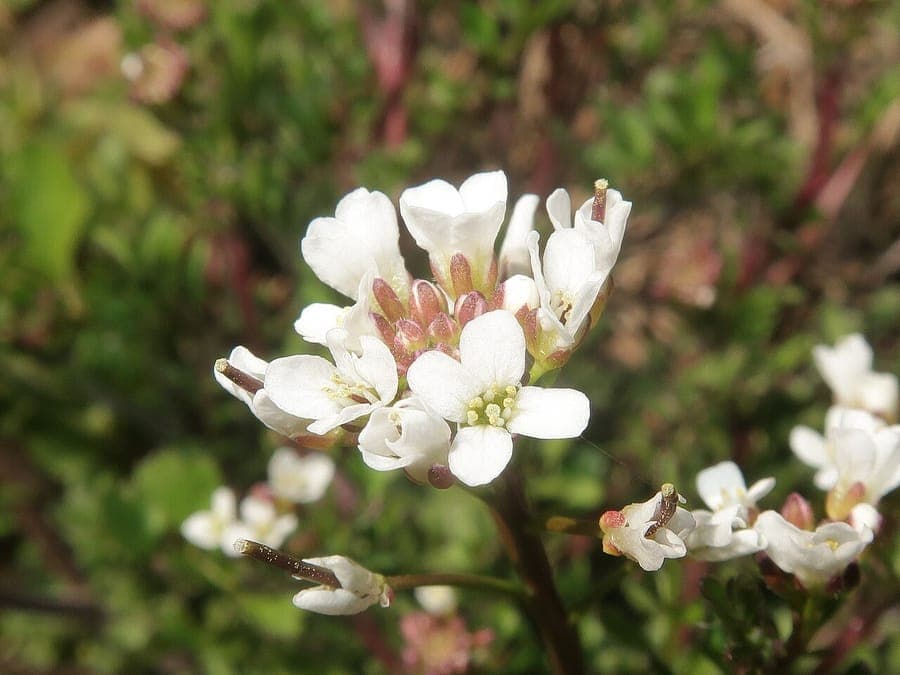
Flowers appear from February through May and sometimes again in autumn during mild conditions. Each flower is small, just 3 to 5 mm across, with four white petals in the characteristic cross arrangement of the Brassicaceae family. While individual flowers are modest, a patch of densely growing plants in full bloom can create a fine, misty white veil across moist ground in early spring. After flowering, the plant forms narrow siliques 15 to 25 mm long that split open explosively when ripe, shooting seeds across a small radius and contributing to the plant's rapid spread.
Cool, moist conditions suit this plant best. It grows and flowers in the colder months, sometimes as early as late winter, and tends to retreat or die back during the heat and drought of summer.
Ideal location
Cardamine occulta is a plant for partial to full shade in a moist, cool situation. In its Asian homeland it grows along stream banks, in rice paddies, at the margins of moist woodland and in mountain meadows at altitude. In European gardens it does well in the shade of hedges or buildings, in the north or east-facing corners of a garden, and in any moist spot that stays cool through summer.
Full sun is generally unsuitable, especially when combined with dry soil. In a reliably moist, cool environment, a half-shaded position can work, but the plant wilts quickly at the first sign of drought. Container growing is possible only if you can maintain consistent moisture, which makes it less practical than in an open garden bed.
Soil
Hidden bittercress is not demanding about soil quality but shows a clear preference for moist, humus-rich ground with reasonable organic content. It grows best on slightly acidic to neutral soil (pH 5.5 to 7.0). Clay soils that retain moisture without becoming waterlogged are ideal. Sandy soils are less suitable unless you can provide regular supplementary water or incorporate substantial organic matter.
In kitchen gardens the plant often appears spontaneously as a self-sown annual ground cover between vegetables. Its small size means it rarely competes seriously with larger crops, and it is easily removed if unwanted. Some gardeners deliberately encourage it as a living mulch in moist, shaded vegetable beds.
Watering
Consistent moisture is the single most important factor for Cardamine occulta. During dry periods the plant wilts and retreats quickly. In a well-maintained shaded border with a good layer of organic mulch, supplementary watering is usually unnecessary during a typical northern European summer, but during prolonged dry and warm spells regular watering is essential.
The plant does not tolerate waterlogging: soil that stays saturated for extended periods damages the roots. Good drainage is therefore important even for this moisture-loving species. Incorporating leaf mould or well-rotted compost into the soil helps regulate moisture levels by improving both water retention and aeration simultaneously.
Water deeply and infrequently rather than shallowly and often. Deep watering encourages the roots to grow downward and find moisture in the subsoil, making the plant more resilient to short dry spells.
Free design
Want to see Hidden bittercress: complete guide in your garden? Make a free design now.
Pruning
As an annual, Cardamine occulta needs no pruning in the conventional sense. Plants complete their lifecycle and die without intervention. If you want to limit self-seeding, remove the siliques before they ripen and burst open. The plant self-sows very readily in moist conditions and can cover a sizeable area if left to its own devices.
If you want to use it deliberately as a self-renewing ground cover in a moist shaded corner, simply remove the dead stems in autumn and lightly rake over the soil to create a good seed bed. New seedlings will emerge the following late winter or early spring and flower before most garden perennials have woken up. Remove any yellowing older plants after flowering to keep the patch looking fresh and to make room for the next generation.
Maintenance calendar
January to February: watch for early seedlings in sheltered, moist spots. In mild winters germination can begin as early as late January.
February to May: flowering season. No feeding required. Enjoy the early white flowers that attract small early-season insects.
April to May: siliques ripen and burst open. Remove plants you do not want to spread further.
June to August: plants die back in heat and drought, or persist in cool, shaded, moist refuges. Seeds lie dormant in the soil.
September to November: new seedlings appear in moist, shaded spots. Lightly loosen the soil in chosen areas to improve germination conditions for autumn-sown seeds.
December: in mild winters some plants remain semi-evergreen. No action needed.
Winter hardiness
Cardamine occulta is well suited to its lifecycle as a cool-season annual in temperate climates. It germinates in late autumn or early spring, flowers in the cold months, sets seed and dies back in summer warmth. Seeds persist in the soil and germinate the following year without assistance. In USDA zones 6 to 9 it behaves as a reliable cool-season annual that self-renews year after year in suitable spots.
Frost tolerance is moderate: the plant survives light frosts down to around -5 degrees Celsius without serious damage. In harder frosts the above-ground parts die back, but the seed bank in the soil ensures regrowth. No winter protection is required.
The plant is occasionally available from specialist nurseries alongside other Cardamine species, but it often establishes itself spontaneously in moist gardens without any purchase being necessary. Gardenworld.app can help you design a planting scheme that welcomes such self-sowing species as part of a naturalistic, low-maintenance border.
Companion plants
Cardamine occulta blends naturally into moist shaded borders alongside other cool-loving, shade-tolerant plants:
- Hostas (Hosta species): the large, bold leaves of hostas provide a strong backdrop for the delicate white flowers of the bittercress.
- Ferns (Dryopteris, Athyrium): ferns maintain a moist microclimate around their bases, exactly what the bittercress needs, and provide beautiful textural contrast.
- Solomon's seal (Polygonatum multiflorum): the arching stems and hanging white flowers are an elegant companion in a woodland garden style.
- Lesser periwinkle (Vinca minor): as a competing ground cover it fills the gaps left as bittercress dies back in summer, maintaining coverage year-round.
- Lungwort (Pulmonaria officinalis): spring-flowering and shade-loving like the bittercress, lungwort adds pink and blue to the white-dominant early-spring palette.
Closing
Hidden bittercress rewards the observant gardener. It is there, in the moist corners of gardens across Europe, producing a quiet curtain of white flowers in late winter and early spring when little else is in bloom, attracting small insects at the time they need early nectar most. It asks nothing, causes no harm and adds a thread of ecological continuity to gardens that welcome naturalistic planting. Once you learn to recognise it, you will start to see it as a quiet, reliable guest worth keeping. For inspiration on how to design a full naturalistic shade border that incorporates low self-sowing herbs like hidden bittercress alongside hostas, ferns and perennials, visit gardenworld.app and explore the available design templates.
Want to see Hidden bittercress: complete guide in your garden? Make a free design now.
Upload a photo, pick a style, and get a photorealistic design with plant list in under a minute.
10,000+ gardens designed already
No credit card required


Similar plants
Brassica cretica: complete guide
Brassica cretica
Brassica cretica, the Cretan cabbage, grows wild on Aegean cliffs. Discover how to grow this drought-tolerant, yellow-flowered Mediterranean perennial.
Corsican cabbage: complete guide
Brassica insularis
Corsican cabbage is a rare Mediterranean rock cabbage with white flowers and blue-green leaves. Location, soil and winter protection.
Prostrate cabbage: complete guide
Brassica procumbens
Prostrate cabbage is a creeping North African cliff plant with yellow flowers. Discover location, soil type and winter protection.