
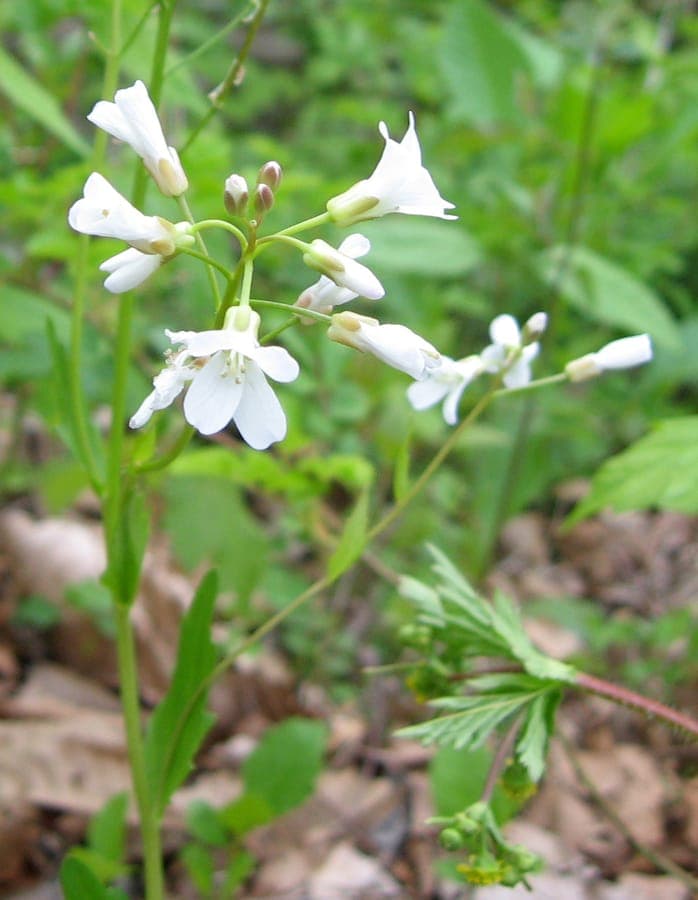
Mason Brock (Masebrock) / Public domain, via Wikimedia Commons
Bulbous bittercress: complete guide
Cardamine bulbosa
Want to see Bulbous bittercress: complete guide in your garden?
1 minute, no credit card
Overview
Cardamine bulbosa, commonly known as bulbous bittercress or spring cress, is a distinctive early-blooming perennial herb in the mustard family (Brassicaceae). It was formally described by Britton, Sterns, and Poggenb in 1888, drawing on earlier work by Schreber and Muhlenberg. The species is native to a broad swath of central and eastern North America, from Manitoba and Quebec in Canada southward through Wisconsin, Illinois, Indiana, Ohio, Michigan, Minnesota, Iowa, New York, New Jersey, Pennsylvania, Maryland, Virginia, West Virginia, Kentucky, Tennessee, and all the way to Florida, Alabama, Mississippi, Louisiana, Texas, and Oklahoma.
What sets this species apart from most other Cardamine species is the prominently swollen, bulb-like corm at the base of the stem - the characteristic that gives the plant both its botanical name ('bulbosa') and its English common name. This fleshy storage organ allows the plant to break dormancy very early in spring, often while the ground still retains winter cold, making bulbous bittercress one of the earliest perennials to flower in a woodland garden.
In its natural habitat, the plant colonises moist to wet deciduous forests, stream banks, floodplain meadows, and swampy woodland edges - always on soil that remains consistently damp through most of the year. For European gardeners, it offers a charming, reliable early-season display of white flowers in shaded, moist garden situations. Discover how to incorporate it into a planting design at gardenworld.app.
Appearance & bloom cycle
Cardamine bulbosa is a compact, upright perennial reaching 20 to 50 cm in height. The most distinctive structural feature is the rounded, corm-like base of the stem, clearly visible when the plant is gently lifted from the soil. This bulb-like structure stores starch and nutrients through the dormant period, enabling rapid, vigorous growth as soon as soil temperatures rise above approximately 5 °C in late winter or early spring.
The basal leaves are kidney-shaped to broadly rounded, soft in texture, and bright green. Stem leaves are narrower and more rhomboidal. All leaves are hairless or nearly so, with entire to slightly toothed margins. The foliage has an unmistakably fresh, bright quality that is typical of early-season woodland herbs.
Flowers appear from March through May in European cultivation. Each bloom is pure white, with four petals in the classic cross-shaped Brassicaceae arrangement, each petal 5 to 8 mm wide. The flowers are held in loose terminal racemes and are attractive to early-season bees and other pollinators. Bloom period typically lasts four to six weeks in cool, overcast weather, or shorter during warm, sunny springs.
After flowering, the plant sets narrow seed pods (siliques) that explode at maturity to scatter seeds. Following seed set (May to June), the above-ground portion of the plant dies back substantially, and the corm enters a period of summer dormancy. This semi-ephemeral behaviour - emerge early, flower, set seed, retreat - makes the plant ideal for layered plantings with later-emerging perennials that will fill the space vacated by the retreating Cardamine.
Ideal location
Cardamine bulbosa requires a shaded to semi-shaded position with consistently moist soil. Dappled light beneath a deciduous canopy is ideal - the kind of filtered light typical of an open woodland floor. Direct afternoon sun causes rapid wilting and leaf scorch. North- or east-facing borders, the shaded sides of walls or fences, and the margins of garden ponds or watercourses are all excellent positions.
Of all site requirements, consistent soil moisture is the most critical factor. The plant naturally grows in floodplain and swamp-edge situations where soil moisture is reliably high year-round, including during the dormant period. In drier border conditions, the summer dormancy will succeed only if the corm retains some access to residual soil moisture through the dry season. A deep mulch of leaf mould helps enormously in this regard.
An important practical note: because the plant dies back in summer, it is easy to forget its presence and inadvertently disturb the corms when planting or cultivating the border. Mark the positions clearly when the plant is dormant, or pair it with larger companions whose foliage covers and protects the corm zone.
Soil requirements
Rich, humus-laden, moisture-retentive soil is the foundation for success. Soil pH between 5.0 and 6.8 is suitable, with the plant performing best in the slightly acid range (pH 5.5–6.5). On very alkaline soils (pH above 7.0), growth slows and leaf chlorosis may develop. On neutral to mildly alkaline soils, the plant will still grow but may not reach its best.
The species is naturally adapted to heavy, moisture-retentive floodplain soils - clay-loam and loam are ideal. Sandy soils need significant amendment with 40 to 50% by volume of well-rotted compost or leaf mould to achieve the required water retention. An annual top-dressing of leaf mould (5 to 8 cm deep) in late autumn or early spring mimics the rich woodland floor conditions the plant enjoys and is the single most effective cultural intervention for this species.
Avoid calcareous soils, dry sandy soils, and any situation where the soil dries out completely in summer. Also avoid compacted, waterlogged clay with no aeration - while moisture is needed, the soil must retain some oxygen in the root zone.
Free design
Want to see Bulbous bittercress: complete guide in your garden? Make a free design now.
Watering
Cardamine bulbosa has a higher moisture requirement than most shade perennials. At pond or stream margins, natural water availability usually meets all the plant's needs without supplemental irrigation. In border situations away from water, plan to water two to three times per week during dry spells, particularly during the critical March-to-May growing and flowering period.
Even during summer dormancy, the corm needs to remain in slightly moist soil to survive. A 5 to 8 cm mulch of leaf mould over the planting zone provides significant moisture retention and reduces the frequency of supplemental watering considerably. In dry summers, watering once per week through the mulch is usually sufficient to keep the corm viable.
Rainwater or soft water is preferable to hard tap water, particularly in areas with high calcium content in the mains supply. If only tap water is available, allow it to stand for 24 hours before use, which reduces some of the dissolved minerals. Do not over-water in cold, wet conditions - while the plant likes moisture, waterlogged, anaerobic soil will cause corm rot, particularly in autumn and winter.
Pruning
Cardamine bulbosa requires almost no active pruning. Once the plant has finished flowering and the siliques have released their seeds (typically May to June), the dying stems and yellowing foliage can be cut back neatly to ground level. This keeps the border tidy and reduces the risk of fungal issues from rotting plant matter.
If self-seeding needs to be controlled - the plant can spread quite freely in suitable conditions thanks to its explosive seed-dispersal - remove the developing siliques before they ripen and split, typically in April to May, immediately after petal drop.
Division of the corms every three to four years in early spring (February to March) is beneficial but not essential. Lift the corms carefully, separate any clusters into individual units, and replant at a depth of 5 to 8 cm and a spacing of 20 to 25 cm. Division reinvigorates old clumps and allows you to spread the plant to new areas of the garden.
No further pruning is needed. The plant's naturally ephemeral growth cycle makes most interventions unnecessary beyond the seasonal clean-up.
Maintenance calendar
January – February: Dormant period. The corm rests safely underground. No action needed for established plants. First-year plants benefit from a light protective mulch of straw or pine branches if temperatures drop below -15 °C.
March: Growth begins as soil warms. Remove any winter mulch protection. Apply 3 to 5 cm of well-rotted compost as a spring feed around the corm zone.
April – May: Peak flowering season. Ensure consistent moisture. Remove developing seed pods if self-seeding needs to be limited.
May – June: Above-ground portion dies back. Cut back dead stems to ground level. Note corm positions to avoid inadvertent disturbance.
July – August: Summer dormancy. Maintain light soil moisture through mulch. No active watering needed if leaf mould is in place except in severe drought.
September – October: Divide and replant corms if needed. Apply a 5 cm layer of fresh leaf mould as autumn mulch.
November – December: Winter rest. Mulch intact. No further work required.
Winter hardiness
Cardamine bulbosa is rated for USDA hardiness zones 4 to 8, covering minimum winter temperatures from -34 to -12 °C. This means the plant is reliably hardy throughout the Netherlands, Belgium, and most of Germany (zones 6–8), surviving even the coldest winters typical of northwestern Europe without special protection.
The corm provides built-in frost protection: its dense, starchy structure is far more frost-resistant than a simple root system, and as long as the corm is buried at least 5 to 8 cm deep, it will survive typical European winters without damage. On light, sandy soils with minimal insulation, a 10 cm mulch of leaf mould or straw over the corm zone in autumn provides an additional safety margin during hard frost spells.
The main winter risk, as with many moisture-loving plants, is not cold but rather a combination of frost and persistently saturated, oxygen-depleted soil causing corm rot. Well-structured soil with adequate drainage - even if naturally moist - prevents this effectively.
Companion plants
Because Cardamine bulbosa is semi-ephemeral (its above-ground portion retreats in summer), it is most effective when paired with plants that emerge after it and fill the space it vacates. The best companions share its preference for moist, humus-rich shade:
- Hosta sieboldiana 'Elegans' - this large, blue-leaved hosta unfurls its leaves just as the Cardamine is finishing, covering the bare ground beautifully.
- Polygonatum multiflorum - Solomon's seal emerges and flowers in May to June, perfectly timing its appearance to follow the Cardamine bloom.
- Dryopteris erythrosora - the coppery-red young fronds of this fern provide a warm colour contrast to the white Cardamine flowers in spring.
- Anemone nemorosa - wood anemone blooms simultaneously with Cardamine bulbosa in April, together creating a classic white spring carpet in a woodland garden.
- Allium ursinum - wild garlic thrives in identical conditions and blooms just after the Cardamine, extending the season of interest.
- Mertensia virginica - Virginia bluebells, a fellow North American spring ephemeral for moist, shaded sites; the blue flowers complement the white Cardamine perfectly.
Avoid drought-tolerant, sun-demanding companions such as ornamental grasses requiring full sun, Mediterranean herbs, or late-season perennials that need dry conditions in summer.
Closing
Cardamine bulbosa is a special, early-flowering perennial that earns its place in any moist, shaded garden situation. Its distinctive corm, precocious spring growth, and bright white flowers arrive when the garden most needs them - before almost anything else is in bloom. The summer dormancy, far from being a disadvantage, is an opportunity to create beautifully layered seasonal plantings that change their character through the year.
For professional planting plans that make the most of early-season shade perennials like Cardamine bulbosa, visit gardenworld.app and explore garden designs tailored to your specific site conditions.
Want to see Bulbous bittercress: complete guide in your garden? Make a free design now.
Upload a photo, pick a style, and get a photorealistic design with plant list in under a minute.
10,000+ gardens designed already
No credit card required


Similar plants
Brassica cretica: complete guide
Brassica cretica
Brassica cretica, the Cretan cabbage, grows wild on Aegean cliffs. Discover how to grow this drought-tolerant, yellow-flowered Mediterranean perennial.
Corsican cabbage: complete guide
Brassica insularis
Corsican cabbage is a rare Mediterranean rock cabbage with white flowers and blue-green leaves. Location, soil and winter protection.
Prostrate cabbage: complete guide
Brassica procumbens
Prostrate cabbage is a creeping North African cliff plant with yellow flowers. Discover location, soil type and winter protection.