
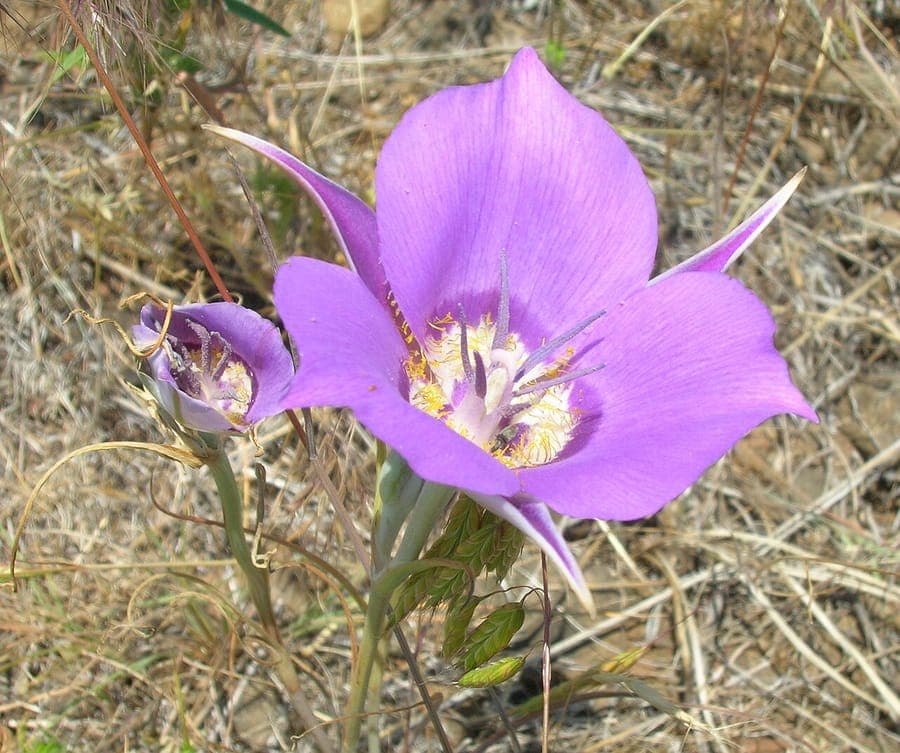
J Brew / CC BY-SA 2.0, via Wikimedia Commons
Sagebrush Mariposa Lily: complete guide
Calochortus macrocarpus
Want to see Sagebrush Mariposa Lily: complete guide in your garden?
1 minute, no credit card
Overview
Calochortus macrocarpus, commonly known as the sagebrush mariposa lily or green-band mariposa lily, is a remarkable bulbous perennial in the Liliaceae family native to the sagebrush steppes of western North America. Its native range extends from British Columbia in Canada southward through Washington, Oregon, Idaho, Montana, Nevada and California, covering a broad belt of semi-arid, open terrain characterised by dry summers and cold, relatively moist winters. The species was first formally described by the Scottish botanist David Douglas in 1828, following his extensive botanical surveys of the Pacific Northwest on behalf of the Horticultural Society of London.
The genus Calochortus encompasses more than ninety species of corm-bearing plants, all native to North America, and is universally admired for the exceptional beauty of its cup-shaped or globe-shaped flowers. C. macrocarpus is among the larger-flowered species, bearing blooms 5 to 7 cm across in shades of lavender, lilac and deep purple, each petal marked with a distinctive longitudinal green stripe that gives the plant its alternative common name, green-band mariposa lily. The word 'mariposa' is Spanish for butterfly - a fitting name for flowers whose broad, swept petals resemble butterfly wings when viewed from below.
Despite its spectacular flowers, this species remains relatively uncommon in European horticulture, where it is mostly found in specialist collections and botanical gardens. Its strict cultural requirements - full sun, sharp drainage, and a dry summer dormancy - make it less straightforward than many popular garden bulbs, but the effort is richly rewarded with blooms of unusual colour and structure that set this species apart from anything else in the summer border. For gardeners seeking inspiration for drought-tolerant planting schemes, gardenworld.app offers a wealth of design ideas incorporating specialist bulbs and perennials that thrive in dry, sunny conditions.
Appearance and bloom cycle
Calochortus macrocarpus grows from a tunicate corm that sits at a depth of 10 to 15 cm below the soil surface. In early spring, usually March or April, the elongated basal leaf emerges - narrow, grass-like, 20 to 40 cm long and only 4 to 8 mm wide, with a greyish-green colouration that reflects the plant's arid origins. This basal leaf often withers and dies back before the flowers fully open, a trait common in many Calochortus species and not a cause for concern.
The flowering stem rises to 30 to 60 cm and may branch to carry two to five flowers, each on a slender stalk. The flowers open successively from the base of the inflorescence upward, extending the display period over two to three weeks. Each flower consists of three broad petals in lavender to deep purple, 3 to 5 cm long, with a conspicuous green median stripe running from base to tip. At the base of each petal, a nectary gland is surrounded by a fringe of yellowish hairs and bordered by a darker purple crescent, lending the interior of the flower an intricate, jewel-like appearance that rewards close inspection. The three sepals are narrower, greenish, and remain visible beneath the petals.
In European gardens, blooming typically occurs from mid-June to late July, depending on planting time and local climate. After the flowers fade, the plant develops distinctive three-angled seed capsules 4 to 6 cm long that mature to a pale brown and split open to release numerous flat seeds in August or September. By August the aerial parts die back completely and the corm enters a long dormant period through autumn and winter. This complete die-back is entirely natural and should not be interpreted as the plant's demise.
Ideal location
This plant is uncompromisingly sun-loving and demands a position receiving at least six to eight hours of direct sunlight daily. A south-facing slope, a raised bed against a warm wall, or an open rocky terrace in full exposure are all ideal. In partial shade the plant produces weak, elongated stems, fails to flower reliably, and becomes far more susceptible to corm rot. There are no half-measures with positioning: either full sun, or the plant will consistently underperform.
Equally critical is summer dryness around the corm during dormancy. In the sagebrush habitats of western North America, summers are reliably dry - the corm remains dormant in dust-dry soil from July to October without any risk of rotting. In the wetter climate of north-western Europe, replicating this summer drought is the main challenge. A site sheltered from summer rain - under the eaves of a building, beneath a lean-to cold frame, or in a raised gravel bed that sheds rain rapidly - can make the difference between long-term success and disappointment.
For open garden planting, choose the most freely draining spot available and incorporate substantial amounts of coarse horticultural grit or sharp sand into the existing soil. The plant associates naturally with sagebrush (Artemisia tridentata), bunchgrasses and low-growing steppe herbs, so a gravel garden or dry steppe-style border planted with compatible drought-tolerant species provides the most authentic and hospitable setting. Spacing corms 15 to 20 cm apart in groups of five or more creates a naturalistic impression that shows the flowers to best advantage.
Soil requirements
Sharp drainage is the single most important soil requirement for Calochortus macrocarpus. The corm rots readily in heavy, waterlogged or consistently moist soil. The ideal growing medium is sandy to sandy-loam, lean and low in organic matter. The pH range recorded for this species is 5.7 to 7.0, with optimum performance in slightly acidic to neutral conditions around pH 6.0 to 6.5.
On heavy clay soils, substantial amendment is necessary before planting: incorporate a 50% volume of coarse horticultural grit or perlite through the top 30 cm of soil, and place a 3 to 5 cm layer of pea gravel directly beneath each corm at planting time to further improve drainage at the critical root zone. Organic amendments such as well-rotted compost should be used sparingly - high fertility encourages lush leafy growth at the expense of flowers and increases the risk of fungal rot. A light annual application of a low-nitrogen, high-potassium bulb fertiliser in late March or early April, when the first shoots appear, is sufficient to maintain vigour without overfeeding.
For container cultivation, use a specialist bulb compost mixture of two parts coarse sharp sand, one part loam-based compost and one part perlite, ensuring that the pot has large drainage holes and sits on feet to allow free water exit. Terracotta pots are preferable to plastic as they allow evaporation through the walls, reducing the risk of excess moisture around the corm. In containers, corms can be removed to dry storage in summer more easily than in open ground, which is a significant practical advantage in wet-summer climates. Specialist bulb suppliers and well-stocked garden centres carry suitable bulb composts.
Free design
Want to see Sagebrush Mariposa Lily: complete guide in your garden? Make a free design now.
Watering
During the active growth period from March to June, Calochortus macrocarpus benefits from moderate, infrequent watering. Allow the top 3 to 4 cm of soil to dry out between waterings, then water thoroughly. In most years, natural rainfall in spring provides adequate moisture, and supplemental watering is only required during extended dry spells of more than two weeks. Over-watering in spring, especially in cold soil below 10 °C, is a leading cause of corm rot and must be avoided rigorously.
Once the flowers have faded - typically by mid-July - watering must be stopped entirely. The corm requires a completely dry rest period from mid-July through September or October. Do not resume watering until the first signs of new growth appear the following spring, or until the corm is replanted after summer storage. In a free-draining outdoor bed, natural summer rainfall generally does no harm provided drainage is adequate, but in an unusually wet summer it is wise to lift the corm and store it dry.
In autumn, as temperatures cool and rainfall increases, the corm will naturally take up moisture and begin root development. No intervention is needed: the corm absorbs what it requires from the gradually moistening soil. Avoid watering with heavily chlorinated tap water where possible, as this species, like many specialist bulbs, performs better with collected rainwater or water that has been allowed to stand overnight.
Deadheading and trimming
Calochortus macrocarpus requires minimal intervention after flowering. Leave the stems and foliage in place until they have died back completely and turned yellow or straw-coloured: during this senescence period the plant translocates nutrients and carbohydrates back into the corm for the following season's growth and flowering. Removing the foliage prematurely - however untidy it may appear - weakens the corm and reduces next year's performance significantly.
Once the stems are fully dry and detach easily with a light pull, remove them at soil level with clean, sharp scissors or secateurs. If you wish to collect seed, leave a few of the distinctive three-cornered capsules to ripen fully on the plant: they split naturally to release flat, light brown seeds in August and September. Seedlings raised from self-sown seed take three to four years to reach flowering size, so patience is required. Dividing offset corms is a faster propagation method - small daughter corms can be separated when replanting in autumn and grown on in nursery conditions for one to two seasons before they flower.
Maintenance calendar
January – February: Corms dormant and dry. If stored indoors, check periodically for rot and ensure storage conditions remain cool (10–15 °C) and completely dry.
March – April: First shoots emerge. Begin light watering if the spring is dry. Apply a low-nitrogen, high-potassium bulb fertiliser lightly around the planting area.
May – June: Active growth and flowering. Water moderately during extended dry spells. Watch for aphids on young stems and treat with insecticidal soap if needed.
July: Flowers fade and seed capsules develop. Reduce watering to zero by mid-month. Allow foliage to die back naturally without interference.
August – September: Full dormancy. Keep dry. In a wet summer, consider lifting corms and storing in dry vermiculite or sand at 15–20 °C.
October – November: Replant stored corms or check in-ground corms. Plant depth 10 to 15 cm, spacing 15 to 20 cm. New corms from specialist garden centres can be planted until late November.
December: In cold areas, mulch the planting site with 5 to 8 cm of dry straw or conifer bark to moderate soil temperature and prevent waterlogging.
Winter hardiness
Calochortus macrocarpus is classified as hardy in USDA zones 5 to 9, tolerating minimum temperatures of approximately -15 °C when the corm is dry and well insulated by soil. In the milder maritime climates of the Netherlands and Belgium, where winter temperatures rarely fall below -10 °C, the corm will survive outdoors in free-draining soil without special protection in most years. The critical factor, as with most western North American bulbs, is not cold alone but the combination of cold and persistent moisture, which is the primary cause of corm rot.
In heavier soils or in gardens with notably wet winters, the safest approach is to lift the corms after the foliage has completely died back in late August or September, clean away any soil and dried roots, and store them in paper bags or open trays of dry sand or vermiculite in a cool, airy, frost-free location (8 to 15 °C) until replanting in October or November. This storage approach also makes it easy to inspect corms for rot or disease before replanting in autumn.
For gardeners who prefer to leave bulbs in the ground year-round, a dry mulch of straw, chopped bark or dry leaf litter 5 to 8 cm deep applied in November provides useful frost insulation. Removing the mulch in late February or early March as temperatures begin to rise prevents excessive moisture accumulation around the emerging shoots. A layer of fine gravel or stone chippings over the surface also improves drainage and helps moderate soil temperature fluctuations. Explore complete garden planning tools at gardenworld.app to design planting schemes that incorporate bulbs with varying hardiness requirements alongside reliably winter-hardy perennials.
Companion plants
The dry, sunny habitat requirements of Calochortus macrocarpus naturally limit companion choices to plants that thrive under the same conditions. The following combinations work particularly well in a steppe-style or gravel border:
Allium christophii (star of Persia): Large, silvery-purple spherical flower heads bloom in late May and June, overlapping with the mariposa lily's flowering period and providing complementary colour and dramatic textural contrast. Both species require the same sunny, dry conditions and are reliably hardy in USDA zone 4.
Eremurus stenophyllus (narrow-leaved foxtail lily): The slender, bright yellow flower spikes of this species provide a strong vertical accent alongside the cup-shaped blooms of C. macrocarpus. Plant corms or crowns 40 to 60 cm apart in well-drained soil.
Artemisia 'Powis Castle': The feathery, silver-grey mound of this ornamental wormwood makes an outstanding foil for the purple mariposa flowers and has the virtue of thriving in lean, dry soil with minimal care, reaching approximately 60 to 90 cm in height.
Stipa tenuissima (feather grass): The fine, hair-like foliage and delicate swaying plumes of this ornamental grass create movement and softness in a steppe planting without competing aggressively with nearby bulbs. Space plants 30 to 40 cm apart.
Iris bucharica: This species bulbous iris with yellow and white flowers blooms in April and May, extending the season before the mariposa lily takes over. Both share a preference for dry, well-drained soils and summer dormancy.
When designing a border incorporating C. macrocarpus, remember that the planting area will be entirely bare from August through February. Fill the gaps with low, spreading, drought-tolerant ground-covering plants such as Thymus serpyllum, Sedum reflexum or Erodium varieties that require minimal water and do not disturb the corm layer beneath.
Closing thoughts
Calochortus macrocarpus is a plant of extraordinary grace that rewards the gardener prepared to meet its specific needs. Mastering its requirements - full sun, perfect drainage, and summer drought - opens the door to one of western North America's most beautiful wildflowers. With its jewel-toned petals, subtle inner markings and long elegant stems, this mariposa lily stands apart from the more familiar tulip and lily hybrids and offers a genuinely unique contribution to any planting scheme. The dry, spare beauty of the sagebrush steppe translated into a cultivated garden setting is something that cannot be replicated with more conventional plants.
For those ready to try something truly distinctive, the sagebrush mariposa lily is an outstanding choice. Browse the plant inspiration gallery and design tools at gardenworld.app to see how specialist bulbs like Calochortus macrocarpus can be woven into a personalised garden plan that delivers colour, structure and botanical interest from spring through to autumn.
Want to see Sagebrush Mariposa Lily: complete guide in your garden? Make a free design now.
Upload a photo, pick a style, and get a photorealistic design with plant list in under a minute.
10,000+ gardens designed already
No credit card required


Similar plants
Reverchon's gagea: complete guide
Gagea reverchonii
Full guide to Gagea reverchonii, Reverchon's gagea: rare Pyrenean bulb with bright yellow spring flowers, soil needs and companion planting.
Leafy gagea: complete guide
Gagea foliosa
Gagea foliosa is a rare Mediterranean bulb with bright yellow star-shaped flowers blooming February to March in well-drained rocky settings.
Tubular gagea: complete guide
Gagea fragifera
Gagea fragifera is a mountain bulb with golden-yellow star flowers blooming May to July on subalpine slopes from Europe to the Himalaya.