
A-P Drapeau Picard / CC0, via Wikimedia Commons
American sea rocket: complete guide
Cakile edentula
Want to see American sea rocket: complete guide in your garden?
1 minute, no credit card
Overview
American sea rocket (Cakile edentula) is one of North America's toughest coastal pioneers, growing naturally along beaches and dunes from Labrador south to North Carolina and westward along the shores of the Great Lakes. Its extraordinary adaptability has carried it far beyond this native range: today it grows on beaches in Australia, New Zealand, Japan, the Azores and several Pacific islands, arriving in most cases via ocean-borne seeds that can survive weeks of saltwater immersion. For gardeners seeking authentic coastal character without the complexity of salt marsh management, the sea rocket is one of the most rewarding annuals available. The plant catalogue at gardenworld.app includes many coastal and seaside planting inspirations where Cakile edentula fits naturally as a front-of-border pioneer.
The genus name Cakile comes from an Arabic word for a species of sea kale, while the species epithet edentula means 'toothless' in Latin, referring to the smooth-margined silicles (seed pods) that distinguish this species from its close relatives. First formally described by William Jackson Hooker in 1830 using earlier material collected by Jacob Bigelow, the plant has also appeared in botanical literature as Bunias edentula and Cakile lanceolata var. edentula.
Appearance and bloom cycle
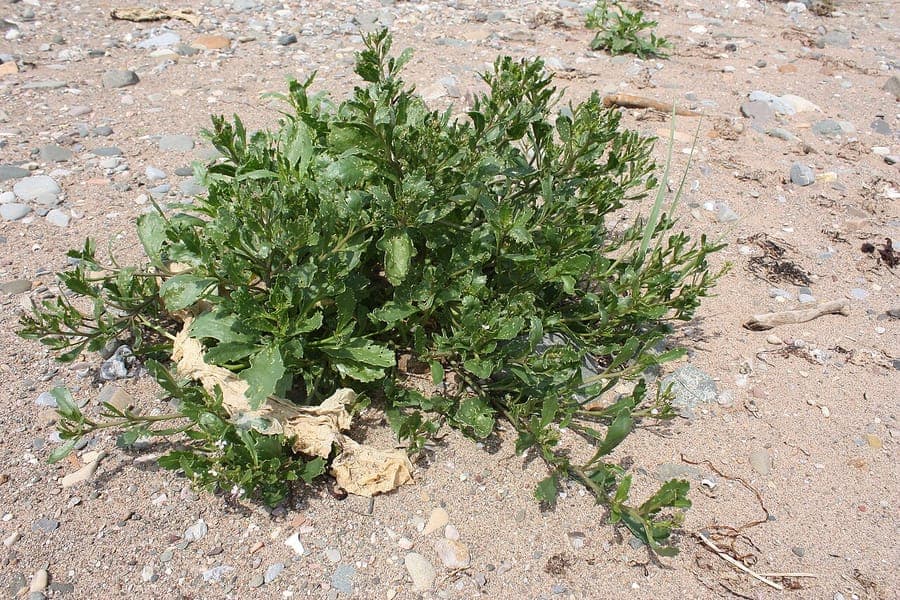
Cakile edentula grows as a low-spreading annual, branching heavily from near the base to form a bushy mound 30 to 60 cm wide and 20 to 40 cm tall. Its leaves are distinctly succulent, deeply lobed or coarsely toothed, grey-green and covered with a thin waxy cuticle that reduces water loss in the harsh coastal environment. This fleshy texture is immediately apparent when you handle the plant and sets it apart from most other mustard family members.
Flowers appear from June through October, each consisting of four white to pale lilac petals arranged in the classic cross-shaped pattern of the Brassicaceae family. Individual flowers are small, measuring just 6 to 8 mm across, but they are produced in such abundance along the branching stems that a plant in full bloom has an airy, almost frothy quality reminiscent of sea spray. After flowering, the plant sets two-jointed silicles that float readily in seawater, explaining the natural spread of the species along coastlines worldwide.
Growth from seed to first flower takes as little as six to eight weeks under warm conditions, making the sea rocket an excellent choice for filling gaps in summer borders or for experimenting with a 'wild coast' planting scheme without committing to permanent infrastructure.
Ideal location
Full sun is non-negotiable for Cakile edentula. In its natural habitat it occupies the most exposed positions on the beach and foredune, receiving direct sunlight all day long and coping with relentless wind. In the garden it needs the same exposure: a south or south-west facing open position with good air movement. Shade causes the stems to elongate and flop, and flowering is greatly reduced in anything less than six hours of direct sun per day.
The sea rocket is well suited to roof gardens, gravel gardens, coastal borders, seaside rockeries and any dry, exposed spot where other plants struggle. It tolerates salt spray and saline soil without complaint, making it a natural companion for properties near the sea. Inland gardens with well-drained, sandy or gritty soil are equally suitable, even without a marine atmosphere.
Soil
Poor, sandy, freely draining soil is what Cakile edentula does best in. It thrives on the lean, slightly alkaline substrate of coastal dunes where organic matter is scarce and drainage is instant. The ideal soil pH range is 6.5 to 8.0. Rich, heavy clay soils lead to root problems and poor growth; if your garden soil is on the heavier side, work in substantial quantities of coarse horticultural sand or fine grit before sowing.
No fertiliser is needed or desirable. Feeding the sea rocket encourages lush, soft growth at the expense of flowers and makes the plant more susceptible to fungal problems. Think of it like a Mediterranean herb: the harsher the conditions within the plant's tolerance range, the better it performs. Salt tolerance is genuine, and a moderate level of soil salinity causes no harm whatsoever.
Free design
Want to see American sea rocket: complete guide in your garden? Make a free design now.
Watering
Once established, the sea rocket is highly drought tolerant and requires little supplementary watering beyond natural rainfall. On its native dune habitat it survives months of dry summer weather with almost no available groundwater. In a garden setting, watering once a week during prolonged dry spells is usually sufficient. During a typical northern European summer with regular rainfall, no additional watering is needed at all.
Seedlings need slightly more attention in the first two weeks after germination: water gently with a fine rose watering can to avoid washing them out of the soil, aiming to keep the top 5 cm of soil just barely moist. Once plants reach 10 to 15 cm tall, they can largely fend for themselves.
Overwatering is the most common mistake. Waterlogged soil causes the root collar to rot within days, and there is no recovery from this. Always water at the base of the plant rather than overhead, and ensure surplus water drains away freely. If you are growing sea rocket in containers, use terracotta pots with generous drainage holes and a gritty potting mix.
Pruning
Cakile edentula requires essentially no pruning. As a self-contained annual it grows, flowers, sets seed and dies within a single season, and there is no woody structure to manage from year to year. Deadheading spent flower clusters is optional: if you remove fading flowers before seed sets, you may slightly extend the flowering period, but the plant tends to keep producing new buds regardless.
If you want the plant to self-seed for next year, leave a proportion of the silicles to ripen and drop. The seeds are moderately cold tolerant and can survive mild winters in the soil, germinating the following spring without any intervention. To limit self-seeding, remove the seed-bearing stems as soon as they begin to turn brown but before the joints break apart.
In autumn, after the first frosts have blackened the stems, remove the dead top growth. The roots decompose quickly and pose no problems for subsequent planting.
Maintenance calendar
March to April: sow seeds directly outdoors in their final position, or start indoors at 15 to 18 degrees Celsius. Direct sowing is preferred because the taproot does not transplant well. Sow thinly across prepared sandy soil and cover lightly, no more than 2 mm deep.
April to May: thin seedlings to 20 to 30 cm apart once they reach 5 cm tall. No feeding required.
June to October: flowering season. Remove spent blooms occasionally if you wish to encourage continued flowering. Monitor for aphids on young shoots.
September to October: harvest seed from dried silicles for storage in a cool, dry place if you prefer not to rely on self-seeding.
November: remove dead stems and leave the bed open to drain over winter. Do not mulch heavily as this can retain moisture and inhibit seed germination next spring.
Winter hardiness
Cakile edentula is a true annual and does not survive as a living plant through winter. All top growth is killed by the first hard frost. However, the seeds can withstand light to moderate freezing and will often persist in open, sandy soil through mild winters in USDA zones 3 to 9, germinating voluntarily the following spring.
In the mild maritime climates of western Europe, including coastal Netherlands and Belgium, self-seeding colonies can establish reliably if the soil is left undisturbed over winter. In colder, drier inland situations the seeds may not survive, but fresh seed is readily available from specialist wildflower seed suppliers and some larger garden centres to restart the display each year.
Companion plants
Cakile edentula combines naturally with other plants that share its preference for full sun, poor soil and excellent drainage. Effective companions include:
- Sea lavender (Limonium vulgare): the misty purple-pink flower sprays of sea lavender complement the sea rocket's white flowers beautifully in a coastal palette.
- Rock samphire (Crithmum maritimum): a fellow Brassicaceae relative that tolerates identical conditions and attracts bees and hoverflies.
- Yellow horned poppy (Glaucium flavum): bright yellow flowers on a similar sandy substrate create a vivid colour contrast.
- Sea campion (Silene uniflora): low cushions of white flowers echo the sea rocket's own floriferous habit.
- Sea holly (Eryngium maritimum): the spiky blue-grey structure of sea holly provides dramatic textural contrast to the sea rocket's soft, fleshy foliage.
For a coherent coastal border planting, gardenworld.app offers design tools that can help you position companion plants at appropriate spacings and visualise the full composition before you buy a single seed packet.
Closing
The American sea rocket may be small and short-lived, but it punches well above its weight as a garden plant. It colonises bare sandy ground where little else will grow, carries on flowering from early summer right through autumn, demands almost nothing in return, and brings an unmistakable wild coast atmosphere to any border or gravel garden. If you have a sunny, dry spot that has always proved difficult to plant up successfully, the sea rocket deserves a trial: direct-sow it in spring, stand back, and let this resilient little pioneer do what it does best.
Want to see American sea rocket: complete guide in your garden? Make a free design now.
Upload a photo, pick a style, and get a photorealistic design with plant list in under a minute.
10,000+ gardens designed already
No credit card required


Similar plants
Brassica cretica: complete guide
Brassica cretica
Brassica cretica, the Cretan cabbage, grows wild on Aegean cliffs. Discover how to grow this drought-tolerant, yellow-flowered Mediterranean perennial.
Corsican cabbage: complete guide
Brassica insularis
Corsican cabbage is a rare Mediterranean rock cabbage with white flowers and blue-green leaves. Location, soil and winter protection.
Prostrate cabbage: complete guide
Brassica procumbens
Prostrate cabbage is a creeping North African cliff plant with yellow flowers. Discover location, soil type and winter protection.