
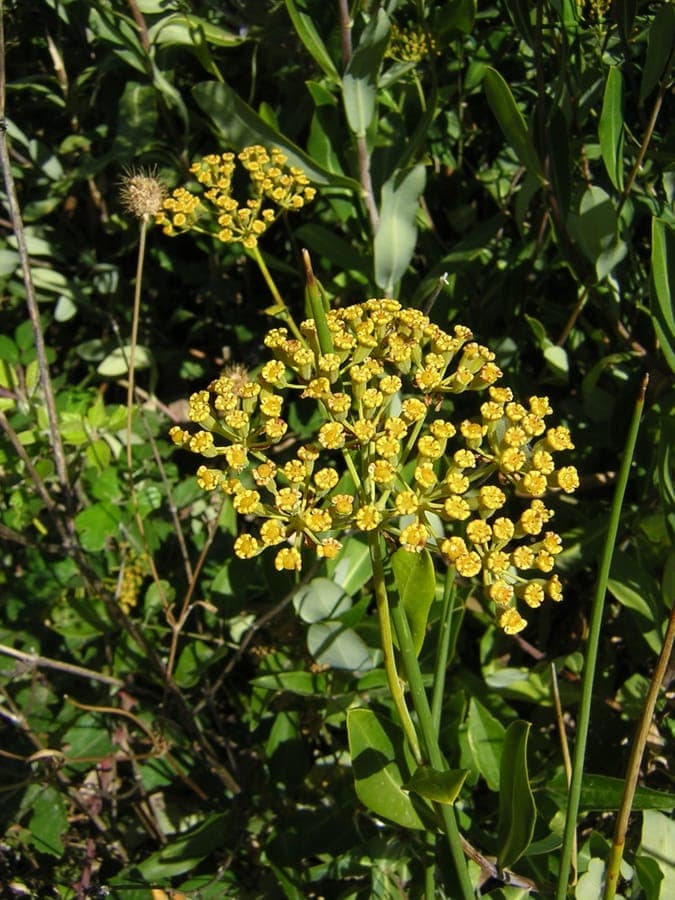
No machine-readable author provided. Aroche assumed (based on copyright claims). / CC BY-SA 2.5, via Wikimedia Commons
Shrubby hare's-ear: complete guide
Bupleurum fruticosum
Want to see Shrubby hare's-ear: complete guide in your garden?
1 minute, no credit card
Overview
Bupleurum fruticosum, commonly known as shrubby hare's-ear, is an evergreen shrub belonging to the carrot family (Apiaceae). Native to the western and central Mediterranean basin, it was first formally described by Linnaeus in his Species Plantarum of 1753. In the wild it grows naturally across southern France, Spain, Portugal, Italy, Sardinia, Sicily, Greece, Algeria, Morocco, and Tunisia; it has become naturalised in parts of Great Britain and the Crimean Peninsula. The genus Bupleurum contains both annual and perennial herbaceous species as well as a handful of woody ones - fruticosum is the only fully shrubby species widely grown in ornamental gardens.
The plant is valued for its combination of year-round evergreen foliage, a remarkably long flowering period from April to August, and outstanding resistance to drought, coastal wind, and salt spray. These qualities make it especially suitable for coastal gardens and seaside plantings, but it performs equally well in sheltered, sunny inland borders. On gardenworld.app you can explore how Mediterranean shrubs like this one can be used as structural anchors in low-maintenance garden designs.
Two subspecies are recognised: the typical form and subsp. insulare, native to the Balearic Islands. Nurseries in the UK and western Europe almost exclusively stock the typical form. Synonyms recorded in botanical literature include Buprestis fruticosa, Tenoria fruticosa, and Bupleurum terminale.
Appearance and bloom cycle
At maturity, shrubby hare's-ear forms a dense, rounded to dome-shaped shrub measuring 1 to 2 metres in both height and spread. The stems are greenish when young and gradually become woody towards the base while the growing tips remain pliable each year. Individual leaves are lance-shaped to elliptic, 4 to 10 cm long and 1 to 2.5 cm wide, with a clearly defined midrib and a smooth, leathery surface. The leaf colour is deep green to blue-green; in winter it may take on a slight yellowish cast.
The flowers are compound umbels - clusters of five to seven smaller secondary umbels, each carrying twenty to thirty tiny yellow florets. Individual umbels measure 5 to 10 cm across and are held on upright, stiff stems. Flowering runs from April to August, peaking in June and July; in mild winters or early springs, the first flowers may appear as early as late March. After flowering, the plant carries small, oval green fruits approximately 5 to 7 mm long that gradually ripen to brown and add further ornamental interest.
The yellow flowers are attractive to a wide range of insects: hoverflies, butterflies, bumblebees, and numerous species of solitary bee visit the plant consistently throughout its long flowering season. The combination of evergreen foliage, yellow flowers, and subsequent brown fruit means the plant provides decorative interest across all twelve months of the year.
Growth rate is moderate: expect 15 to 25 cm of annual extension, reaching a mature spread of approximately 150 by 150 cm within five to seven years. Young plants are somewhat more sensitive to hard frost than established specimens, and their cold hardiness increases noticeably with age and root establishment.
Ideal location
Bupleurum fruticosum thrives in full sun to light partial shade. It requires a minimum of four hours of direct sunlight daily for reliable flowering; in full sun the blooms are more numerous and the foliage is denser and more compact. Choose a warm, sheltered, south- or west-facing position where the plant can benefit from heat stored in walls or paving.
In its native Mediterranean habitat, shrubby hare's-ear grows on dry, rocky limestone slopes and in maquis scrubland, regularly exposed to strong sea breezes and occasional salt spray. In garden settings it replicates this naturally: it thrives against warm walls, at the top of banks, and in coastal front gardens where wind exposure rules out more tender plants. It is one of the few ornamental shrubs that combines genuine salt tolerance with attractive year-round appearance.
Container growing on a sunny terrace or courtyard is highly successful provided the pot is at least 40 cm in diameter with a deep profile. Move container-grown specimens under cover or into an unheated greenhouse during prolonged hard frost. In the open garden, a sheltered, sunny position against a south-facing wall is ideal in regions at the northern edge of its hardiness range.
Soil requirements
Good drainage is the single most important requirement. On waterlogged or poorly drained soil the roots deteriorate quickly, particularly in cold, wet winters. The ideal growing medium is light, sandy to loamy, with a pH between 5.5 and 6.5. The plant tolerates calcareous, lime-rich conditions but may develop leaf yellowing through iron deficiency when the pH rises significantly above 7.5.
On heavy clay soils, thorough preparation is essential before planting: dig to a depth of 15 to 20 cm and incorporate a generous amount of coarse grit and well-rotted garden compost to improve drainage. The soil does not need to be particularly nutrient-rich; excess nitrogen encourages soft, lush growth that is more susceptible to fungal disease and cold damage. Apply only a light annual dressing of a slow-release fertiliser in early spring if the soil is known to be very poor. Garden centres stock a range of Mediterranean and free-draining planting composts that suit this species well.
A 5 cm mulch of coarse grit around the base of the shrub keeps the crown dry, raises the soil temperature, suppresses weeds, and closely replicates the plant's natural growing conditions.
Free design
Want to see Shrubby hare's-ear: complete guide in your garden? Make a free design now.
Watering
Once established - typically two to three years after planting - shrubby hare's-ear requires very little supplementary watering. The species has evolved for long, dry Mediterranean summers and draws on deep soil moisture reserves once its root system is fully developed. For the first two years after planting, regular watering is essential to encourage deep rooting.
In year one, water thoroughly every ten to fourteen days and allow the soil to dry out completely between waterings. Avoid frequent, shallow watering - this encourages roots to stay near the surface where they are vulnerable to both drought and cold. Deep, infrequent watering trains the roots downwards and builds long-term drought resilience.
From the third year, additional water is needed only during extended dry spells lasting more than six weeks. A well-mulched border reduces moisture loss significantly and further reduces the need for irrigation. Container-grown plants dry out more quickly and will need checking weekly in hot summer weather - but the same principle applies: allow the compost to dry out between waterings rather than keeping it constantly moist.
On gardenworld.app you can find garden design ideas that show how drought-tolerant evergreen shrubs like shrubby hare's-ear can anchor a planting scheme that looks good every month of the year with minimal irrigation.
Pruning
Bupleurum fruticosum needs only a light annual trim to maintain a tidy, compact shape and encourage fresh flowering growth. Without regular pruning the plant tends to become woody and open at the base. The best time to prune is immediately after flowering, in August to September, or alternatively in early spring (March) just before new growth begins.
An annual post-flowering tidy consists of removing spent flower stems and cutting back any outward-growing shoots to the desired outline. Never remove more than one-third of the total volume in a single session. Removing old, fully woody stems at the base encourages fresh basal shoots and keeps the plant looking youthful. Wear gloves when pruning as the sap of Bupleurum can cause skin irritation in sensitive individuals.
A hard renovation pruning is possible on older, overgrown specimens: cut the entire plant back to 20 to 30 cm above ground level in early spring. Most established plants recover remarkably well from such treatment and regenerate vigorously from the base. Reserve hard pruning for plants that are at least three years old and well-rooted; young plants respond less reliably to drastic cutting back.
Maintenance calendar
January–February: No pruning required. Check for frost damage on the evergreen foliage. Remove heavy snow accumulations from branches to prevent structural breakage.
March: Remove any winter-damaged shoots back to healthy wood. Carry out a light corrective trim before new growth starts. Apply a light dressing of slow-release fertiliser.
April–May: Flowering begins. Monitor young shoots for aphid activity. Water if the soil has dried out.
June–July: Peak flowering. Enjoy the insect activity. Supplement watering only if necessary.
August–September: Remove spent flower stems. Carry out the main annual light trim. Remove old woody basal growth to stimulate fresh shoots.
October–November: No further pruning. Apply a mulch of coarse grit or well-rotted compost around the base if desired.
December: Check recently planted specimens for cold damage. Protect the crown of young plants from severe frost with dry leaves or horticultural fleece.
Winter hardiness
Bupleurum fruticosum is moderately frost-hardy, tolerating temperatures down to approximately -10 to -12 °C during brief cold spells. It is reliably winter-hardy in USDA zones 7 to 9. In the milder coastal regions of the British Isles and western Europe it overwinters without difficulty; in colder, more continental climates it benefits from the protection of a warm south-facing wall and a dry mulch around the base.
The main winter risk is the combination of hard frost and desiccating cold wind, which causes the evergreen leaves to dry out and die - a condition known as frost desiccation. Protect the plant during severe spells by wrapping it loosely in horticultural fleece or hessian. Young plants in their first or second winter are significantly more vulnerable than established specimens and should always receive some protection when hard frost is forecast.
After a severe winter that kills the top growth, do not give up on the plant: cut the damaged stems back in April to the first signs of living tissue (look for a green layer beneath the bark) and allow several weeks for recovery. Established shrubby hare's-ear has excellent powers of regeneration and frequently regrows strongly from the base even after the above-ground portions have died.
Companion plants
Bupleurum fruticosum is an excellent structural shrub for Mediterranean-inspired borders, dry gardens, and coastal plantings. It partners beautifully with other Mediterranean shrubs such as Cistus species (sun roses), Rosmarinus officinalis (rosemary), Lavandula angustifolia (lavender), and Phlomis fruticosa (Jerusalem sage). Together these form an aromatic, insect-friendly border that blooms prolifically in summer and asks little of the gardener.
For colourful contrast with the yellow umbels, consider Eryngium planum (flat sea holly, blue-silver, 60 cm), which provides a cool foil against the warm yellow flowers, or Perovskia atriplicifolia (Russian sage, lavender-blue, up to 120 cm), whose cloudlike flower spikes contrast beautifully with the compact, rounded form of the hare's-ear. Both share the same requirements for poor, well-drained soil and full sun.
In a coastal garden, shrubby hare's-ear combines well with Hippophae rhamnoides (sea buckthorn) as a windbreak backdrop and with lower-growing companions such as Centranthus ruber (red valerian, red or white, 60 cm) and Armeria maritima (sea thrift, pink, 20 cm). For shaded areas within the same border, Euphorbia characias subsp. wulfenii (spurge, yellow-green, 120 cm) provides similarly imposing structure with the same drought tolerance.
Closing thoughts
Bupleurum fruticosum is one of those plants that earns its place in the garden every month of the year. The glossy evergreen foliage provides winter structure when many borders are bare; the long flowering season from April to August fills the garden with soft yellow colour and insect life; and the subsequent brown seed heads extend the season of interest into autumn. Add to this exceptional drought tolerance, salt resistance, and low maintenance requirements, and shrubby hare's-ear stands out as an outstanding choice for any sunny, well-drained garden.
Want to see Shrubby hare's-ear: complete guide in your garden? Make a free design now.
Upload a photo, pick a style, and get a photorealistic design with plant list in under a minute.
10,000+ gardens designed already
No credit card required


Similar plants
Whorled carrot: complete guide
Daucus involucratus
Daucus involucratus is a Mediterranean umbellifer with white flower heads framed by lacy bracts. Growing this gravel garden gem.
Daucus muricatus: complete guide
Daucus muricatus
Daucus muricatus, the spiny wild carrot, grows wild on Mediterranean coasts. Discover sowing, June-July bloom, and wildflower meadow use.
Daucus pumilus: complete guide
Daucus pumilus
Daucus pumilus is a dwarf wild carrot relative with white lacy umbels, thriving on dunes and coastal rock in poor, fast-draining soil.