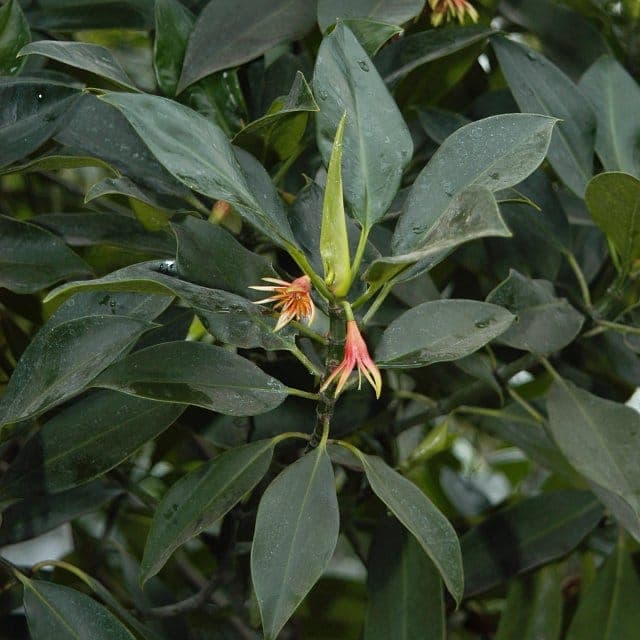
Ulf Mehlig / CC BY-SA 2.5, via Wikimedia Commons
Bruguiera gymnorhiza: complete guide
Bruguiera gymnorhiza
Want to see Bruguiera gymnorhiza: complete guide in your garden?
Full design in HD: €7.99
Look after your Bruguiera gymnorhiza with the GardenWorld app
Identify plants with your camera and get a care calendar with reminders for this plant.


Overview
Bruguiera gymnorhiza, commonly known as the oriental mangrove or Burmese mangrove, is an impressive tropical mangrove tree growing along coastlines and in swamps throughout the Indo-Pacific region. This tree is an ecosystem engineer playing a crucial role in protecting shorelines, providing habitat for fish and shellfish, and storing enormous amounts of carbon.
The tree's characteristic root system and adaptations to saltwater conditions make it a fascinating subject for botanical study.
Appearance & Bloom
Bruguiera gymnorhiza can reach 25 meters in height and has a broad, spreading crown. The leaves are opposite, elliptical, and glossy dark green, approximately 8-15 cm long. They have a smooth texture.
Flowers appear in summer, forming small yellow to reddish blooms with fragrant nectaries. After flowering, the trees produce large, pear-shaped seed pods that can be quite heavy. The most characteristic feature of this tree are the distinctive arched prop roots (aerial roots) that descend from the lowest branches.
Ideal Location
Bruguiera gymnorhiza grows exclusively in tropical coastal zones where saltwater conditions prevail. The tree is found in mangrove forests, along river mouths, and in tidal marshes. In these natural environments, it grows in full sun to partial shade.
The tree tolerates regular saltwater flooding and can grow in conditions where most other plants cannot survive.
Soil
Bruguiera gymnorhiza grows in poorly aerated, muddy sediments that are largely underwater. Unlike most other plants, this is the preferred growing environment. The tree is adapted to low oxygen conditions through use of its characteristic prop roots.
The tree can adapt to a wide range of substrates, from pure clay to sandy mud, as long as they remain saturated with water.
Free preview
Want to see Bruguiera gymnorhiza: complete guide in your garden? Make a free preview of your design.
Watering
In its natural environment, Bruguiera gymnorhiza undergoes regular tidal saltwater flooding. The tree is not drought-resistant but requires regular saltwater saturation. Dry conditions can be fatal.
In pot culture, this requires saltwater mixtures. Freshwater is unsuitable.
Pruning
Pruning is rarely applied to Bruguiera gymnorhiza in its natural environment. Under cultivated conditions, dead wood and disease can be removed, but shaping pruning is uncommon.
Maintenance Calendar
Spring: Check for damage from the previous season. Maintain saltwater environment.
Summer: Peak flowering period. Water regularly with saltwater mixture.
Fall: Fruit set. Continue saltwater care.
Winter: In tropical regions minimal seasonal effect. In marginal tropical areas slight growth decrease may occur.
Winter Hardiness
Bruguiera gymnorhiza is strictly tropical and cannot tolerate frost conditions. The tree dies immediately at temperatures below approximately 15 degrees Celsius. This is a tree that can only be grown in truly tropical and subtropical regions.
Companion Plants
In its natural mangrove ecosystem, Bruguiera gymnorhiza grows alongside other mangrove species such as Avicennia and Rhizophora. In cultivated systems, cohabitation with other saltwater-tolerant plants is uncommon.
Closing Thoughts
Bruguiera gymnorhiza is more than just a decorative tree - it is an ecosystem engineer of global significance. For people living in tropical coastal areas, it serves a crucial ecological role. For most other gardeners in temperate climates, this will be a tree that can only be grown in specialized greenhouses.
This is a plant worthy of better understanding and protection. On gardenworld.app, discover more about tropical plants and how ecosystems function. Further research into mangrove forest preservation is critically important for future generations.
Frequently asked questions about Bruguiera gymnorhiza
Is Bruguiera gymnorhiza winter hardy?
Bruguiera gymnorhiza is strictly tropical and cannot tolerate frost conditions. The tree dies immediately at temperatures below approximately 15 degrees Celsius.
When and how do you prune Bruguiera gymnorhiza?
Pruning is rarely applied to Bruguiera gymnorhiza in its natural environment. Under cultivated conditions, dead wood and disease can be removed, but shaping pruning is uncommon.
How much water does Bruguiera gymnorhiza need?
In its natural environment, Bruguiera gymnorhiza undergoes regular tidal saltwater flooding. The tree is not drought-resistant but requires regular saltwater saturation.
Where does Bruguiera gymnorhiza grow best?
Bruguiera gymnorhiza grows exclusively in tropical coastal zones where saltwater conditions prevail. The tree is found in mangrove forests, along river mouths, and in tidal marshes.
What soil does Bruguiera gymnorhiza need?
Bruguiera gymnorhiza grows in poorly aerated, muddy sediments that are largely underwater. Unlike most other plants, this is the preferred growing environment.

See it in your garden
See Bruguiera gymnorhiza in your garden
One photo of your garden and a few questions. You see the result in about a minute.
Try it with a photoIdentify this plant in your own garden. Identify a plant
Similar plants
Glossy abelia: complete guide
Abelia × grandiflora
Everything about glossy abelia (Abelia × grandiflora): position, soil, pruning and hardiness of a shrub that flowers from July to October with scented white bells.
Trailing abutilon (Abutilon megapotamicum): care guide
Abutilon megapotamicum
Grow trailing abutilon (Abutilon megapotamicum) in a basket or against a wall: watering, feeding, pruning and overwintering for red and yellow lantern flowers.
Flowering maple (Abutilon): container shrub guide
Abutilon × hybridum
How to grow flowering maple (Abutilon × hybridum) in a pot: position, watering, feeding, March pruning and overwintering indoors for flowers from May to October.
