
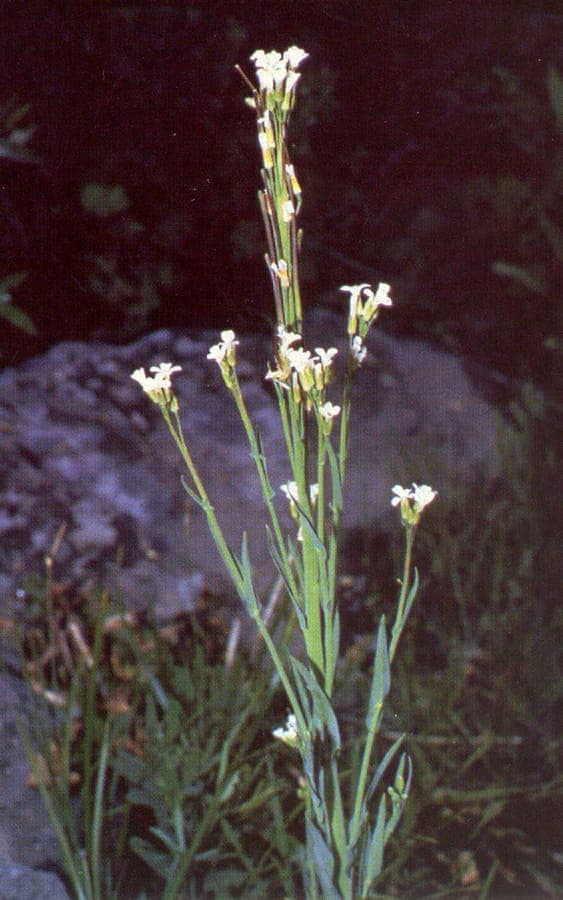
Wikimedia Commons / Public domain, via Wikimedia Commons
Boechera stricta: complete guide
Boechera stricta
Want to see Boechera stricta: complete guide in your garden?
1 minute, no credit card
Overview
Boechera stricta, commonly known as Drummond rockcress or Canadian rockcress, is a fascinating perennial herb belonging to the mustard family, Brassicaceae. Formally described in 2003 by taxonomist Al-Shehbaz, it was named in honour of Thomas Drummond, the Scottish botanist who documented much of North America's flora in the early nineteenth century. In the wild, Boechera stricta grows on rocky slopes, limestone outcrops, open mountain meadows and gravelly roadsides throughout the Rocky Mountains and adjacent western ranges, from subarctic Canada southward into Colorado, Utah and Nevada.
For gardeners interested in native plants, wildlife-friendly planting or a classic rock garden, Boechera stricta offers genuine charm with minimal demands. Its modest appearance belies impressive resilience: the plant tolerates prolonged drought, poor soils, intense summer radiation and winters cold enough to kill most garden plants. Once established, it requires almost no attention beyond the occasional removal of spent flower stems. At gardenworld.app you can explore how rockcress fits into a complete front-garden design, alongside other low-maintenance species.
The genus Boechera was formerly lumped within Arabis, but molecular studies in the early 2000s confirmed it merited recognition as a distinct genus. Within Boechera, dozens of species have been described, many of them narrowly restricted to single mountain ranges. Boechera stricta is one of the more broadly distributed members, occurring across much of the western interior of North America wherever suitable rocky, well-drained habitats exist.
Appearance and bloom cycle
Boechera stricta forms a basal rosette of narrow, grey-green leaves, each typically 3–8 cm long, with a slightly rough texture caused by tiny forked hairs - a classic feature of the Brassicaceae family. In spring, one or occasionally a few erect, unbranched flowering stems arise from the rosette, reaching a height of 20–60 cm depending on soil richness and available moisture. Smaller, stem-clasping leaves are distributed along the stem at regular intervals.
Bloom time falls between March and June, varying with elevation and latitude. At lower elevations in mild years, the first flowers open as early as late February. The small flowers have four white or pale pink petals arranged in a cross - the classic cruciform structure that gives the mustard family its former name, Cruciferae. Individual flowers are only 4–6 mm across but are held in elongating racemes that can carry twenty to forty blossoms, creating a delicate but conspicuous white display.
After the flowers fade, long, narrow siliques (seed pods) develop, standing strictly upright along the stem - a trait that gives the species its Latin epithet 'stricta', meaning erect or strict. The siliques reach 4–7 cm in length and contain a single row of small, brown seeds. When mature, the pods split longitudinally and the seeds disperse by wind. The plant may behave as a biennial or short-lived perennial, completing its life cycle over two to three years before dying, but it self-seeds reliably under suitable conditions.
Ideal location
Boechera stricta thrives in a fully open, sun-exposed position receiving at least six hours of direct sunlight daily. In its native habitat it colonises cliff faces, talus slopes and gravelly flats where competition from taller plants is minimal and air circulation around the stems is excellent. In the garden, a classic rock garden, a raised gravel bed or a dry stone wall are ideal settings.
The plant is intolerant of waterlogged conditions and appreciates good air movement, which reduces the risk of fungal problems during cool, wet springs. A south- or south-west-facing slope is ideal in northern European gardens, as it mimics the warm, sun-baked exposures the plant occupies in its native range. Planting in crevices between paving stones or at the base of a sunny south-facing wall is another attractive option.
In terms of climatic suitability, Boechera stricta is rated for USDA hardiness zones 3–6. It withstands temperatures well below -20 °C and has no difficulty with the relatively mild winters of north-western Europe, provided the soil is well drained. In regions with persistently wet winters, planting on a slight raised mound or in a free-draining substrate is advisable to prevent crown rot.
Soil requirements
Poor to moderately fertile, sharply drained soil is what Boechera stricta asks for. It performs best in substrates with a pH between 5.4 and 7.4, which covers the full range from moderately acidic to slightly alkaline - meaning it will adapt to most garden soils in Western Europe as long as they are not waterlogged heavy clay.
For a rock garden or gravel bed, a mixture of one part loamy topsoil, one part coarse horticultural grit and one part pea gravel works well. Working a 10–15 cm layer of grit or crushed stone into the planting area before setting the plants improves drainage dramatically on heavier soils. Avoid adding rich compost or slow-release fertiliser to the planting hole, as excessive nitrogen promotes lush but weak leafy growth at the expense of flowering, and makes the plant more susceptible to fungal infection.
A surface mulch of 3–5 cm of decorative gravel or crushed granite serves multiple purposes: it keeps the crown dry, suppresses weeds, reflects warmth onto the plant in early spring and maintains a steady soil temperature. Garden centres carry suitable grit mulches in various colours that can complement the planting aesthetically.
Free design
Want to see Boechera stricta: complete guide in your garden? Make a free design now.
Watering
Once established, Boechera stricta is highly drought tolerant and requires only minimal supplemental irrigation. In its natural environment it survives months without rainfall by drawing on moisture stored deep in rocky substrates. During the first growing season after planting, water twice a week to help the roots establish; after the first winter, reduce watering to once a week or less, and stop entirely once the plant shows signs of having rooted deeply - typically from the second growing season onwards.
The single most important rule is to allow the soil to dry completely between watering sessions. Standing water near the roots for more than 24 hours risks crown rot, which is usually fatal. On sandy or gravelly soils in an average Northern European summer, natural rainfall is generally sufficient. In unusually dry years, a single deep soak every ten to fourteen days during summer is enough to keep the plant in good health.
Avoid overhead irrigation during cool or overcast weather, as wet foliage is an invitation to fungal disease, particularly Botrytis. A drip line or soaker hose positioned at soil level is far preferable to sprinkler irrigation. In well-established rock gardens with an adequate gravel mulch, manual watering is often unnecessary even during dry spells.
Pruning
Boechera stricta requires very little pruning. After the flowers fade and the siliques have ripened, the flowering stems can be removed at their base to keep the planting tidy. If you wish to encourage self-seeding - which is the easiest way to propagate this plant and build up a larger colony - leave the stems standing until the pods are fully brown and the seeds have begun to disperse naturally; then simply pull the dry stems away from the rosette with a gentle tug.
The basal leaf rosette needs no pruning during the growing season. The leaves serve as a nutrient store for the plant and remain green through summer. In autumn, as temperatures drop and the leaves yellow and wither, remove the dead material to reduce slug habitat and prevent fungal spores from overwintering in the debris close to the crown.
No hard renovation cutting is ever needed. In established colonies, simply remove the spent stems each year, keep fallen leaves from accumulating around the crowns, and thin out overcrowded seedlings in spring if the colony becomes too dense.
Maintenance calendar
January–February: Check that drainage remains adequate and remove any dead leaf litter sitting on the crown. Top up the gravel mulch if it has been displaced by frost heave.
March–April: First flowers open. Water if the soil has been dry for two weeks or longer. Pull any weeds that have germinated in the mulch, as they can crowd out the low-growing rosettes.
May–June: Full bloom at higher elevations and in shadier positions. Decide whether to allow self-seeding or to cut the stems promptly after flowering. A light application of very dilute liquid fertiliser (half the recommended rate) can be applied once in May if growth seems very slow.
July–August: Siliques ripen and seeds disperse. Reduce watering. Watch for aphid colonies on the flowering stems; a strong jet of water is usually enough to dislodge them.
September–October: New seedling rosettes appear around the parent plant. Transplant any that have emerged in unwanted positions. Remove old flower stems entirely.
November–December: The plant retreats into its basal rosette for winter. Apply a fresh 3 cm layer of gravel mulch on heavier soils. Do not feed - lean conditions promote hardier overwintering.
Winter hardiness
Boechera stricta is exceptionally cold-hardy, tolerating sustained temperatures of -30 °C and below, placing it in USDA hardiness zones 3 and even 2. In the wild it endures the brutal winters of the Rocky Mountain interior: months of snow cover, freeze-thaw cycles and violent temperature swings that would kill less well-adapted plants. By comparison, the relatively mild winters of Belgium, the Netherlands and the UK pose almost no challenge.
The main winter risk is not cold but moisture. A frozen soil that is also saturated with water can cause the crown to rot, particularly on heavy clay soils. Preventing this is straightforward: ensure the planting area drains freely and lay a collar of coarse grit around the crown each autumn. In gardens with reliably wet winters, raising the planting level by 10–15 cm above the surrounding grade makes a significant difference.
No protective fleece or cloches are normally needed. The basal rosette lies low to the ground and is naturally protected by its own dense structure. Snow cover, when it occurs, acts as an insulating blanket rather than a threat. In fact, the plant emerges from snow cover looking perfectly healthy and often begins to produce flower buds while overnight temperatures are still dropping to -5 °C.
Companion plants
Boechera stricta is most at home in the company of other sun-loving, drought-tolerant plants that appreciate lean, well-drained soils. In a classic rock garden, Phlox subulata (moss phlox) is an outstanding companion: it blooms at approximately the same time and its carpeting, cushion-like habit creates a strong visual contrast with the upright flower stems of Boechera. Choose white or pale pink cultivars of Phlox subulata such as 'Snowflake' or 'Emerald Cushion White' to complement the delicate tones of the rockcress.
Sedum acre (biting stonecrop) and various Sempervivum species offer year-round interest and ask for exactly the same conditions. For early spring colour before Boechera comes into bloom, small bulbs such as Muscari armeniacum, Crocus tommasinianus or Tulipa tarda tuck in beautifully between the rosettes, dying back by early summer before the rockcress stems elongate. Festuca glauca (blue fescue) provides a fine-textured blue-grey foil that highlights the white flowers and the silvery siliques that follow.
For a more naturalistic prairie-style planting, Boechera stricta combines well with Erigeron speciosus (fleabane), Gaillardia aristata (blanket flower) and low-growing Achillea species. At gardenworld.app, you can design your entire front garden around these native and naturalised species and visualise the result before lifting a spade.
Closing
Boechera stricta is one of those unassuming plants that repays close attention. Its early flowers are a lifeline for bees and hoverflies emerging in the thin sunshine of early spring. Its drought tolerance and near-total lack of maintenance requirements make it an ideal candidate for the resource-conscious garden of the future. Whether tucked into a crevice in a dry stone wall, scattered through a gravel bed or grown as part of a naturalistic rock garden planting, it contributes a quality of authenticity and ecological purpose that more showy plants rarely match.
Want to see Boechera stricta: complete guide in your garden? Make a free design now.
Upload a photo, pick a style, and get a photorealistic design with plant list in under a minute.
10,000+ gardens designed already
No credit card required


Similar plants
Brassica cretica: complete guide
Brassica cretica
Brassica cretica, the Cretan cabbage, grows wild on Aegean cliffs. Discover how to grow this drought-tolerant, yellow-flowered Mediterranean perennial.
Corsican cabbage: complete guide
Brassica insularis
Corsican cabbage is a rare Mediterranean rock cabbage with white flowers and blue-green leaves. Location, soil and winter protection.
Prostrate cabbage: complete guide
Brassica procumbens
Prostrate cabbage is a creeping North African cliff plant with yellow flowers. Discover location, soil type and winter protection.