
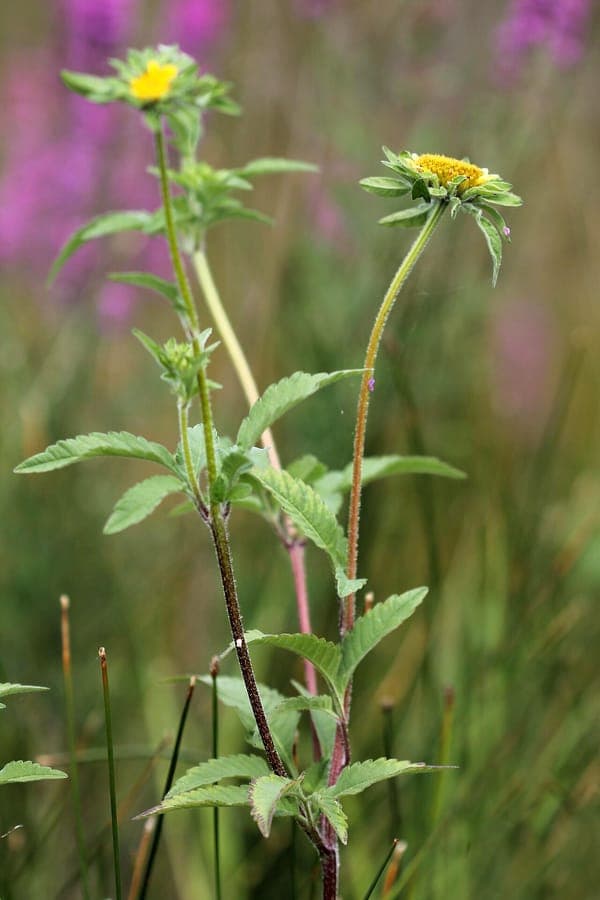
Rob Routledge, Sault College, Bugwood.org / CC BY 3.0, via Wikimedia Commons
Tall beggar-ticks: complete guide
Bidens vulgata
Want to see Tall beggar-ticks: complete guide in your garden?
1 minute, no credit card
Overview
Tall beggar-ticks (Bidens vulgata), also known as big devil's beggartick, is a striking annual plant from the Asteraceae family. This North American native is widely cultivated for its vibrant golden-yellow flowers and especially for its sticky seeds that immediately adhere to clothing and animal fur. The plant grows to approximately 60-90 cm tall and forms a bushy structure with abundant branching.
Appearance and Bloom
The plant displays dark green, toothed leaves arranged opposite each other. From August through October, numerous small yellow flowers appear in clusters. Each individual flower is just a few millimeters across, but their sheer abundance creates a cheerful golden tapestry. After flowering, the plant produces characteristic black seeds with two long, barbed appendages that cling tenaciously to socks and pet hair. This isn't accidental but a brilliant natural dispersal strategy.
Ideal Location
Tall beggar-ticks thrives in full sun to partial shade. The plant is unfussy and grows equally well along a meadow path or in a formal border. For maximum flowering, choose a sunny spot. In partial shade, the plant blooms but less abundantly. In many gardens across Western Europe, this plant appears spontaneously along driveways, beside sheds, and in unmanicured corners. When integrated into a front garden design, planting in groups delivers maximum visual impact.
Soil
The soil can be moderately fertile. Bidens vulgata shows no preference for heavy or light soils; it accepts nearly anything except permanently waterlogged conditions. Sandy, clayey, or loamy soil all work. A pH between 7.0 and 7.5 is ideal, though slightly more acidic conditions are tolerated. Ensure good drainage; heavy, muddy soil leads to root rot.
Free design
Want to see Tall beggar-ticks: complete guide in your garden? Make a free design now.
Watering
During the early growth phase (May-June), the young plant appreciates regular moisture. In dry weather, water 2-3 times weekly until the plant establishes well. Once rooted (July onwards), reduce watering frequency. Tall beggar-ticks is drought-tolerant and manages dry spells without supplemental irrigation. During extremely dry weeks in August, you may wish to water, especially if neighboring plants show stress. Avoid waterlogging.
Pruning
Pruning is optional. For a more compact, denser plant, pinch the tips of young plants in June, which encourages lateral shoots and more flowers. Remove spent blooms and dead leaves to keep the plant tidy. In early September, dead material can be removed. After the growing season (October-November), the plant naturally dies back as an annual should. No winter protection is needed.
Maintenance Calendar
May: Sow seed directly or plant seedlings. May-July: Water regularly. August: Peak flowering. Abundant blooms and seed set. September-October: Flowers continue until first frost. November: Remove spent plants after frost kills them. Winter: No maintenance; natural reseeding from fallen seed.
Winter Hardiness
Tall beggar-ticks is frost-sensitive. As a true annual, it dies at -5 degree Celsius or colder. Frost protection isn't needed; the plant simply completes its lifecycle. However, you may collect and dry seed for next season's planting. In warm autumns (through mid-October), plants continue blooming.
Companion Plants
Tall beggar-ticks pairs beautifully with other yellow summer bloomers: Heliopsis, Rudbeckia, and Coreopsis work well alongside. Low-growing Sedum and Chrysanthemum varieties serve as attractive underplanting. In wilder corners, expect volunteer plants to appear naturally. Dark green conifer backgrounds make the yellow flowers pop dramatically.
Closing
Tall beggar-ticks is straightforward and cheerful, requiring minimal effort for maximum summer impact. Ideal for gardeners seeking effortless color without complicated care routines. The seed dispersal mechanism makes this plant botanically fascinating for children. Integrate into front garden designs for playful, naturalistic appeal.
Want to see Tall beggar-ticks: complete guide in your garden? Make a free design now.
Upload a photo, pick a style, and get a photorealistic design with plant list in under a minute.
No credit card required


Similar plants
Calendula stellata: complete guide
Calendula stellata
Complete guide to Calendula stellata, the star-flowered marigold from Sicily: location, soil, watering and companion planting tips.
Korean chrysanthemum: complete guide
Chrysanthemum x rubellum
Chrysanthemum x rubellum is a hardy autumn perennial with single pink to copper flowers from August to November. Care and combinations.
Helianthus divaricatus: complete guide
Helianthus divaricatus
Helianthus divaricatus is a North American woodland sunflower with yellow summer blooms, ideal for naturalistic borders and shady edges.