
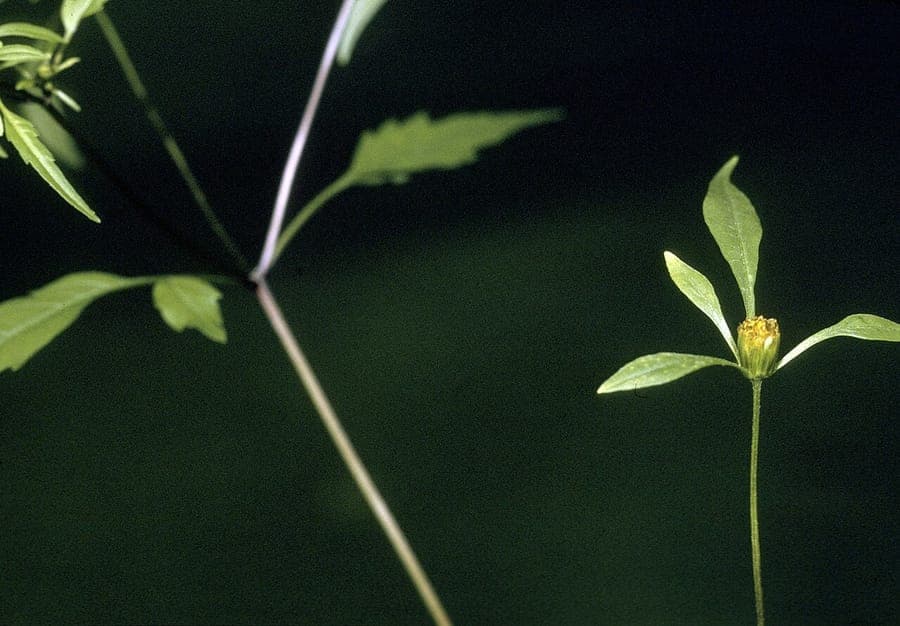
Robert H. Mohlenbrock. USDA NRCS. 1995. Northeast wetland flora: Field office guide to plant species. Northeast National Technical Center, Chester. Courtesy of USDA NRCS Wetland Science Institute. / Public domain, via Wikimedia Commons
Bidens discoidea: complete guide
Bidens discoidea
Want to see Bidens discoidea: complete guide in your garden?
1 minute, no credit card
Overview
Bidens discoidea, commonly known as discoid beggarticks, small beggarticks, or swamp beggarticks, is an annual herbaceous plant in the daisy family (Asteraceae). Described in 1893 by botanist Nathaniel Lord Britton, it is native to a wide stretch of eastern North America, from New Brunswick and Maine south to Texas, Florida, and across to the Great Lakes states. It has also been recorded as an introduced species in parts of France, where it sometimes establishes along waterways.
The species name discoidea refers directly to its disc-only flowerheads: unlike many of its showier relatives, it lacks the ray florets (the elongated petal-like structures) seen in garden marigolds or Bidens ferulifolia. Instead, the flowerheads consist entirely of tight yellow disc florets surrounded by small green bracts - a modest but botanically interesting arrangement that appeals to naturalistic garden styles.
For gardeners working with wet corners, pond margins, rain gardens, or ditch banks, Bidens discoidea is a useful annual that establishes quickly and self-sows reliably. On gardenworld.app you can explore garden design ideas for wet and semi-aquatic planting zones. Its rapid growth rate means it fills a gap in the planting quickly, and its barbed fruits - the characteristic 'beggarticks' that cling to clothing and animal fur - ensure it perpetuates itself without any effort from the gardener.
Ecologically, it functions as a modest nectar source for small pollinators, particularly small bees and hoverflies, and its seeds are taken by wetland songbirds. It thrives in areas where other ornamental plants might struggle: seasonally flooded depressions, the margins of farm ponds, and the edges of wet meadows.
Appearance and bloom cycle
Bidens discoidea is an erect, branching annual reaching 40 to 80 cm in height under typical conditions, occasionally exceeding 100 cm on especially rich, wet soils. The stems are angular, slightly hairy, and often tinged with reddish-purple, particularly towards the base. The leaves are pinnately compound with toothed leaflets, dark green, and noticeably coarse in texture - fitting for a plant that grows in rough, wet habitats.
The flowerheads are strictly discoid: there are no ray florets whatsoever. Each head is roughly 6 to 10 mm across, with bright yellow disc florets that open progressively from the outside inward. The outer involucral bracts (the green leaf-like structures around the base of the head) are noticeably elongated compared to those of closely related species - this feature, along with the absence of rays, is one of the key identification characters. The heads are borne on long, slender peduncles that allow the flowers to nod gently in the breeze.
The blooming period runs from mid-July through to September, with peak flowering typically in August. By late August and September the fruits ripen: narrow achenes, about 5 to 8 mm long, tipped with two to four stiff, retrorsely barbed awns - the 'ticks' in 'beggarticks'. These attach readily to clothing, socks, dog fur, and bird feathers, ensuring wide seed dispersal. The ripe fruiting plant has a distinctive ragged appearance that is not unattractive in a wilder garden setting, particularly when backlit by low autumn sun.
The overall habit is open and loosely branched, giving the plant a natural, unmanicured look that suits pond margins and wildlife-friendly garden areas perfectly.
Ideal location
This plant demands a position with full sun to light partial shade combined with consistently moist to wet soil. In its natural range it grows along stream banks, pond margins, wet meadows, swamp edges, and seasonally flooded low-lying areas. It handles brief full submersion reasonably well and is at home in the transition zone between open water and dry land.
In the garden, the best position is the margin of a wildlife pond, the bank of a rain garden, a wet border that receives run-off from a lawn or path, or the edge of a ditch or stream. Plant at 30 to 40 cm spacings to allow individual plants room to branch. In a naturalistic mass planting, slightly closer spacing of 20 to 25 cm creates a dense stand that shades out competition from coarse weeds.
Light is critical: in shade, plants become leggy, weak, and reluctant to flower. A minimum of six hours of direct sun per day produces a stocky, well-branched plant with abundant flowerheads. South-facing or west-facing pond banks are ideal. Sheltered spots with a high ambient humidity also suit the plant well, as does the microclimate of a south-facing rain garden in a sunny corner of the garden.
Garden centres across the UK and US occasionally stock wetland annuals; if Bidens discoidea is not available, seed can be collected from naturalised plants along canal towpaths or river banks in areas where it has established.
Soil requirements
The preferred soil pH range for Bidens discoidea is 5.1 to 7.1 - tolerating mildly acid to neutral conditions. It performs particularly well on moisture-retentive, organically rich soils: heavy clay loams, silty alluvial deposits, and peaty margins are all suitable. Sandy, free-draining soils are unsuitable unless kept permanently wet by supplemental irrigation or groundwater.
Soil fertility matters considerably: on nutrient-poor substrates the plant remains small and flowers sparsely. On rich, silty soils - such as those naturally deposited along slow-moving watercourses - it grows vigorously and produces many branching stems. Adding a layer of well-rotted garden compost or leafmould to the planting area before sowing or transplanting significantly improves establishment.
Waterlogging is not a problem: the species is genuinely semi-aquatic and its roots tolerate prolonged saturation. The soil structure does not need to be particularly open or free-draining; the opposite is true. If planting on the margin of a new wildlife pond, the natural clay-rich bank soil is often the best possible substrate with no amendment needed.
On neutral to slightly alkaline soils (pH 6.5 to 7.1) growth is still acceptable, and this covers most garden soils in the UK and the Netherlands. In garden centres such as Dobbies or local wildlife-garden specialists, you may find it labelled under one of its synonyms (Coreopsis discoidea in older horticultural literature).
Free design
Want to see Bidens discoidea: complete guide in your garden? Make a free design now.
Watering
Once established in a genuinely wet position - pond margin, rain garden, or permanently moist border - Bidens discoidea requires no supplemental watering. The plant has evolved for wet habitats and draws all the moisture it needs from its surroundings. In drier positions, however, watering must be consistent: allow the soil to approach (but not reach) dryness between waterings, and always water deeply at the roots rather than lightly from above.
During summer drought, plants in border conditions may need watering every two to three days. Signs of water stress include wilting in the morning (rather than just the afternoon heat), yellowing of the lower leaves, and premature seed ripening. A deep, thorough soak at the base of the plant is far more effective than frequent light sprinkling. Using a mulch of bark chips or compost around the stems, leaving a clear circle around the actual stem base, helps retain moisture considerably.
In containers or large tubs, daily watering may be necessary in hot weather; standing the container in a saucer of water or using a self-watering planter solves the problem neatly. On gardenworld.app you can find design suggestions for incorporating wet-garden plants into container arrangements and pond-side planting schemes.
Pruning
As an annual, Bidens discoidea does not require seasonal pruning in the traditional sense. The main decisions are around deadheading and autumn clearance. Removing spent flowerheads before the achenes fully ripen reduces self-sowing considerably - useful if you want to control the spread of the plant. Left to set seed, it will self-sow prolifically, and seedlings the following spring can appear metres away from the parent plant, carried there by clothing, pets, or birds.
If a more compact, densely branched habit is desired, pinching out the main growing tips in early June - when plants are roughly 15 to 20 cm tall - encourages multiple lateral shoots to form and results in a bushier, lower plant with more flowerheads per stem. This is particularly useful in a mixed border where tall, open plants might look out of place.
In autumn, once the plant has died back after the first frosts, the old stems can be cut to ground level. In a wildlife-friendly garden, leaving the standing dead stems until late February provides shelter for overwintering insects and a seed source for birds through the winter months. The dead stems can then be cut and composted in late February before the soil warms and new seedlings emerge.
Maintenance calendar
January – February: No action needed. Overwintering seeds remain viable in the soil. Leave standing stems for wildlife if not already cut.
March: Begin checking for early seedling emergence on warm, wet soil. Remove unwanted weedy competition.
April – May: Direct sow seeds or transplant purchased seedlings once night temperatures reliably stay above 8°C. Plant at 30 to 40 cm spacings. Water in thoroughly.
June: Pinch out growing tips for a bushier habit if desired. Keep soil moist. Remove competing weeds.
July – August: Main flowering period. Enjoy the yellow flowerheads. Deadhead promptly to limit self-sowing if needed. Water during dry spells.
September: Fruit ripening. Decide whether to allow self-sowing or collect seed for intentional sowing next year. Reduce watering as temperatures fall.
October: First frosts kill the plant. Collect remaining seeds. Cut stems to ground level or leave for wildlife.
November – December: Dormancy. No action needed.
Winter hardiness
Bidens discoidea is a true annual and does not survive winter as a mature plant. It is killed by the first hard frost, typically in October in the UK and the Netherlands. In USDA hardiness zones 4 through 9, it is used purely as an annual. However, its seeds are genuinely cold-hardy and survive the winter months in the soil without difficulty, germinating reliably the following spring once soil temperatures climb above 12°C.
This means that in a suitable wet position the plant behaves as a self-perpetuating annual, reappearing each spring from the self-sown seed bank without any intervention from the gardener. In the wild across its native North American range - where winters can reach -20°C in the northern states - the seed has no trouble surviving. For zone 7 and 8 gardens in western Europe, no special protection of seeds is necessary.
If you wish to ensure a supply of plants for the following year, collect some ripe fruiting heads in early September and store them in a paper bag in a cool, dry shed over winter. Sow the following May directly onto moist soil. The germination rate is typically good, with seedlings appearing within ten to fourteen days at 15 to 20°C soil temperature.
Companion plants
In a naturalistic wetland border or pond margin planting, Bidens discoidea combines well with other moisture-loving species. Yellow flag iris (Iris pseudacorus), planted 40 cm apart, provides strong vertical structure and vivid yellow blooms in May and June, which precede the bident's July flush and thus extend the season of interest. Purple loosestrife (Lythrum salicaria), with its tall magenta spires reaching 80 to 120 cm, pairs beautifully in terms of both height and ecological function.
For lower ground cover at the water's edge, water mint (Mentha aquatica) fills the space between taller plants with aromatic, creeping stems, and great willowherb (Epilobium hirsutum) contributes a soft pink note to the mix. Narrow-leaved cattail (Typha angustifolia), planted 60 cm apart, provides the bold vertical accent that defines the character of the wetland planting, with the bident's branching habit filling the mid-height zone between the iris and the cattail.
For a wilder meadow edge, combining Bidens discoidea with hemp agrimony (Eupatorium cannabinum), meadowsweet (Filipendula ulmaria), and ragged robin (Silene flos-cuculi) creates a richly layered, wildlife-friendly planting that supports bees, hoverflies, butterflies, and wetland birds throughout the summer.
Closing
Bidens discoidea is not the most glamorous plant in the nursery catalogue, but it has a genuine and unpretentious character that suits the modern naturalistic garden well. Its preference for wet, rich soils with a pH of 5.1 to 7.1 makes it specifically useful in a niche where showier plants often fail. Fast-growing, self-sowing, and ecologically valuable, it rewards the gardener who lets it find its own place in a wet-garden scheme. Planted thoughtfully alongside yellow iris, purple loosestrife, and water mint, it contributes to a layered, seasonal tapestry of colour and texture that few purely ornamental annuals can match.
Want to see Bidens discoidea: complete guide in your garden? Make a free design now.
Upload a photo, pick a style, and get a photorealistic design with plant list in under a minute.
10,000+ gardens designed already
No credit card required


Similar plants
Calendula stellata: complete guide
Calendula stellata
Complete guide to Calendula stellata, the star-flowered marigold from Sicily: location, soil, watering and companion planting tips.
Korean chrysanthemum: complete guide
Chrysanthemum x rubellum
Chrysanthemum x rubellum is a hardy autumn perennial with single pink to copper flowers from August to November. Care and combinations.
Helianthus divaricatus: complete guide
Helianthus divaricatus
Helianthus divaricatus is a North American woodland sunflower with yellow summer blooms, ideal for naturalistic borders and shady edges.