
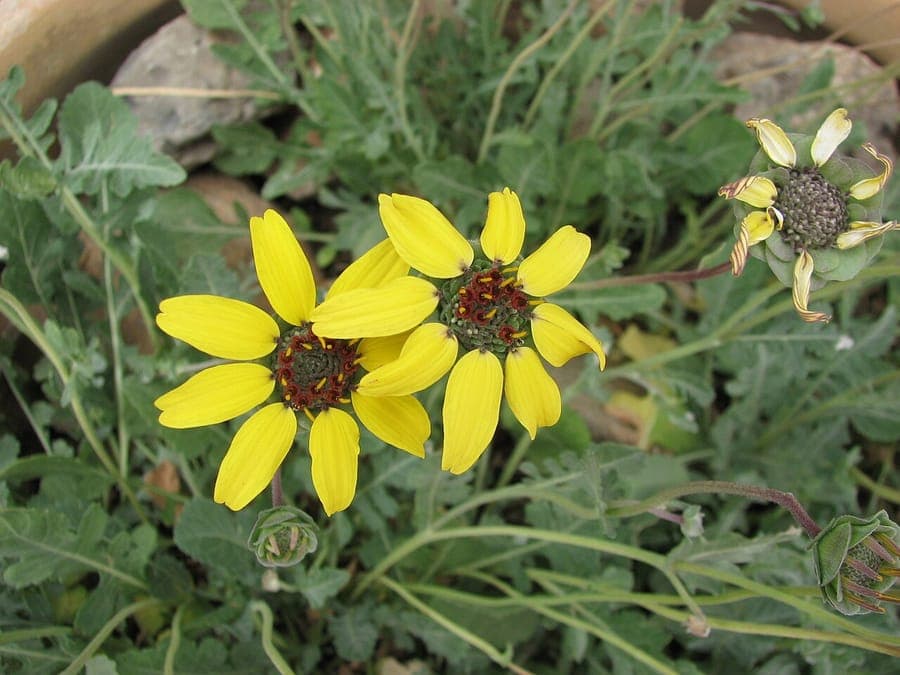
Melburnian / CC BY-SA 3.0, via Wikimedia Commons
Chocolate flower: complete guide
Berlandiera lyrata
Want to see Chocolate flower: complete guide in your garden?
1 minute, no credit card
Overview
Berlandiera lyrata, commonly known as the chocolate flower or lyreleaf greeneyes, is a perennial member of the daisy family (Asteraceae) native to the semi-arid prairies and limestone hillsides of the American Southwest and northern Mexico. Described by botanist George Bentham in 1839, the plant has earned a loyal following among gardeners for one singular characteristic: its flowers produce an unmistakable scent of dark chocolate or cocoa. This fragrance, driven by volatile compounds including phenylacetaldehyde, is strongest in the early morning between sunrise and approximately 9 a.m., gradually fading as the day warms up.
In the wild, chocolate flower grows across Arizona, Colorado, Kansas, New Mexico, Oklahoma, Texas, and into northeastern and northwestern Mexico. It thrives on thin, well-drained soils in full sun - conditions where many ornamental plants struggle. This adaptation to harsh environments translates directly into low-maintenance performance in the garden, particularly in beds and borders where drought tolerance is valued. On gardenworld.app you'll find design ideas for incorporating drought-tolerant perennials into attractive, cohesive plantings.
The species has also been recorded under the synonyms Berlandiera incisa and Berlandiera lyrata var. purpurea. The genus Berlandiera contains only a small number of species, of which lyrata is by far the most widely grown, both for its fragrance and for the attractive cut-leaf foliage that adds texture even when the plant is not in flower.
Appearance and bloom cycle
Berlandiera lyrata forms a loose, upright clump with multiple flowering stems reaching 30 to 60 cm in height. The foliage is grey-green, densely covered in soft hairs, and deeply lobed to pinnately cut - the lyre-shaped outline giving the species its name. Individual leaves measure 5 to 15 cm in length and remain partially evergreen in mild climates.
The flowers are typical composites, with bright yellow ray florets that display distinctive green veining on the undersides. The disc at the centre of each bloom consists of small dark brown to burgundy-red florets, creating an attractive two-tone contrast. Each flower head measures 4 to 6 cm across. After the ray florets fall, the flat, disc-like green seed heads remain on the plant and are themselves ornamental - often described as resembling small green buttons.
Flowering typically begins in May and continues uninterrupted through autumn, often until November in mild years. During hot, dry summers the plant blooms especially prolifically, producing a continuous succession of flowers on fresh stems. The chocolate scent is most intense on newly opened blooms and fades within a day or two as individual flowers age.
The dense coat of soft hairs covering the stems and leaves is not merely decorative - it is a functional adaptation that reduces water loss through transpiration in the hot, dry conditions of the plant's native habitat. In garden settings, this same characteristic gives the foliage a soft, tactile appeal and a pleasant silvery-grey cast in bright sunshine.
Ideal location
Full sun is non-negotiable for Berlandiera lyrata. It requires a minimum of six hours of direct sunlight per day to flower well and develop its characteristic fragrance. In partial shade the plant will survive but produce fewer flowers and a noticeably weaker scent. Choose a south- or west-facing position that receives unobstructed sunshine from mid-morning onwards.
The plant is particularly well suited to warm microclimates within the garden: raised beds, gravel gardens, paving edges, south-facing walls, and terraces where heat accumulates are ideal. In cooler or wetter climates, a raised position improves drainage and winter survival considerably. Container growing on a sunny terrace or courtyard is also very successful provided the pot is at least 30 cm in diameter and fitted with adequate drainage holes.
Berlandiera lyrata makes an excellent subject for a prairie-style or Mediterranean-inspired planting, where it partners well with other sun-loving, drought-tolerant species. Its long flowering season makes it one of the most valuable plants for late summer and autumn colour in such schemes.
Soil requirements
The essential requirement for success with chocolate flower is good drainage. On waterlogged or poorly drained soil the roots rot quickly, especially during winter. The ideal growing medium is lean, sandy or gravelly, with a pH between 6.5 and 9.5 - the plant tolerates both neutral and moderately alkaline, lime-rich conditions without difficulty.
On heavy clay soils, prepare the planting area thoroughly before installing the plant: dig to a depth of at least 20 cm and incorporate a generous amount of coarse horticultural grit or pea shingle, along with some well-rotted garden compost. A ratio of approximately 60% existing soil, 30% coarse grit, and 10% compost is a reasonable starting point. Avoid adding large quantities of nutrient-rich compost or fertiliser, as this encourages lush, leafy growth at the expense of flowers.
A surface mulch of fine gravel or grit around the base of the plant serves multiple purposes: it keeps the crown dry, warms the soil, suppresses weeds, and replicates the natural conditions of the plant's native habitat. Garden centres stock a range of alpine and Mediterranean planting mixes that are well suited to this species.
Free design
Want to see Chocolate flower: complete guide in your garden? Make a free design now.
Watering
Once established - typically by the end of the first growing season - Berlandiera lyrata is highly drought tolerant and requires very little supplementary watering. During the first year after planting, regular watering is essential to allow the root system to develop deeply into the soil: water thoroughly once a week, allowing the soil to dry out to a depth of at least 5 cm between waterings.
From the second year onwards, additional water is only needed during prolonged dry spells lasting more than four weeks. In such cases, water deeply every two weeks, preferably in the evening or early morning to reduce evaporation. Avoid allowing water to pool around the crown of the plant at any time - standing moisture at the base is the primary cause of root and crown rot.
In a container, ensure that the pot drains freely after every watering and that water never sits in a saucer beneath the pot. Container plants will require more frequent watering than those in the ground, particularly during hot weather, but the same principle applies: allow the compost to dry out between waterings rather than keeping it constantly moist.
The increasing frequency of dry summers in northern Europe makes Berlandiera lyrata an increasingly valuable garden plant - it maintains its bloom reliably through drought conditions when many other perennials are struggling. On gardenworld.app you can explore how to build a drought-resilient garden that stays colourful from May to November.
Pruning
Berlandiera lyrata requires minimal pruning. During the growing season, deadheading spent flowers by cutting the flower stems back to just above the basal rosette encourages the formation of new flower buds and extends the overall flowering period significantly. Use clean, sharp secateurs and cut approximately 2 cm above the leaf rosette.
At the end of autumn or in early winter, the plant can be lightly cut back to a height of 10 to 15 cm above ground level. This is not strictly necessary - the dried stems provide some protection to the crown during hard frost and add winter interest with their distinctive flat seed heads - but a tidy cut back in autumn gives the plant extra energy for spring growth. On older, more woody plants, removing old basal stems entirely in early spring stimulates vigorous new growth.
No hard rejuvenation pruning is necessary, as Berlandiera lyrata renews itself naturally through self-seeding and through fresh basal shoots each spring. If a clump spreads wider than desired, the outer portions can be lifted and divided in early spring (March to April) and replanted elsewhere in the garden.
Maintenance calendar
January–February: Leave the dried stems in place for winter protection. No pruning required. Check that any winter protection (dry leaves or mulch) remains intact after wind or heavy rain.
March: Remove winter protection carefully. Cut back dried stems to 10 cm above ground level. Look for new basal shoots emerging. Apply a thin layer of well-rotted compost around (not on top of) the crown if desired.
April: Divide or replant any rooted offsets. Begin regular watering if the soil dries out. Monitor young shoots for aphid activity.
May–June: First flowers appear. Begin deadheading regularly. Enjoy the morning chocolate fragrance.
July–August: Peak flowering period. Provide supplementary water during prolonged drought. Collect ripe seed heads for propagation if desired.
September–October: Late summer flowering continues. Allow some seed heads to ripen for birds. Remove spent stems but leave the green basal rosette intact.
November–December: Cut stems back or leave for winter structure. Apply a light mulch of dry leaves or pine needle litter in colder, wetter gardens.
Winter hardiness
Berlandiera lyrata is a reliably hardy perennial from USDA zone 4 to 9, tolerating winter temperatures down to approximately -35 °C (zone 4) and surviving reliably through to zone 9 (-7 °C). In most of northern and central Europe, it overwinters without difficulty provided the soil is well drained.
The greatest winter risk is not cold itself but the combination of cold and wet - waterlogged roots in freezing conditions deteriorate quickly. Plant on a raised or sloping site in free-draining soil, and mulch the crown with 5 cm of coarse grit in autumn to keep it dry. Container plants should be moved under cover or into an unheated greenhouse during prolonged hard frosts.
In the first winter after planting, when the root system is not yet fully established, some protection is prudent: apply a layer of dry fallen leaves or a 8 cm layer of pine needle mulch over the crown in November and remove it again in March once the worst frost risk has passed. Established plants in well-drained soil typically need no additional protection at all.
Companion plants
Berlandiera lyrata combines beautifully with other drought-tolerant sun-loving perennials. A classic pairing is with Salvia nemorosa 'Caradonna' (ornamental sage, blue-violet, 50 cm): the complementary combination of yellow and violet is particularly striking, and both plants share the same requirements for sun and lean, well-drained soil. Adding Echinacea purpurea 'Magnus' (purple coneflower, 80 cm) provides height and structural contrast.
For a prairie-inspired planting scheme, chocolate flower works well alongside Penstemon strictus (penstemon, blue, 60 cm), Gaillardia aristata (blanket flower, red-yellow, 50 cm), and Agastache rupestris (hummingbird mint, orange-pink, 60 cm). This combination provides continuous colour from June to October and supports a wide range of pollinators including bumblebees, solitary bees, butterflies, and hoverflies.
As a low-growing companion beneath or between the flowering stems, Thymus serpyllum (wild thyme) or varieties of Sempervivum (houseleek) are ideal: they share the same preference for poor, dry conditions and fill the spaces between stems attractively. For larger borders, Nassella tenuissima (Mexican feathergrass, 50 cm) provides movement and contrast alongside the more upright, structured stems of the chocolate flower.
Closing thoughts
Berlandiera lyrata is one of those garden plants that surprises people who encounter it for the first time. The morning scent of chocolate from a sun-baked border is entirely unexpected, and the combination of an unusually long flowering season - May to November - with genuine drought tolerance and near-zero maintenance makes this a plant of exceptional garden value.
For anyone looking for an original, low-effort accent in a sunny border, gravel garden, or prairie planting, the chocolate flower delivers reliably year after year. Plant it close to a path, terrace, or garden seat where you pass in the early morning to make the most of its remarkable and fleeting fragrance.
Want to see Chocolate flower: complete guide in your garden? Make a free design now.
Upload a photo, pick a style, and get a photorealistic design with plant list in under a minute.
10,000+ gardens designed already
No credit card required


Similar plants
Calendula stellata: complete guide
Calendula stellata
Complete guide to Calendula stellata, the star-flowered marigold from Sicily: location, soil, watering and companion planting tips.
Korean chrysanthemum: complete guide
Chrysanthemum x rubellum
Chrysanthemum x rubellum is a hardy autumn perennial with single pink to copper flowers from August to November. Care and combinations.
Helianthus divaricatus: complete guide
Helianthus divaricatus
Helianthus divaricatus is a North American woodland sunflower with yellow summer blooms, ideal for naturalistic borders and shady edges.