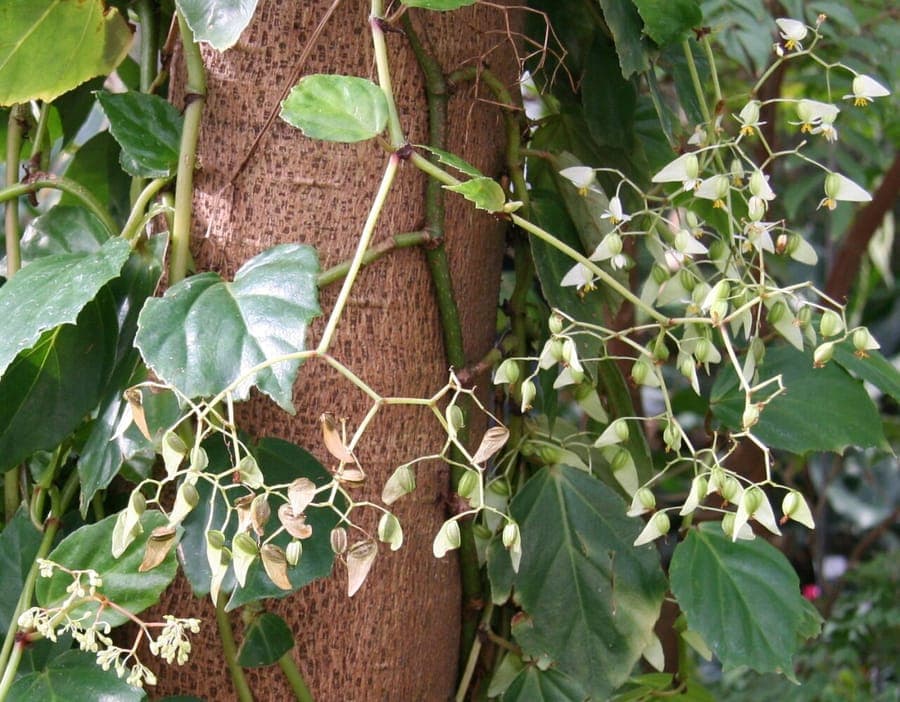
Michael Wolf / CC BY-SA 3.0, via Wikimedia Commons
Climbing Begonia: complete guide
Begonia glabra
Want to see Climbing Begonia: complete guide in your garden?
Full design in HD: €7.99
Look after your Climbing Begonia with the GardenWorld app
Identify plants with your camera and get a care calendar with reminders for this plant.


Overview
The Climbing Begonia (Begonia glabra), also called Candy Begonia or Smooth Begonia, is a tropical plant from Mexico to tropical America. This plant is part of the Begoniaceae family and is known for its climbing vine-like growth and delicate, rounded foliage. Unlike many begonias, this species can grow outdoors in warm, humid climates. In Europe, grow it best in containers and hanging baskets.
Appearance and Bloom
The Climbing Begonia grows slender and long, with thin, flexible stems that can attach to supports or trellises. The leaves are small to medium, smooth, and often with a subtle sheen. They are greenish to reddish in color. The flowers are small, white to light pink, appearing in clusters. They are delicate and appear during the growing season.
Ideal Location
The Climbing Begonia loves semi-shade. Place it where it receives indirect sunlight, without direct sun exposure. Suitable for east or north-facing windows. Too much sun causes leaf scorch. Warmth and high humidity are preferred.
Soil
Use fertile, slightly acidic potting soil with humus. Mixes with peat moss or coco coir work well. The plant appreciates moist soil. Ensure good drainage to prevent water accumulation.
Free preview
Want to see Climbing Begonia: complete guide in your garden? Make a free preview of your design.
Watering
Water regularly to keep soil consistently moist. This plant dislikes drying out. Water at soil level, not over leaves. In winter, moisture loss can be slightly less. Consistent moisture is better than fluctuating wet and dry.
Pruning
Pruning encourages denser, fuller growth. You can shorten long, thin stems and pinch branching points. This makes the plant fuller and better shaped. Remove dead leaves as needed.
Maintenance Calendar
Spring: Pruning and begin feeding; Summer: Water regularly, feed every 2 weeks; Autumn: Gradually reduce watering; Winter: Minimal water, stop feeding.
Winter Hardiness
Not frost-hardy in temperate Europe. Houseplant or pot in protected location. Minimum temperature 12-15°C. Protect from frost and cold drafts.
Companion Plants
Pair with other shade-loving climbers: Rhaphidophora tetrasperma, small Monstera deliciosa, other Begonia species. They share the same preference for humid semi-shade.
Final Thoughts
The Climbing Begonia is an interesting choice for those seeking height in shaded corners. With moist, fertile substrate and consistent warm climate, it grows beautifully. Available at major garden centres. More plant guides on gardenworld.app.
Frequently asked questions about Climbing Begonia
Is Climbing Begonia winter hardy?
Not frost-hardy in temperate Europe. Houseplant or pot in protected location.
When and how do you prune Climbing Begonia?
Pruning encourages denser, fuller growth. You can shorten long, thin stems and pinch branching points.
How much water does Climbing Begonia need?
Water regularly to keep soil consistently moist. This plant dislikes drying out.
Where does Climbing Begonia grow best?
The Climbing Begonia loves semi-shade. Place it where it receives indirect sunlight, without direct sun exposure.
What soil does Climbing Begonia need?
Use fertile, slightly acidic potting soil with humus. Mixes with peat moss or coco coir work well.

See it in your garden
See Climbing Begonia in your garden
One photo of your garden and a few questions. You see the result in about a minute.
Try it with a photoIdentify this plant in your own garden. Identify a plant
Similar plants
Bolivian begonia: complete guide
Begonia boliviensis
Everything about Bolivian begonia (Begonia boliviensis), the trailing ancestor of tuberous begonias: position, watering, overwintering and pet toxicity.
Rieger begonia: complete guide
Begonia × hiemalis
Everything about the Rieger or Elatior begonia (Begonia × hiemalis): position indoors, watering, reflowering and toxicity to pets. Months of colour.
Tuberous begonia: complete guide
Begonia × tuberhybrida
Everything about tuberous begonia (Begonia × tuberhybrida): starting tubers, position, watering, overwintering and pet toxicity. Flowers year after year.
