
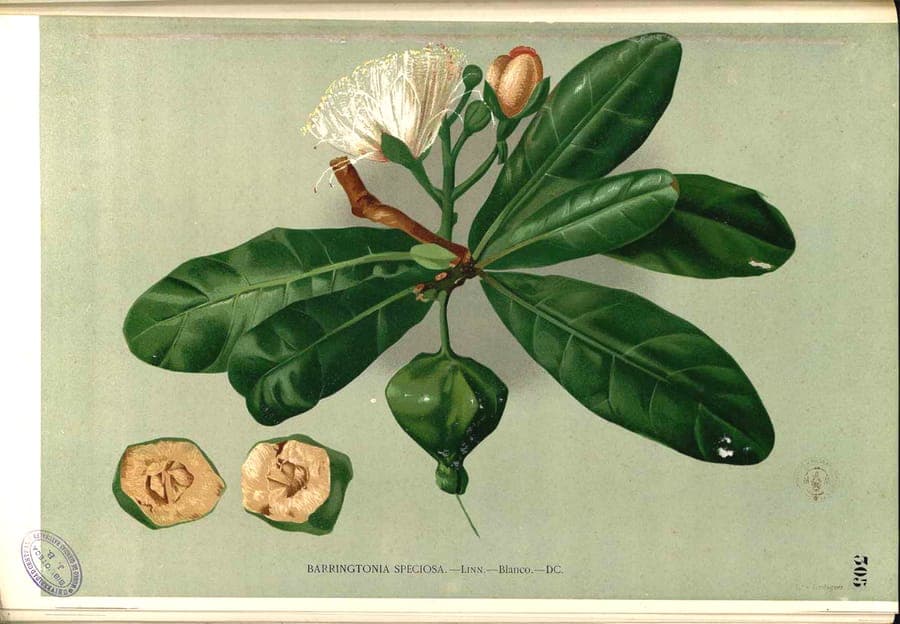
Francisco Manuel Blanco (O.S.A.) / Public domain, via Wikimedia Commons
Barringtonia asiatica: complete guide
Barringtonia asiatica
Want to see Barringtonia asiatica: complete guide in your garden?
1 minute, no credit card
Barringtonia asiatica, commonly called Mango-pine or Asian barringtonia, is a spectacular tropical tree distinguished by remarkable pink and white flowers. Native to Indo-Pacific regions, this tree naturally occurs along beaches and in mangrove habitats.
Overview The Mango-pine is a stately tree with broad crown providing impressive beauty and shade. The tree attains significant proportions, creating dominant landscape presence. This is a tree for gardens offering substantial space.
Appearance and Bloom Large, glossy, dark-green foliage provides lush tropical character. Flowers are the true attraction: large, showy flower clusters with pink and white stamens that dramatically extend outward. Flowering occurs in warm seasons, attracting numerous pollinators. Distinctive fruits serve as interesting structural elements year-round.
Ideal Location Barringtonia asiatica thrives in full sun positions in warm, sheltered locations. The tree tolerates coastal winds, reflecting its natural habitat preferences. Avoid regions with regular frost.
Soil This tree is not particularly fussy regarding soil type, growing in sandy, clay, or loamy soils. Good drainage is essential, however. The tree even tolerates slight soil salinity, mirroring natural coastal environments.
Watering Regular watering in establishment year is advisable. Once mature, the tree proves drought-tolerant. During extreme heat, supplemental watering enhances growth and flowering potential.
Pruning Minimal pruning is necessary for this tree. Remove dead branches and control growth if required. Natural form is typically attractive, requiring minimal intervention.
Maintenance Calendar Nutrient supplementation in early years promotes rapid development. After establishment, minimal feeding is needed. Mulching base areas improves moisture retention.
Winter Hardiness Barringtonia asiatica lacks frost tolerance and requires warm year-round climate. In temperate regions, grow in large containers and relocate indoors during winter.
Companion Plants This tree pairs beautifully with other tropical species and flowering shrubs. Underplant with low-growing tropical shrubs and flowering groundcovers. The large silhouette serves as focal point in spacious gardens.
Conclusion Barringtonia asiatica is a spectacular choice for large, warm gardens. With stunning flowers and tropical character, it creates incomparable beauty. Available from quality nurseries. Design complete tropical gardens via gardenworld.app.
Want to see Barringtonia asiatica: complete guide in your garden? Make a free design now.
Upload a photo, pick a style, and get a photorealistic design with plant list in under a minute.
No credit card required


Similar plants
Freshwater mangrove: complete guide
Barringtonia acutangula
Barringtonia acutangula, the freshwater mangrove, is a tropical tree with stunning flowers and decorative fruits. Discover everything about cultivation and care.
Brackwater Mangrove: complete guide
Barringtonia racemosa
Discover the brackwater mangrove with spectacular hanging flower spikes. Complete care guide for this tropical tree suited to waterside gardens.
Lecythis zabucajo: complete guide
Lecythis zabucajo
Lecythis zabucajo is a magnificent tree from the Amazon rainforest with unique fruits. Learn how to grow this exotic fruit tree in warm climates.