
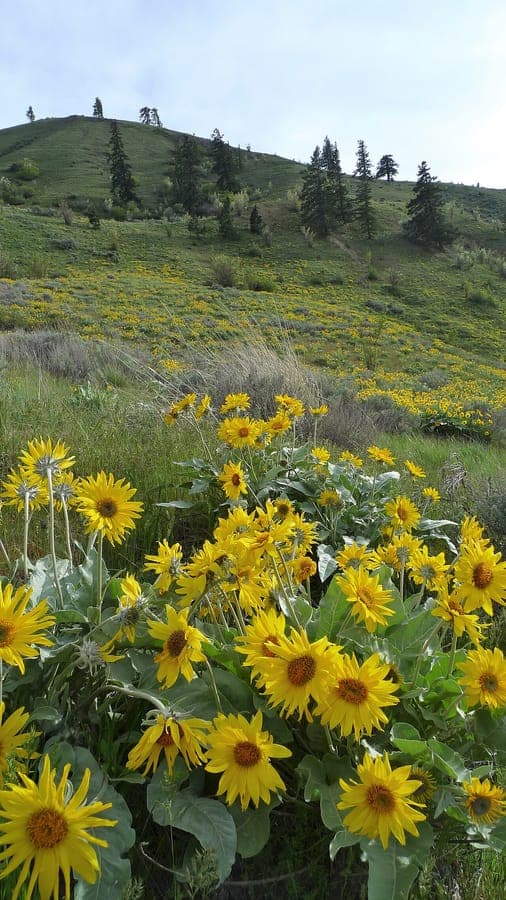
Thayne Tuason / CC BY-SA 4.0, via Wikimedia Commons
Arrowleaf balsamroot: complete guide
Balsamorhiza sagittata
Want to see Arrowleaf balsamroot: complete guide in your garden?
1 minute, no credit card
Overview
Arrowleaf balsamroot (Balsamorhiza sagittata) is one of the most spectacular drought-tolerant perennials from the western prairies and semi-arid mountain slopes of North America. A member of the daisy family (Asteraceae), it bears showy, sunflower-like golden-yellow blooms 5–8 cm across on stout stems above a rosette of large, silvery-grey, arrow-shaped leaves. In its native range - from British Columbia to California, Idaho to Montana and Nevada - it paints entire hillsides yellow in April and May, emerging as one of the earliest pollen sources for bees and butterflies following winter dormancy. Its common name refers to the arrow-shaped (sagittate) leaves and to the resinous taproot, which exudes a balsam-scented sap when damaged - a fragrance historically valued by indigenous peoples as a medicine and flavouring. On gardenworld.app it appears in xeriscape and low-water border designs where architectural, long-lived perennials are needed.
The plant is remarkably long-lived; established specimens of fifty years or more are documented in the wild. This longevity is matched by a deep taproot that may penetrate 1.5 to 2 metres into the soil, extracting moisture from deep subsoil layers long after surface soils have dried out completely. In European gardens it remains uncommon, but interest has grown considerably as dry summers make water-smart planting an urgent priority.
Appearance and bloom cycle
In its resting state, arrowleaf balsamroot forms a bold rosette of grey-green to silver-white leaves, each 20–50 cm long, with a deeply cordate to sagittate base. The leaf surface is densely covered with white, branched (candelabra) hairs that give it a felted, glistening appearance; these hairs reduce water loss by reflecting excess sunlight and trapping a layer of still air over the leaf surface. The texture is rough and papery to the touch. The overall effect in the garden is of a large-scale silver rosette that holds its decorative value even when the plant is not in flower.
Flowering occurs from April to June depending on elevation and local climate, typically three to four weeks earlier in lowland European gardens than in its high-altitude native habitat. Multiple flowering stems 30–70 cm tall emerge from the centre of the rosette, each terminating in a single composite flower head with 13–21 bright yellow ray florets and a dense yellow disc centre. The flowers are richly nectariferous and attract a wide range of pollinators. After pollination the ray florets drop and the disc sets small, oblong, brownish seeds - the achenes - that are dispersed by wind and seed-eating birds such as goldfinches and siskins. Leaving the seed heads standing through autumn and winter adds structural interest and provides food for these birds.
Ideal location
Arrowleaf balsamroot demands full sun throughout the day. Even light shade for more than three to four hours reduces flowering significantly and increases the risk of powdery mildew on the large hairy leaves. In its native habitat it occupies open, south-to-southwest-facing slopes that receive maximum sun exposure. In the garden, a warm south-facing border, a gravel garden or a raised dry bed suits it perfectly. Avoid low-lying areas where cold air pools in winter or where rainwater collects after storms; winter waterlogging is the main cause of failure in European cultivation.
Plant in groups of three to five for the most effective display, with 40–50 cm between individuals. As a specimen in a gravel mulch or cobble matrix it is extraordinarily effective, its silver rosette and golden flowers creating a focal point that needs no supporting cast. Do not move established plants; the deep taproot almost invariably snaps during transplanting and the plant rarely recovers.
Soil requirements
Poor to moderately fertile, sharply drained, slightly acid to slightly alkaline soil (pH 6.5–8.0) is ideal. Arrowleaf balsamroot actively dislikes rich, moisture-retentive soil; on fertile loam it produces excessive leafy growth with few flowers. On heavy clay soils, excavate the planting area to 40–50 cm depth and refill with a mixture of sharp sand, coarse grit and a small amount of compost in a ratio of roughly 6:3:1. Adding a 5 cm top-dressing of fine gravel improves drainage further and replicates the natural substrate of rocky, well-drained mountain soils with pH 6.5 to 8.
Fertilising is rarely beneficial and often detrimental. If the soil is very poor chalk or extremely acidic sand, a light application of potassium-rich fertiliser in spring - 20 g sulphate of potash per square metre - can improve flowering without stimulating excessive leafy growth. Nitrogen-rich feeds invariably produce floppy, over-vegetative plants with reduced flower numbers. A permanent gravel mulch 5 cm deep conserves moisture, prevents winter waterlogging of the crown and gives the planting a neat, purposeful appearance.
Free design
Want to see Arrowleaf balsamroot: complete guide in your garden? Make a free design now.
Watering
Once established - after two to three growing seasons - arrowleaf balsamroot requires virtually no supplementary watering in a typical western European climate receiving 600 mm or more of annual rainfall. The deep taproot accesses moisture from subsoil layers that surface irrigation never reaches. Young plants in their first year do require more attention: water weekly with 5–8 litres per plant during dry spells until the taproot reaches adequate depth. Overwatering of established plants is the most common cause of failure; the combination of warmth, high humidity and wet foliage triggers botrytis and crown rot. Always water at the base, never overhead.
In dry summers with less than 25 mm rainfall per month, a single deep watering every two to three weeks is sufficient for established plants. Drip irrigation laid just inside the outer margin of the rosette - not directly over the crown - is the most efficient delivery method. Gardenworld.app features drought-smart garden designs that demonstrate how balsamroot can anchor low-water borders alongside complementary species.
Pruning
Minimal maintenance is needed. After flowering in June–July, remove spent flower heads if you wish to tidy the planting and prevent excessive self-seeding. Alternatively, leave them standing through autumn as bird-feeding stations and structural interest. The leaf rosette remains decorative throughout the growing season and should not be cut back. In October–November, remove the dry, collapsed leaves from the previous season at ground level; this is aesthetically desirable but not strictly necessary, as the dead leaves provide some frost protection to the growing points at the centre of the rosette.
Never attempt to divide or transplant established clumps. The taproot is the plant's insurance policy and breaking it dooms the plant. Propagation is by seed only; sow fresh-harvested seed in September–October in small containers of gritty compost and overwinter in a cold frame, or sow directly into prepared sandy soil in the final planting position in autumn.
Maintenance calendar
January–February: dormancy; no action needed. March: first leaves of the rosette emerge; check gravel mulch is intact. April–May: full bloom; ideal time to sow saved seed from previous year. June: late blooms and seed set; seed heads decorative. July–August: seeds ripen; harvest if saving. September–October: sow fresh seed in containers or final position. November: remove dead leaves and flower stems at ground level. December: dormancy.
Winter hardiness
Arrowleaf balsamroot is reliably hardy to USDA zones 3–4, tolerating temperatures down to -34 to -40 °C. It overwinters without any protection throughout the Netherlands, Belgium, the United Kingdom and Germany. Its deep taproot insulates itself from even the hardest frosts. The main risk in temperate European climates is not cold but winter wet; ensure excellent drainage at the planting site. In regions with very high winter rainfall or heavy clay soils, a raised bed or slope position is strongly recommended.
Companion plants
Arrowleaf balsamroot combines beautifully with other drought-tolerant and prairie-inspired plants. In a gravel garden, pair it with blue oat grass (Helictochloa sempervirens), lamb's ears (Stachys byzantina 'Silver Carpet') and great mullein (Verbascum olympicum) for a silver and gold scheme. The warm yellow of the balsamroot blooms harmonises perfectly with the blue-purple spikes of salvia (Salvia nemorosa 'Caradonna'), the orange-brown tones of sneezeweed (Helenium 'Moerheim Beauty') and the silvery wands of white sage (Salvia apiana).
For a North American prairie planting, combine with coneflower (Echinacea purpurea or E. angustifolia), black-eyed Susan (Rudbeckia hirta), prairie clover (Dalea purpurea) and blue wild lupine (Lupinus perennis). In a Mediterranean-inspired dry garden, its silver rosette works superbly alongside lavender (Lavandula angustifolia 'Hidcote'), sun rose (Cistus × dansereaui) and sea lavender (Limonium latifolium). In the United Kingdom and northern Europe, specialist drought-tolerant nurseries and seed suppliers are the best source for this plant; it is rarely stocked at general garden centres. Visit gardenworld.app to explore how arrowleaf balsamroot can anchor a striking low-water border in your own garden design.
Closing thoughts
Arrowleaf balsamroot embodies a rare combination of wild, dramatic beauty and practical toughness that few perennials can match. Once its taproot is established, it will outlive its owner, asking almost nothing in return for a spectacular golden display each spring. It is a plant for the patient gardener - the first two seasons demand some care - but the reward is a companion for decades, becoming more impressive with every passing year.
Want to see Arrowleaf balsamroot: complete guide in your garden? Make a free design now.
Upload a photo, pick a style, and get a photorealistic design with plant list in under a minute.
10,000+ gardens designed already
No credit card required


Similar plants
Calendula stellata: complete guide
Calendula stellata
Complete guide to Calendula stellata, the star-flowered marigold from Sicily: location, soil, watering and companion planting tips.
Korean chrysanthemum: complete guide
Chrysanthemum x rubellum
Chrysanthemum x rubellum is a hardy autumn perennial with single pink to copper flowers from August to November. Care and combinations.
Helianthus divaricatus: complete guide
Helianthus divaricatus
Helianthus divaricatus is a North American woodland sunflower with yellow summer blooms, ideal for naturalistic borders and shady edges.