
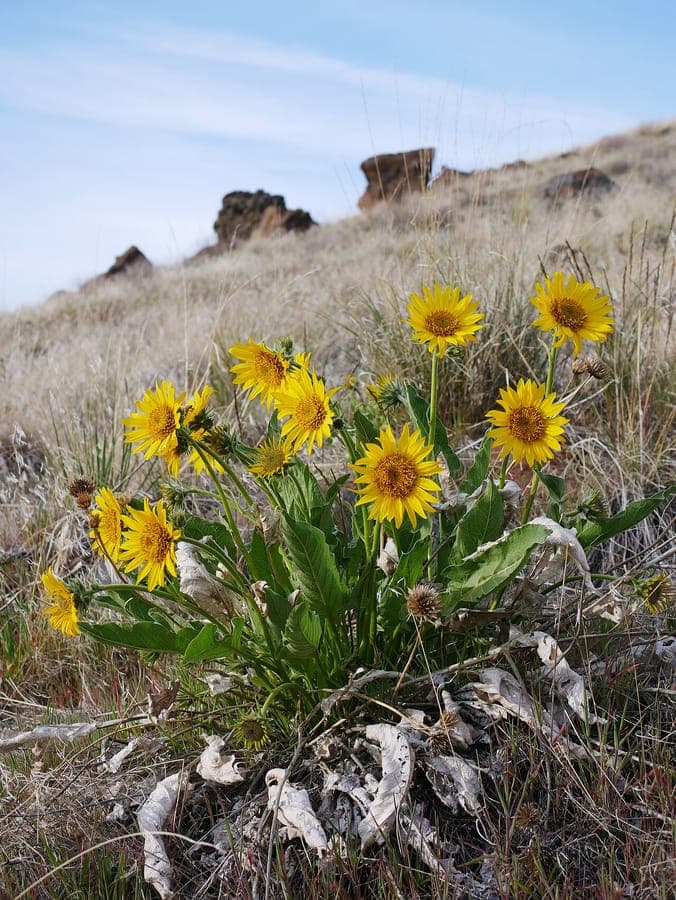
Thayne Tuason / CC BY 4.0, via Wikimedia Commons
Balsamorhiza careyana: complete guide
Balsamorhiza careyana
Want to see Balsamorhiza careyana: complete guide in your garden?
1 minute, no credit card
Overview
Balsamorhiza careyana, first described by the botanist Asa Gray in 1849, is a member of the Asteraceae family and belongs to the balsamroot genus native to the Pacific Northwest of North America. Its natural range covers Oregon and Washington, where it grows on rocky grasslands, open pine forests, and dry south-facing slopes. The species name honours John Carey (1797–1880), a contemporary of Gray who contributed substantially to early knowledge of North American flora.
The genus name Balsamorhiza derives from the Greek for balsam-root, a reference to the resinous, aromatic smell of the thick taproot. Various Indigenous peoples of the Pacific Northwest made extensive use of these plants: seeds and young shoots were eaten raw or cooked, root bark was prepared as a medicinal preparation, and the resin was applied to seal wounds and waterproof containers. While Balsamorhiza careyana is less widely studied than the more common Balsamorhiza sagittata, it shares the same ecological niche and horticultural requirements, making knowledge of the latter fully applicable to cultivation of the former.
As interest in drought-resilient and wildlife-friendly planting continues to grow, Balsamorhiza careyana deserves far greater recognition in the gardening world. Specialist native plant nurseries and some larger garden centres now offer plants, and seeds can be obtained from seed exchanges, making this remarkable perennial accessible to gardeners across temperate climates.
Appearance and bloom cycle
Balsamorhiza careyana forms a low, dense basal rosette of large, broadly ovate to triangular-lanceolate leaves that can reach 40 cm in length. The foliage is grey-green and slightly rough to the touch due to fine surface hairs, giving the plant a soft, almost silvery appearance that contrasts beautifully with the vivid yellow blooms. In spring, sturdy flower stems rise 30 to 60 cm above the rosette, each bearing a single large composite flower head measuring 6 to 10 cm across. Both the ray and disc florets are a deep, rich golden yellow, lending the plant a strong resemblance to a scaled-down sunflower.
Blooming typically begins in April and extends through June, with timing varying by elevation: plants at lower altitudes can open as early as mid-March, while those at higher elevations may not peak until July. After flowering, small triangular achenes develop and are dispersed by wind and small mammals. The foliage persists through summer but slowly yellows as drought intensifies; by autumn the above-ground portion largely dies back, and the plant overwinters via its substantial fleshy taproot, which can extend 60 to 90 cm into the soil.
A notable characteristic of the genus is the extraordinary longevity of individual plants: established specimens can live for many decades, with the taproot gradually expanding in girth and giving rise to ever-more-impressive displays of flowering stems. Older plants may produce twenty or more flower stems in a single season, creating a spectacular mass of golden colour in late spring. This characteristic makes Balsamorhiza careyana a long-term investment that rewards patient gardeners handsomely.
Ideal location
Full sun is the non-negotiable requirement for Balsamorhiza careyana. South- or south-west-facing positions are ideal, as the plant has evolved in habitats receiving intense direct sunlight for most of the day. Partial shade is tolerated but results in noticeably reduced flowering and a tendency for the plant to produce more foliage at the expense of blooms. Adequate air circulation is also beneficial, helping to prevent the fungal problems that can arise if moisture lingers around the crown.
In the garden, this plant excels in prairie-style borders, rock gardens, dry banks, and gravel gardens where irrigation is minimal. It integrates beautifully with ornamental grasses, drought-adapted perennials, and native wildflowers to create a naturalistic planting that needs little maintenance. Spacing should be generous - 60 to 90 cm between plants - to allow the broad foliage rosettes to develop fully without crowding. The plant is also well-suited to slopes and terracing, where its deep taproot helps stabilise the soil and its cascading foliage can be appreciated from below.
Soil requirements
Balsamorhiza careyana demands well-drained, lean soil with a pH in the range of 6.6 to 9.0. Heavy clay soils are unsuitable because they retain moisture, which leads to crown and root rot - the most common cause of failure with this species. Sandy, gravelly, or stony soils approximate the plant's native habitat most closely and are ideal.
In average garden soil, drainage can be significantly improved by mixing in 30 to 50% coarse grit or fine gravel at planting time. Raised beds are an excellent option for gardens with heavy soil, as they provide both the necessary drainage and the elevated position that keeps water away from the crown. Nutrient levels should be kept low: excess nitrogen causes lush, floppy growth, reduced flowering, and shortened plant life. No fertiliser is needed or desirable once the plant is established. A top-dressing of fine gravel or granite grit around the crown area serves a dual purpose: it improves drainage, keeps the crown drier, and provides an aesthetically attractive mulch in keeping with the plant's rocky, open-habitat origins.
Free design
Want to see Balsamorhiza careyana: complete guide in your garden? Make a free design now.
Watering
Once established, Balsamorhiza careyana is among the most drought-tolerant perennials available to temperate gardeners. In its natural Pacific Northwest habitat, the plant regularly endures summer droughts lasting four to six months, surviving on moisture stored in its deep taproot. In a garden context, supplemental irrigation is only truly necessary during the first growing season after planting, when the root system is still becoming established.
During the first year, deep watering once every two weeks is recommended - meaning infrequent but thorough saturation that drives moisture 40 to 50 cm into the soil, encouraging the plant to root deeply rather than shallowly. From the second year onward, rainfall alone is sufficient in most temperate climates. During exceptional summer droughts, a single deep watering per month can help maintain vigour and improve the following season's flower display. Overwatering is harmful and can quickly kill an otherwise healthy plant; standing water around the crown or in the root zone is invariably fatal.
Cutting back
Maintenance cuts for Balsamorhiza careyana are minimal. After flowering, the dried flower stems can be cut back to 5 to 10 cm above ground if a tidier appearance is desired, but this is purely cosmetic. If seed collection is intended for propagation, the stems should be left standing until the seed heads are fully ripe - recognisable by the browning and partial opening of the achenes.
The basal rosette does not need to be cut back in autumn. The ageing, yellowing leaves act as a natural mulch protecting the taproot crown through winter. If a cleaner appearance is required, old foliage can be removed in early spring before new growth emerges. Young plants less than two years old are best left entirely uncut, as any root disturbance or crown damage at this stage can set back establishment significantly. gardenworld.app features design examples of this species in low-maintenance prairie borders where minimal cutting is part of the intentional aesthetic.
Maintenance calendar
January–February: Dormancy. No action required. The taproot overwinters safely underground.
March: Watch for the first new shoots emerging from the crown. Remove any remaining dead foliage from the previous year if desired.
April–June: Flowering season. The golden flower heads appear in succession. Bees, bumblebees, and hoverflies visit the blooms regularly - a significant wildlife benefit.
July–August: Post-bloom period. Cut spent stems or leave them for seed development. Reduce or eliminate supplemental watering completely.
September–October: Seeds ripen and self-sow sparingly. Collect ripe seeds for deliberate propagation if desired.
November–December: The plant enters full dormancy. No feeding, no cutting back needed.
Winter hardiness
Balsamorhiza careyana is a fully winter-hardy perennial rated to USDA hardiness zone 4, tolerating temperatures down to approximately -30°C. In practice, the plant can be grown without any protection throughout most of temperate Europe, including the UK, the Netherlands, Belgium, and Germany. The limiting factor in these climates is not cold but excessive winter wetness: the fleshy taproot is vulnerable to rot in waterlogged conditions.
Gardeners with heavy or moisture-retentive soils should either plant on a raised bed or mound, or incorporate a 20 cm layer of coarse gravel beneath the root zone at planting to prevent water from pooling around the crown. Newly planted specimens in their first winter benefit from a light collar of dry straw or pine bark around the crown to buffer temperature fluctuations and wick excess moisture. Established plants are fully self-sufficient through winter and need no further intervention.
Companion plants
Balsamorhiza careyana is a natural fit for any dry, sunny planting scheme that values ecological richness and visual drama. The following companions share its cultural requirements and create a coherent, season-long display:
Penstemon digitalis 'Husker Red' (50–80 cm): white flower spikes with deep burgundy foliage, blooming from June to August, excellent for pollinators.
Achillea millefolium (40–60 cm): flat-topped flower clusters in white, pink, or red, superb for bees and hoverflies, tolerates the driest conditions with ease.
Salvia nemorosa 'Caradonna' (40–60 cm): deep violet-blue spikes from May to September, long-flowering and very low-maintenance.
Echinacea purpurea (60–120 cm): warm pink-purple flowers from July to September, beloved by butterflies and bees, followed by architectural seed heads.
Eryngium planum (50–80 cm): steel-blue spiky flower heads that add structural contrast, extremely drought-tolerant.
Stipa tenuissima (30–60 cm): feathery, wind-responsive ornamental grass that adds movement and softness between the bold perennials.
This combination delivers colour and texture from April through October and is entirely self-sustaining once established. gardenworld.app offers design tools to plan and visualise this type of naturalistic, drought-adapted border for your own garden situation.
Closing
Balsamorhiza careyana is an underappreciated gem of the perennial world that richly deserves a place in more gardens. Its spectacular golden flowers, silvery drought-resistant foliage, extraordinary longevity, and ecological value for pollinators make it an ideal candidate for any sunny, well-drained position. With minimal maintenance requirements and exceptional cold hardiness to zone 4, it offers a superb return on a very modest investment of time and attention.
The key to success with this plant is straightforward: lean, well-drained soil, full sun, and restraint with irrigation. Provide these conditions and Balsamorhiza careyana will reward you with decades of breathtaking spring colour, deepening in impact with every passing year as the taproot and crown expand and the number of flowering stems multiplies season by season.
Want to see Balsamorhiza careyana: complete guide in your garden? Make a free design now.
Upload a photo, pick a style, and get a photorealistic design with plant list in under a minute.
10,000+ gardens designed already
No credit card required


Similar plants
Calendula stellata: complete guide
Calendula stellata
Complete guide to Calendula stellata, the star-flowered marigold from Sicily: location, soil, watering and companion planting tips.
Korean chrysanthemum: complete guide
Chrysanthemum x rubellum
Chrysanthemum x rubellum is a hardy autumn perennial with single pink to copper flowers from August to November. Care and combinations.
Helianthus divaricatus: complete guide
Helianthus divaricatus
Helianthus divaricatus is a North American woodland sunflower with yellow summer blooms, ideal for naturalistic borders and shady edges.