
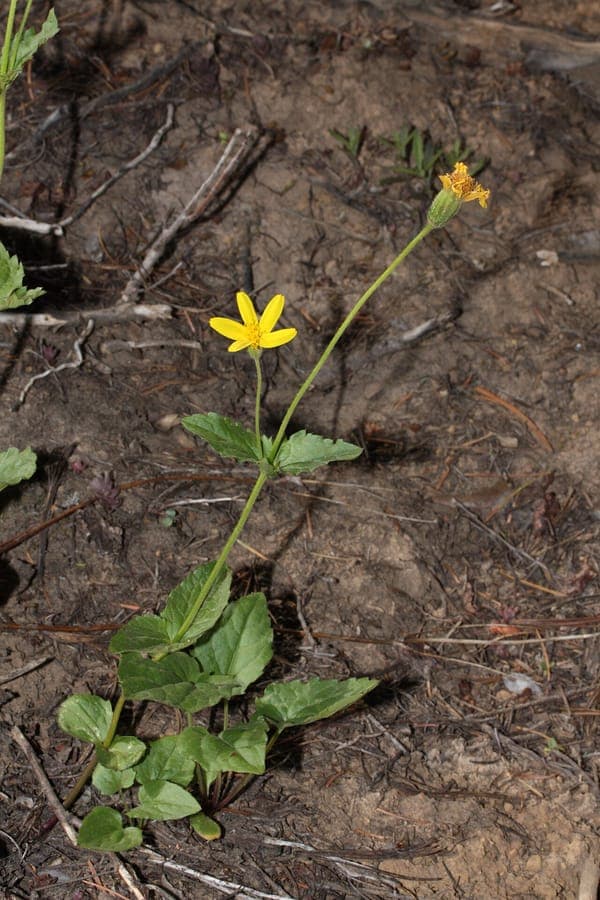
Walter Siegmund (talk) / CC BY-SA 3.0, via Wikimedia Commons
Broadleaf arnica: complete guide
Arnica latifolia
Want to see Broadleaf arnica: complete guide in your garden?
1 minute, no credit card
Overview
Broadleaf arnica (Arnica latifolia) is a herbaceous perennial in the Asteraceae family, first formally described by the Russian botanist August von Bongard in 1832. The species name 'latifolia' means 'broad-leaved', and refers to the notably wide, egg-shaped leaves that immediately distinguish this species from narrow-leaved relatives like Arnica fulgens. In the wild, broadleaf arnica ranges from Alaska and the Yukon in subarctic North America down through the mountain slopes and woodland edges of Washington, Oregon, Montana, Idaho, Wyoming, Colorado, Utah, and California.
In the garden, Arnica latifolia is less widely known than its European relative Arnica montana, but it deserves much wider cultivation. As an ornamental perennial, it offers large, bright golden-yellow flower heads that enliven the border from May through August, exceptional cold-hardiness down to USDA zone 3, and a tolerance for partial shade that makes it particularly valuable in the more challenging corners of the garden. Unlike the spreading Arnica cordifolia and Arnica fulgens, broadleaf arnica grows from a single crown rather than rhizomes, forming a neat clump that does not spread invasively.
On gardenworld.app you can generate garden designs that incorporate shade-tolerant flowering perennials like Arnica latifolia into borders, woodland-edge plantings, and mountain garden styles, combining their structural qualities with seasonal colour interest.
In the botanical literature, the species carries a wide synonym list reflecting its broad morphological range: Arnica menziesii (Hook.), Arnica grandifolia (Greene), Arnica intermedia (Howell ex Rydb.), Arnica latifolia var. teucriifolia, and several others have all been applied to plants now consolidated under the accepted name Arnica latifolia.
Appearance & bloom cycle
Arnica latifolia grows 20 to 60 cm tall, depending on site conditions. The stems are upright, lightly hairy, and carry 2 to 3 pairs of opposite leaves. The leaves are the most distinctive feature of this species: broadly ovate to oval, with toothed margins, noticeably larger and wider than those of other Arnica species. The leaf texture is medium-fine, neither rough nor silky. The leaves are sessile - attached directly to the stem without a stalk - giving the plant a full, compact appearance.
Flowering runs from May through August, with peak intensity in June and July. Each flower head is 4 to 7 cm across, bearing 8 to 14 bright golden-yellow ray florets surrounding a dense central disc. The flower colour is a warm, clean gold-yellow that stands out clearly in partially shaded settings where other bright colours can appear washed out. The flower heads are carried on long, slender stems that rise above the leaf mass.
After blooming, wind-dispersed achene fruits develop with white feathery pappus. Above-ground parts die back in autumn. Unlike rhizomatous species, Arnica latifolia forms a single crown, so it does not creep outward - the same clump returns each spring from the same root system.
Ideal location
Arnica latifolia thrives in semi-sunny to partially shaded positions. In its mountain habitat, it grows at open woodland edges, forest clearings, and alongside mountain streams, where it enjoys the shelter of light tree canopy combined with generous indirect light. In the ornamental garden, a position with morning sun and afternoon shade is ideal - conditions found naturally beneath a light-crowned tree such as a birch or alder.
The plant is particularly well suited to rock gardens with partial shade, naturalistic borders at the edge of small tree groups, and woodland-edge plantings. Avoid deep permanent shade, where flowering becomes sparse and the plant can weaken. A light, open canopy or the north-facing side of taller plantings are ideal positions.
Plant at 30 to 40 cm spacing. Because Arnica latifolia grows from a single crown without spreading rhizomes, it requires modest space and is not competitive toward neighbouring plants - a valuable quality in a mixed planting where careful arrangement matters.
Soil requirements
In its natural habitat, Arnica latifolia grows on humus-rich mountain soils and forest floor with a pH between 6.0 and 7.2. This narrower pH range - compared to Arnica fulgens which tolerates up to pH 9.0 - indicates a clear preference for slightly acid to neutral soils. The species does not perform well on strongly alkaline or calcareous soils.
In the garden, broadleaf arnica does best on well-drained, lightly humus-rich soil of moderate fertility. Work 5 to 7 cm of well-rotted compost or leaf mould into the upper soil layer before planting, to improve water retention and soil structure without adding excessive nutrients. Overly fertile soil encourages lush leaf growth at the expense of flowering. On heavy clay, improving drainage with coarse grit or horticultural sand before planting is essential, as waterlogging around the crown causes root rot.
Soils enriched with pine needle litter, oak leaf compost, or other naturally acidic organic matter are particularly suitable and reflect the plant's native forest floor preferences. Specialist heathland or woodland planting composts, available at most garden centres, provide the right acidity and structure for Arnica latifolia.
Free design
Want to see Broadleaf arnica: complete guide in your garden? Make a free design now.
Watering
Arnica latifolia comes from mountain regions with a temperate to subalpine rainfall pattern. In cultivation it needs regular watering during the active growing season but cannot tolerate waterlogging. The soil may partially dry between waterings, but should not reach the point of complete desiccation.
Once-weekly deep watering is sufficient under normal conditions. In exceptionally dry periods, twice a week may be needed - but always check soil moisture by inserting a finger 5 cm deep before watering. If the soil still feels moist at that depth, wait before the next session. Water in the early morning when possible to allow foliage to dry during the day and minimise the risk of fungal disease.
In winter, supplementary watering is rarely needed. Applying a mulch layer of leaves or wood chips in autumn helps retain soil moisture and stabilise soil temperature through the cold season.
Pruning
Broadleaf arnica requires very little cutting work. In early spring, as the first new shoots become visible, remove the previous season's dried stems by cutting them to ground level. This clears the planting and gives fresh growth unobstructed space and light.
If self-seeding is welcome, leave the spent flower heads to ripen until the feathery pappus unfolds and the wind carries the seeds away. To limit spread, cut the flower stems immediately after blooming. Because Arnica latifolia does not spread by rhizomes, seed dispersal is its primary means of spreading, and careful management makes it easy to keep the plant in its designated space.
For a neater appearance in formal or semi-formal borders, cut all above-ground plant parts back to a few centimetres above soil level in mid-autumn. This encourages compact clump formation and reduces the build-up of dead material.
Maintenance calendar
January - February: No maintenance needed. Leave mulch in place. Check that drainage is functioning and no waterlogging is occurring around the crown.
March: Partially remove mulch to allow the soil to warm. Cut dried stems to ground level. First new shoots should appear.
April: Monitor growth. Apply a light compost dressing if the soil is poor. Plant new specimens at 30-40 cm spacing.
May - June: Flowering begins. Water as needed. Remove weeds around plants. Apply a thin mulch layer (3-5 cm) to retain moisture.
July - August: Peak flowering. In hot, dry spells, water regularly. Monitor for powdery mildew or aphid attack.
September: Flowering subsides. Allow flower heads to ripen for seed dispersal, or remove them for tidiness.
October - November: Plant dies back above ground. Cut stems. Apply a 5-8 cm mulch layer of leaf litter or chipped bark.
December: Dormant period. No maintenance required.
Winter hardiness
Arnica latifolia is an outstandingly cold-hardy species. Its native range extends into subarctic regions such as Alaska and the Yukon, where temperatures of -30 °C and below are not uncommon. Rated for USDA hardiness zones 3 to 8, it overwinters without any supplementary protection across the entire area of the Netherlands, Belgium, northern France, and Germany, including the coldest inland areas and elevated garden positions.
In coastal locations with mild but wet winters, well-drained soil is the critical factor for successful overwintering: the plant tolerates frost and freezing periods well, but is sensitive to persistent waterlogging around the crown, which can cause root rot. A light mulch of dry leaves or straw around (but not directly on) the crown provides extra protection and stabilises the soil temperature during frequent freeze-thaw cycles.
In containers, additional frost protection is needed during severe cold snaps. Move the pot to a sheltered, cool but frost-free space, or wrap the pot and rootball in hessian and bubble wrap. Remove protection gradually in spring once overnight temperatures consistently stay above -5 °C.
Companion plants
The rustic, naturalistic character of Arnica latifolia makes it an excellent companion for partially shaded borders and mountain garden-style plantings. The following plant combinations work particularly well:
Ferns: Dryopteris filix-mas (male fern) and Athyrium filix-femina (lady fern) offer beautiful structural contrast alongside the broad leaves and golden flowers of Arnica latifolia. Ferns share the same preference for lightly acid, humus-rich soil and partial shade.
Meconopsis (blue poppy): Meconopsis betonicifolia is a specialised combination for experienced gardeners aiming for an alpine aesthetic. The blue flowers create a striking colour contrast with the yellow of Arnica - highly eye-catching in a shaded border.
Hosta: Broad-leaved hosta varieties make excellent companions for Arnica latifolia in partial shade. The interplay between wide blue-green hosta leaves and the bright golden Arnica flowers is harmonious and attractive throughout summer.
Astilbe: The feathery purple or white flower plumes of Astilbe x arendsii bloom concurrently with Arnica latifolia and share a preference for moisture-retentive, humus-rich soil in partial shade. Together they create a rich, layered woodland-edge display.
Trollius (globeflower): Trollius europaeus echoes the warm yellow flower colour of Arnica latifolia in a different flower form, creating a warm, coherent colour atmosphere in the border during June and July.
Explore the best plant combinations and generate your own personalised garden design at gardenworld.app.
Closing
Arnica latifolia is a versatile and exceptionally cold-hardy perennial that combines broad-leaved elegance with vivid golden flowers and remarkable adaptability to partially shaded conditions. Whether you are building a naturalistic mountain-inspired planting, creating a flowering woodland-edge border, or simply filling a specific shaded corner of your front garden with seasonal colour, broadleaf arnica is a robust, dependable choice that delivers year after year with minimal care.
Want to see Broadleaf arnica: complete guide in your garden? Make a free design now.
Upload a photo, pick a style, and get a photorealistic design with plant list in under a minute.
10,000+ gardens designed already
No credit card required


Similar plants
Calendula stellata: complete guide
Calendula stellata
Complete guide to Calendula stellata, the star-flowered marigold from Sicily: location, soil, watering and companion planting tips.
Korean chrysanthemum: complete guide
Chrysanthemum x rubellum
Chrysanthemum x rubellum is a hardy autumn perennial with single pink to copper flowers from August to November. Care and combinations.
Helianthus divaricatus: complete guide
Helianthus divaricatus
Helianthus divaricatus is a North American woodland sunflower with yellow summer blooms, ideal for naturalistic borders and shady edges.