
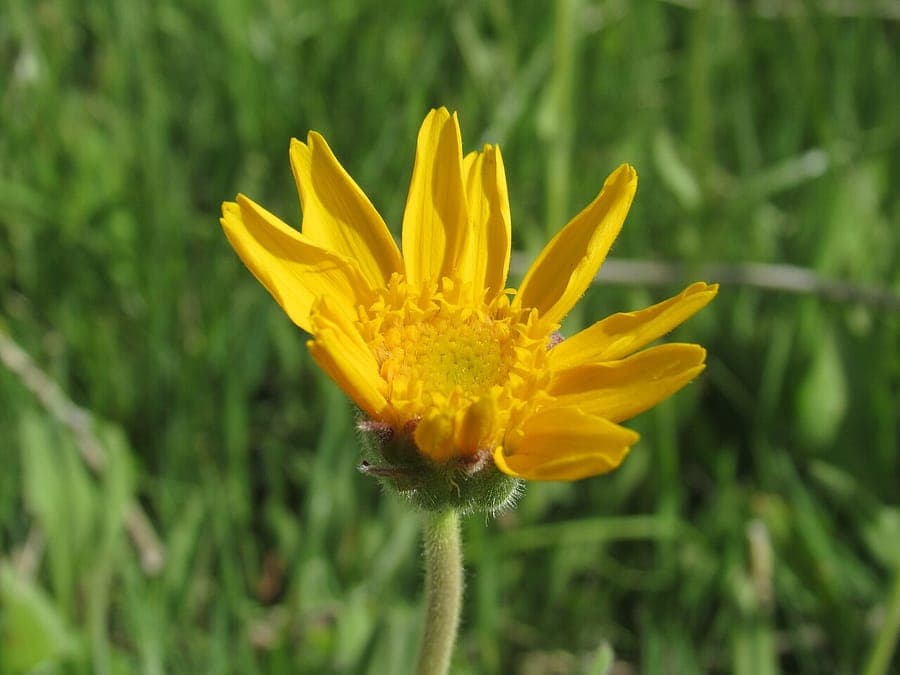
(c) Anders Hastings, some rights reserved (CC BY) / CC BY 4.0, via Wikimedia Commons
Foothill arnica: complete guide
Arnica fulgens
Want to see Foothill arnica: complete guide in your garden?
1 minute, no credit card
Overview
Foothill arnica (Arnica fulgens) is a rhizomatous perennial herb in the Asteraceae family, first described by Frederick Pursh in 1813. The species epithet 'fulgens' means 'shining' or 'gleaming' - a reference to the brilliantly coloured golden-orange flower heads that catch the eye on dry hillsides and open meadows. Common names include hillside arnica, shining arnica, and orange arnica. In the wild, it ranges across western and central Canada and the western United States: Alberta, British Columbia, Montana, North Dakota, South Dakota, Wyoming, Colorado, Idaho, Oregon, and Nevada all fall within its native distribution.
In the garden, Arnica fulgens is a rewarding choice for hot, dry spots where many ornamental perennials struggle. It tolerates drought, alkaline conditions, and poor soils with ease, and rewards even minimal care with a generous display of golden-yellow flower heads from May through August. Its rhizomatous spreading habit means it builds a weed-suppressing groundcover over time, making it both beautiful and functional in a low-maintenance border design.
Foothill arnica is closely related to Arnica montana - the well-known medicinal mountain arnica of European tradition - and was historically classified as Arnica montana var. fulgens. It is now treated as a distinct species in its own right, distinguished by its narrower lance-shaped leaves with three distinct veins (reflected in the synonym Arnica trinervata).
On gardenworld.app you can generate custom garden designs that incorporate drought-tolerant flowering perennials like Arnica fulgens into structured borders, prairie-style plantings, and front garden schemes.
Appearance & bloom cycle
Arnica fulgens grows 30 to 60 cm tall, with height varying according to moisture availability and soil fertility. The stems are upright, slightly sticky-hairy, and carry 2 to 3 pairs of opposite, lance-shaped to elliptic leaves with a smooth to lightly hairy surface and a characteristic three-veined pattern. The foliage has a mild aromatic quality when handled.
Flowering runs from May through August, peaking in June and early July. Each flower head measures 5 to 8 cm across, bearing 8 to 15 ray florets in a warm golden-orange-yellow around a dense central disc of tubular florets. The colour is distinctly warmer and more saturated than Arnica cordifolia - closer to orange-gold than pure yellow - which explains the common name 'orange arnica'. Each stem carries a single flower head, giving the plant a clean, uncluttered elegance in the border.
After flowering, small achene fruits develop with white feathery pappus for wind dispersal. The plant spreads laterally via rhizomes at a moderate rate, more slowly on poor dry soils and more readily on moister, richer ground.
Ideal location
Foothill arnica thrives in full sun to partial shade. In its native range it colonises open, sun-baked dry grasslands and light woodland edges - habitats that translate well into south-facing or west-facing borders, open prairie plantings, heath gardens, and rock gardens. A minimum of six hours of direct sun per day produces the richest flowering. In hotter, drier garden conditions such as against a warm south-facing wall, the plant can still perform well provided some water is available.
Avoid deep or permanent shade, which leads to weak, sparse flowering and increased susceptibility to powdery mildew. The plant is an excellent candidate for a naturalistic dry meadow planting, a wildlife-friendly front garden, or an exposed slope where other perennials find conditions too harsh.
Plant at a spacing of 30 to 40 cm between individuals to allow each plant room to develop its rhizome system. Newly planted specimens need one full growing season to become well established before they reach their full flowering potential.
Soil requirements
Arnica fulgens is notably adaptable in terms of soil chemistry: the species data records a pH range of 6.2 to 9.0, making it one of the more alkaline-tolerant members of its genus. This broad pH tolerance means it performs well on chalk, limestone, or calcareous clay soils that would challenge many other perennials.
The plant prefers lightly to moderately fertile, well-drained soils. Rich, heavy soils encourage excessive leafy growth at the expense of flowers. On sandy or gravelly, nutrient-poor soils it excels without amendment; if you wish to improve structure, a thin layer of well-rotted compost (3 to 5 cm) at planting time is sufficient without adding excessive nutrients.
On heavy clay, improving drainage with coarse grit or horticultural sand before planting is essential: waterlogging damages the rhizomes and promotes root rot, which is the most common cause of failure with this species. In containers, a mix of general-purpose compost and coarse sand or perlite (2:1) works well. Specialist cactus and succulent compost, widely available at garden centres, is another excellent option for its superior drainage characteristics.
Free design
Want to see Foothill arnica: complete guide in your garden? Make a free design now.
Watering
As a native of dry, open grasslands in a semi-arid to subalpine climate, foothill arnica has excellent drought tolerance. In cultivation it needs regular watering during the active growing season, but manages dry spells with considerably more resilience than most ornamental perennials.
Watering once a week is generally sufficient in normal summer conditions; twice a week may be needed during exceptional heat or prolonged dry spells. Always water deeply to moisten the full root zone, then allow the soil surface to dry before the next session. Standing water and persistently wet conditions are detrimental: the rhizomes are vulnerable to rot when the soil remains waterlogged for extended periods.
In winter, supplementary watering is rarely needed in temperate climates. Water in the early morning when possible, allowing foliage to dry during the day to reduce fungal disease risk. A mulch layer applied in autumn helps retain soil moisture through warm summer periods and reduces the frequency of irrigation needed.
Pruning
Arnica fulgens requires minimal cutting back. In early spring, once new shoots begin to emerge (usually March or April), cut the previous year's dried stems to ground level. This clears the way for fresh growth and removes overwintered plant material that can harbour fungal spores.
After flowering, remove the spent flower stems if you wish to prevent self-seeding, cutting as soon as the flowers fade but before the feathery seed heads ripen. If naturalising is welcome in your garden, leave the seed heads to disperse. Note that the plant also spreads by rhizomes regardless of whether seeds are allowed to set.
For a tidier appearance in formal or semi-formal borders, cut all above-ground growth back to a few centimetres in mid-autumn. This encourages a compact clump form the following year and reduces the accumulation of dead material over winter.
Maintenance calendar
January - February: No active maintenance. Leave mulch in place. Ensure drainage is functioning and no waterlogging is occurring.
March: Partially remove mulch to allow soil to warm. Cut previous year's stems to ground level. First new shoots should emerge.
April: Monitor growth. Apply a light compost dressing if the soil is very poor. Plant new specimens or divisions at 30-40 cm spacing.
May - June: Flowering begins. Water as needed. Remove weeds from around plants. Apply a thin mulch layer (3-5 cm) to retain moisture.
July - August: Peak flowering. Monitor for drought stress in very hot spells; water accordingly. Watch for powdery mildew in humid conditions.
September: Flowering winds down. Allow seed heads to ripen naturally or cut them for tidiness.
October - November: Plant dies back. Cut stems to ground level. Apply a 5-8 cm mulch layer of leaf litter or chipped bark.
December: Dormant period. No maintenance required.
Winter hardiness
Arnica fulgens is a highly cold-hardy species, surviving the severe continental winters of northern Canada and the Great Plains where temperatures regularly drop well below -20 °C. It is suited to USDA hardiness zones 3 to 7, encompassing the full range of climates across the Netherlands, Belgium, northern France, and Germany without any supplementary protection.
In regions with mild but persistently wet winters, ensuring well-drained soil is the single most important measure for successful overwintering: Arnica fulgens tolerates extreme cold far better than prolonged wet conditions. A light mulch of dry leaves or straw around the root zone provides a useful buffer against the freeze-thaw cycles that can heave shallow rhizomes out of the ground in variable winter weather.
In containers, the pot can freeze solid if left exposed. Move to a cool, frost-free location or wrap pot and rootball in hessian and bubble wrap. Gradually remove protection in spring once overnight temperatures are consistently staying above -5 °C.
Companion plants
The sunny, open character of Arnica fulgens pairs beautifully with other drought-tolerant perennials, grasses, and grassland wildflowers. The following combinations are particularly effective in practice:
Ornamental grasses: Stipa tenuissima (Mexican feather grass), Festuca glauca (blue fescue), and Helictochloa sempervirens combine wonderfully with Arnica fulgens. The grasses provide movement and textural contrast while Arnica supplies the vivid golden colour accent.
Echinacea (coneflower): Echinacea purpurea flowers slightly later than Arnica fulgens, providing a seamless seasonal handoff from golden yellow to pink-purple tones across the summer border.
Salvia (sage): Salvia nemorosa 'Caradonna' and 'East Friesland' pair their blue-purple flower spikes magnificently with the yellow of Arnica. The colour contrast is lively without being jarring.
Penstemon: Penstemon digitalis or P. strictus adds blue and white tones and flowers concurrently with foothill arnica, creating a varied, wildlife-friendly display.
Achillea (yarrow): Achillea millefolium in white or pale pink shades, and the yellow cultivar 'Coronation Gold', echo Arnica's golden tone in a complementary, airy flower form that pollinators love.
Visit gardenworld.app to explore these combinations visually and generate a personalised garden design that places foothill arnica at the heart of a vibrant, low-maintenance border.
Closing
Arnica fulgens is an underappreciated gem for the sunny, dry border. Its intense golden flowers illuminate the planting from May through August, its exceptional drought tolerance makes it perfectly suited to climate-resilient garden designs, and its high cold-hardiness ensures it returns faithfully season after season. For gardeners seeking a low-maintenance, pollinator-friendly perennial that thrives on poor, dry soils where others fail, foothill arnica is a truly dependable choice.
Want to see Foothill arnica: complete guide in your garden? Make a free design now.
Upload a photo, pick a style, and get a photorealistic design with plant list in under a minute.
10,000+ gardens designed already
No credit card required


Similar plants
Calendula stellata: complete guide
Calendula stellata
Complete guide to Calendula stellata, the star-flowered marigold from Sicily: location, soil, watering and companion planting tips.
Korean chrysanthemum: complete guide
Chrysanthemum x rubellum
Chrysanthemum x rubellum is a hardy autumn perennial with single pink to copper flowers from August to November. Care and combinations.
Helianthus divaricatus: complete guide
Helianthus divaricatus
Helianthus divaricatus is a North American woodland sunflower with yellow summer blooms, ideal for naturalistic borders and shady edges.