
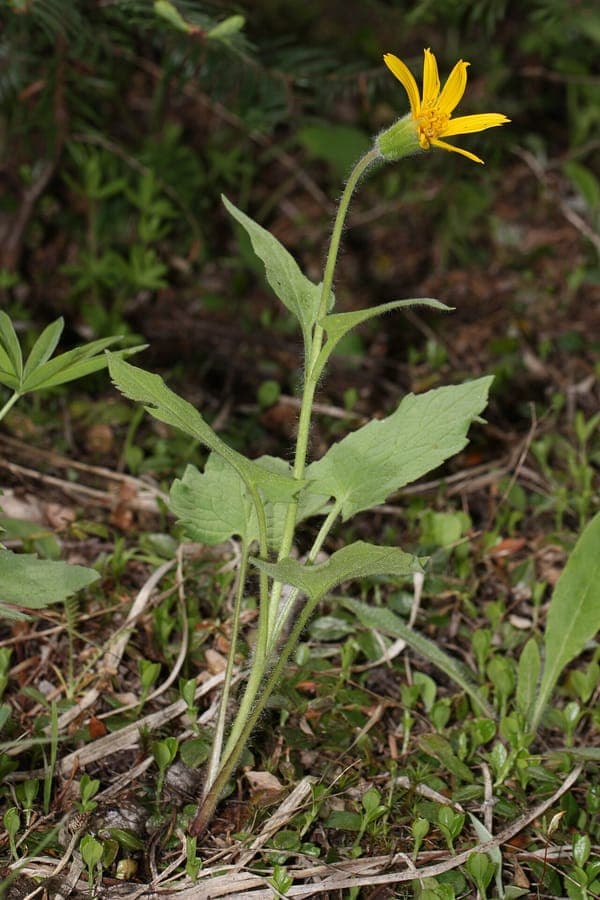
Walter Siegmund (talk) / CC BY-SA 3.0, via Wikimedia Commons
Heart-leaf arnica: complete guide
Arnica cordifolia
Want to see Heart-leaf arnica: complete guide in your garden?
1 minute, no credit card
Overview
Heart-leaf arnica (Arnica cordifolia) is a rhizomatous perennial herb in the Asteraceae family, first formally described by William Jackson Hooker in 1834. The species epithet 'cordifolia' - meaning heart-leaved - refers to the distinctively heart-shaped basal leaves that set this species apart from other members of the Arnica genus. In the wild, it ranges across subarctic North America down through the western and west-central United States, growing naturally in Alberta, British Columbia, Montana, Wyoming, Colorado, Idaho, Washington, Oregon, and many other states and provinces.
In garden settings, Arnica cordifolia offers a naturalistic, bright-yellow presence that resembles small sunflowers. The plant spreads slowly via underground rhizomes, forming gradual colonies that work well as groundcover beneath light tree canopy or along woodland-edge plantings. Its rapid growth rate means it establishes quickly after planting and begins producing its cheerful golden flowers within its first full growing season.
This species is valued for its toughness: it tolerates dry spells, poor soils, and hard winters better than many ornamental perennials. It asks for little fertiliser and grows happily on lean, well-drained soils - qualities that make it an environmentally friendly, low-maintenance choice for modern gardens seeking to reduce chemical inputs and irrigation.
On gardenworld.app you can generate garden designs that incorporate flowering perennials like Arnica cordifolia into structured borders, naturalistic plantings, and front garden schemes.
Appearance & bloom cycle
Arnica cordifolia typically grows 20 to 50 cm tall, depending on moisture and light availability. The stems are upright, lightly hairy, and bear pairs of heart-shaped basal leaves with coarsely toothed margins. The leaf surface has a slightly rough texture from fine hairs, and the foliage has a faint, pleasant aromatic scent when crushed.
Flowering runs from May through August, peaking in June and July. Each flower head is 4 to 7 cm in diameter and carries 8 to 14 bright yellow ray florets surrounding a dense central disc of tubular yellow florets. The colour is a clean, warm golden-yellow - vivid but not garish - that reads well from a distance in borders or naturalistic plantings.
After flowering, small achene fruits develop, each topped with a feathery white pappus that the wind carries away. This dispersal mechanism means well-established plants can colonise nearby suitable ground gently over several seasons. Autumn brings a light yellowing of foliage before dieback, while the rhizomes remain dormant and frost-hardy over winter, pushing up fresh shoots each spring.
Synonyms recorded in the botanical literature include Arnica paniculata (A.Nelson), Arnica macrophylla (Nutt.), Arnica cordifolia var. humilis, and Arnica cordifolia var. macrophylla - reflecting the taxonomic variation described within this species over the decades, all now consolidated under the accepted name Arnica cordifolia.
Ideal location
Heart-leaf arnica thrives in partial shade to light shade, though in cooler climates it tolerates full sun without difficulty. In northern European gardens, a position with morning sun and afternoon shade is ideal: the plant receives enough light to flower freely but is shielded from intense midday heat. Suitable spots include beneath the light canopy of birch, ornamental cherry, or other thin-crowned trees, or along the shaded north-facing side of a hedge or fence.
Avoid deep, year-round shade beneath dense conifers, where reduced light leads to weak, sparse flowering. A naturalistic woodland-edge border, a lightly shaded mixed perennial bed, or a rock garden with partial shade are all excellent choices. The plant is well suited to the north- or east-facing slope of a raised bed.
Spacing at 30 to 40 cm between plants gives each individual room to develop its rhizome system and eventually merge into a solid, weed-suppressing cover. Closer planting accelerates cover formation but can increase competition between neighbouring rhizomes.
Soil requirements
In its native habitat, Arnica cordifolia grows on humus-rich woodland soils and open mountain slopes with a pH ranging from 6.0 to 8.0 - the data records a pH maximum of 8.0 and minimum of 6.0, with best performance in the slightly acid to neutral range of pH 6.5 to 7.0. It prefers well-drained soils and will not tolerate waterlogged conditions, as standing water damages the rhizomes and encourages root rot.
In the garden, a moderately fertile, well-structured bed is sufficient. Work in 5 to 7 cm of well-rotted compost before planting to improve water retention and soil texture, but avoid excessively rich soil: high fertility leads to lush leafy growth at the expense of flowering. On sandy soils, annual top-dressing with compost helps prevent moisture stress during dry summers.
Heavy clay soils benefit from the addition of coarse grit or horticultural sand to improve drainage before planting. In containers, a mix of general-purpose compost, perlite, and coarse sand in a 3:1:1 ratio works well. Specialist alpine or rock-garden composts, available at most garden centres, are also excellent for Arnica cordifolia.
Watering
Heart-leaf arnica comes from a continental mountain climate with seasonal rainfall distribution and dry winters. In cultivation it needs regular watering during the active growing season but tolerates periods of drought better than most ornamental perennials.
Watering once or twice a week during dry summer periods is sufficient. Always water deeply so the entire root zone is moistened, then allow the soil to partially dry between sessions. Waterlogging is harmful - the rhizomes are sensitive to root rot in persistently wet conditions.
In wet temperate winters, supplementary watering is not needed. Avoid watering foliage in the evening to reduce the risk of fungal disease. Applying a mulch layer in autumn helps retain soil moisture through spring and reduces the frequency of summer watering.
Free design
Want to see Heart-leaf arnica: complete guide in your garden? Make a free design now.
Pruning
Arnica cordifolia requires very little cutting back. In early spring, once the first new shoots emerge, cut the previous year's dried stems down to ground level. This tidies the planting and gives fresh growth unobstructed access to light.
If you want the plant to self-sow, leave the flower heads to ripen fully after bloom. If self-seeding is unwanted in a formal design, cut the flower stems as soon as blooms fade but before the feathery seed heads mature. Bear in mind that Arnica cordifolia also spreads via rhizomes, so seed control only limits the generative dispersal pathway.
For a neater winter appearance in formal borders, cut all above-ground growth back to a few centimetres in mid-autumn. This encourages a compact clump form the following spring and reduces the amount of dead plant material that can harbour fungal spores over winter.
Maintenance calendar
January - February: No active maintenance. Leave mulch in place. Check that drainage is functioning and the planting area is not waterlogged.
March: Partially remove mulch to allow the soil to warm. Cut back old stems to ground level. First new shoots should appear.
April: Monitor growth. Apply a light dressing of compost or slow-release fertiliser. Plant new divisions at 30-40 cm spacing if expanding the planting.
May - June: Flowering begins. Water as needed. Remove weeds around the plant. Apply a thin mulch layer (3-5 cm) to retain moisture.
July - August: Peak flowering. Higher temperatures may require more frequent watering. Check for signs of powdery mildew or leaf damage.
September: Flowering winds down. Allow seed heads to ripen for natural dispersal, or cut flower stems for tidiness.
October - November: Plant dies back. Cut stems. Apply a 5-8 cm mulch layer of leaf litter or chipped bark.
December: Dormant period. No maintenance required.
Winter hardiness
Arnica cordifolia is exceptionally cold-hardy, surviving temperatures well below -30 °C in its native subarctic range. It is rated for USDA hardiness zones 3 to 8, covering the full range of climates in the Netherlands, Belgium, northern France, and Germany without any winter protection. It handles the hard, wet winters of coastal climates as well as the drier continental winters of inland regions.
In areas with mild, persistently wet winters, ensuring well-drained soil is more important than providing frost protection, as Arnica cordifolia tolerates cold far better than sustained wet conditions. A light mulch of dry leaves or straw around the root zone adds a buffer against temperature fluctuation and is particularly useful in gardens where the ground freezes and thaws repeatedly.
In containers, the pot itself can freeze solid if left outdoors unprotected. Move containers to a cool but frost-free location, or wrap the pot in hessian and bubble wrap. Remove protection gradually in spring once overnight temperatures remain consistently above -5 °C.
Companion plants
The naturalistic, relaxed character of Arnica cordifolia makes it an excellent partner for other mountain and woodland-edge perennials. The following combinations work particularly well in practice:
Fern species such as Dryopteris filix-mas (male fern) and Polystichum setiferum (soft shield fern) provide structural backdrop and rich textural contrast for Arnica's golden flowers. The ferns add cool green depth that sets off the warm yellow perfectly.
Aquilegia (columbine): Aquilegia vulgaris and hybrid varieties such as 'Nora Barlow' or 'McKana Giants' flower earlier than Arnica, handing off the display as the season advances into June. Together they provide near-continuous flowering from April through August.
Geranium (cranesbill): Geranium sylvaticum and G. phaeum are natural woodland-edge companions that fill the spaces between Arnica clumps with soft purple and blue tones, harmonising beautifully with the yellow of Arnica cordifolia.
Ajuga reptans (bugle): As a low-growing groundcover, ajuga fills the gaps between developing Arnica rhizomes, reinforcing the naturalistic character of the planting and providing early spring colour before Arnica comes into growth.
Trollius (globeflower): Trollius europaeus carries globular yellow flowers in May and early June, echoing the golden tones of Arnica and creating a warm, coherent colour scheme in the border.
Visit gardenworld.app to explore these plant combinations visually and generate a customised garden design that incorporates heart-leaf arnica alongside your chosen companion plants.
Closing
Arnica cordifolia is a dependable, wildlife-friendly perennial for gardeners who want colour, ground coverage, and low maintenance in partially shaded spots. Its bold golden flowers brighten borders from May to August, its rhizomatous habit builds effective weed-suppressing cover over time, and its extraordinary cold-hardiness makes it suitable for almost every temperate garden climate in northern Europe.
Whether you are building a naturalistic mountain-inspired planting, a colourful woodland-edge border, or simply adding a pollinator-friendly accent to a shaded front garden, heart-leaf arnica is a plant that delivers season after season with minimal intervention.
Want to see Heart-leaf arnica: complete guide in your garden? Make a free design now.
Upload a photo, pick a style, and get a photorealistic design with plant list in under a minute.
10,000+ gardens designed already
No credit card required


Similar plants
Calendula stellata: complete guide
Calendula stellata
Complete guide to Calendula stellata, the star-flowered marigold from Sicily: location, soil, watering and companion planting tips.
Korean chrysanthemum: complete guide
Chrysanthemum x rubellum
Chrysanthemum x rubellum is a hardy autumn perennial with single pink to copper flowers from August to November. Care and combinations.
Helianthus divaricatus: complete guide
Helianthus divaricatus
Helianthus divaricatus is a North American woodland sunflower with yellow summer blooms, ideal for naturalistic borders and shady edges.