
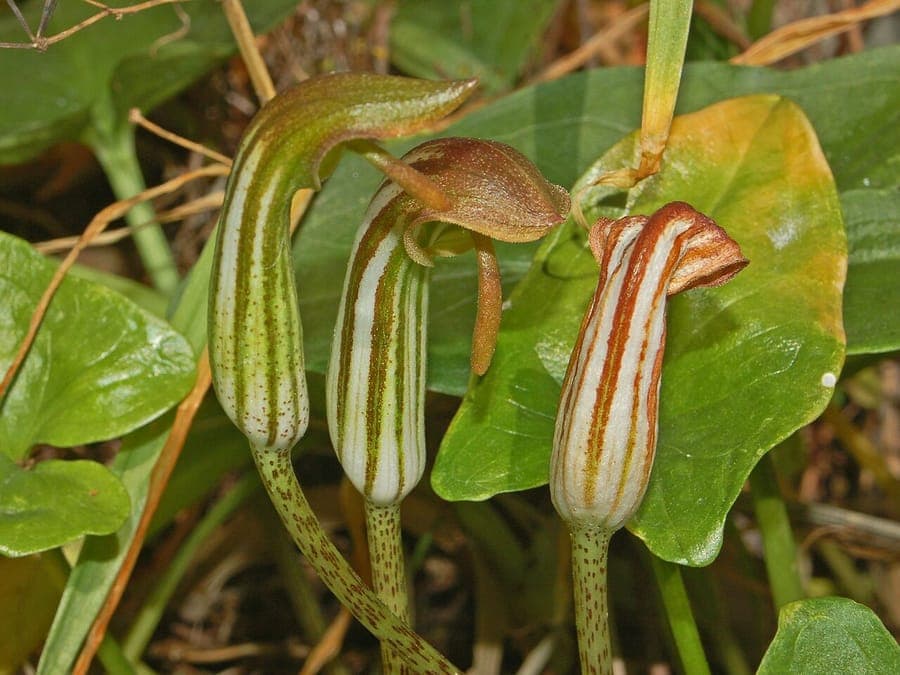
Hectonichus / CC BY-SA 3.0, via Wikimedia Commons
Arisarum vulgare: complete guide
Arisarum vulgare
Want to see Arisarum vulgare: complete guide in your garden?
1 minute, no credit card
Overview
Arisarum vulgare, commonly known as Common Arisarum or Friar's-cowl, is a small yet remarkable plant from the Araceae family. This Mediterranean species is celebrated for its distinctive and striking spathes - modified leaf-like structures that resemble tiny caps or monk's hoods. Growing naturally throughout the Mediterranean region from Albania to Spain and North Africa, this plant brings Old World charm to any garden.
The fascinatingly shaped flowers of Arisarum vulgare are truly attention-grabbing. Brown to purple in coloration, they feature a characteristic cap-like form that creates the appearance of tiny monastic hoods. This makes the plant botanically intriguing while also serving as a visually compelling addition to any shaded corner of your garden.
Appearance and Bloom
Arisarum vulgare grows as a small, clustering plant rarely exceeding 20-30 centimeters in height. The leaves are arrow-shaped with dark green coloration, sometimes featuring lighter venation patterns. They emerge directly from the base of the plant, creating a neat, compact form.
Flowers appear in spring, typically from March to May, and are truly one-of-a-kind. Each bloom consists of a spathe - a specialized leaf-like structure - that curves into a tight, cap-shaped form. These spathes are brown to dark purple, with a refinement that intrigues many observers. The actual flowers are small and inconspicuous, hidden within this characteristic hood.
Following flowering, the plant produces red berries that birds consume, contributing to natural seed dispersal. The fruiting process exemplifies fascinating plant evolutionary strategy.
Ideal Location
Arisarum vulgare flourishes best in shaded to partially shaded environments. In its natural habitat, it grows in shadowed woodland areas beneath dense foliage. This means the plant handles hot, direct sunlight poorly.
The ideal exposure is north-facing or beneath deciduous trees where filtered sunlight penetrates. This recreates the Mediterranean conditions in which the plant naturally thrives.
In cooler climates, the plant can tolerate slightly more direct morning sunlight. However, always protect it from strong midday sun that can cause leaf scorch.
Soil
The soil in which Arisarum vulgare grows must be well-draining yet retain adequate moisture. The plant thrives in alkaline, calcium-rich soils typical of its Mediterranean habitat. Adding limestone or using specially formulated alkaline potting mix can be beneficial.
Aim for a soil composition of approximately 40% garden soil, 30% sand, and 30% mixed organic matter such as leaf mold. This creates a structure supporting both drainage and moisture retention. A pH between 7.5 and 8 is ideal.
Ensure water doesn't stagnate, as this leads to root rot. Properly prepared soil prevents many problems later.
Free design
Want to see Arisarum vulgare: complete guide in your garden? Make a free design now.
Watering
Arisarum vulgare has moderate watering needs. During the growing season (spring and summer), keep soil moist but not waterlogged. A good guideline is watering when the top soil layer feels dry.
During winter dormancy, reduce watering significantly. This mirrors natural conditions where Mediterranean winters are drier.
Rainfall is usually sufficient in regularly-wet climates. Check soil moisture regularly and adjust according to local weather. Too much water is worse than too little for this species.
Pruning
Arisarum vulgare requires minimal pruning. The plant grows compactly and forms a neat shape naturally. Remove yellowed or damaged leaves as you notice them.
After flowering, remove withered spathes if you prefer, though they remain botanically interesting. Leave seed pods intact until ripe, as birds enjoy consuming them, naturally dispersing the plant.
In early spring, clear dead plant material from previous winters. This stimulates new growth and maintains plant health.
Maintenance Calendar
Spring (March-May): Active growth and flowering. Ensure good drainage and consistent watering.
Summer (June-August): Maintain consistent moisture levels. Prevent waterlogging through proper drainage.
Autumn (September-October): Growth slows; reduce watering as temperatures decline.
Winter (November-February): Dormancy period. Water minimally. Foliage may be lost.
Winter Hardiness
Arisarum vulgare is fairly cold-hardy, tolerating temperatures down to approximately -5 degrees Celsius. This means the plant can survive in most European gardens, though protection during severe winters proves beneficial.
In areas experiencing temperatures below -10 degrees Celsius, gardeners are advised to maintain the plant in containers, moveable to shelter during winter. Mulching around the plant base with leaf material provides additional insulation.
In warmer Mediterranean climates, Arisarum vulgare grows outdoors with minimal protection. In northern European regions, container cultivation offers advantages with the option to move plants to shelter seasonally.
Companion Plants
Arisarum vulgare pairs excellently with other Mediterranean shade-lovers. Cichorium cichoreum (wild chicory), Laurus nobilis (Bay Laurel), and Ruscus aculeatus (Butcher's broom) make good companions.
For added bird appeal, plant alongside Hedera helix (Ivy) and Ruscus hypophyllum (Fresh myrtle). This combination creates natural woodland-like habitat.
In container settings, it works well with Acorus gramineus or other ornamental grasses. The contrast between linear foliage and this plant's unique spathes creates compelling visual interest.
Conclusion
Arisarum vulgare is an excellent choice for those seeking authentic Mediterranean atmosphere in a shaded garden corner. With its distinctive flowers, compact growth, and relative low-maintenance nature, it offers substantial benefits. Whether you're having a gardenworld.app design created or gardening independently, this plant deserves serious consideration. Try it and experience the charm of this Araceae beauty.
Want to see Arisarum vulgare: complete guide in your garden? Make a free design now.
Upload a photo, pick a style, and get a photorealistic design with plant list in under a minute.
No credit card required


Similar plants
Arrowhead vine: complete guide
Syngonium auritum
Everything about Syngonium auritum, the tropical five-fingers houseplant. Care, location, watering, and pruning explained clearly for beginners and enthusiasts.
Minute duckweed: complete guide to Lemna perpusilla
Lemna perpusilla
Everything about Lemna perpusilla, the minute duckweed: ecology, pond management, water quality and care in garden water features.
Dead horse arum lily: complete guide
Helicodiceros muscivorus
Everything about the dead horse arum lily (Helicodiceros muscivorus): growing conditions, spectacular bloom, thermogenesis, and care for this Mediterranean aroid.