
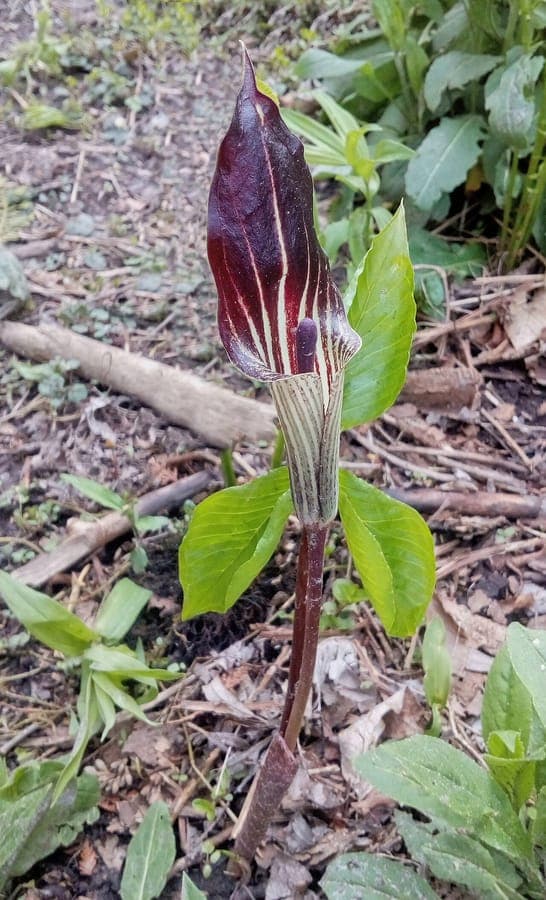
СССР / CC BY-SA 2.5 ca, via Wikimedia Commons
Jack-in-the-pulpit: complete guide
Arisaema triphyllum
Want to see Jack-in-the-pulpit: complete guide in your garden?
1 minute, no credit card
Overview
Jack-in-the-pulpit (Arisaema triphyllum) is one of the most charismatic woodland plants a gardener can grow. A member of the arum family (Araceae), it shares its lineage with calla lilies, philodendrons and lords-and-ladies (Arum maculatum), but it brings a distinctly North American personality to the shady border. In the wild it inhabits rich, moist deciduous forests from New Brunswick and Manitoba south through the Appalachians to Florida, growing on the forest floor alongside trilliums, wild ginger and May apples. In European gardens it has been cultivated since the eighteenth century, though it remains relatively uncommon outside specialist collections. Garden designers on gardenworld.app regularly incorporate it into shaded courtyard schemes and woodland garden designs where unusual foliage is prized.
The plant grows from a flat, irregular corm that produces one or two long-stalked leaves and a single flowering stem each spring. Its common name refers to the preacher figure (the spadix, or Jack) sheltered beneath its overarching hood (the spathe, or pulpit) - a botanical structure that is a modified bract rather than a true flower. After the flowers in May and June, a tight cluster of bright orange-red berries develops on the spadix through summer, ripening spectacularly in August and September. The berries are highly ornamental but toxic to humans and animals; all parts of the plant contain calcium oxalate crystals that cause intense burning and swelling if ingested.
Appearance and bloom cycle
The corm of a mature Jack-in-the-pulpit is roughly disc-shaped, 3–8 cm in diameter, and produces offsets around its margins that slowly form spreading colonies over several years. From the corm emerge one or two stout, mottled pale-green and purple petioles, 30–60 cm tall, each bearing a compound leaf composed of three broad, ovate leaflets 8–18 cm long with pointed tips - the specific epithet triphyllum means three-leaved. The foliage is bold and tropical in character, providing excellent textural contrast in a shady border.
Flowering occurs between late April and early June. The spathe emerges between the leaf stalks as a tightly furled tube that unfolds into an elegant hooded structure 5–10 cm long. Colouration is highly variable: individuals range from green with pale cream striping to deep chocolate-purple with ivory stripes, giving the species a compelling diversity even within a single population. Inside the spathe at the base of the spadix sit the true flowers - tiny and inconspicuous. Young plants typically produce male flowers; as the corm matures and grows larger over successive years, many individuals switch to female-phase flowering, which is botanically rare and makes long-term cultivation particularly rewarding. After pollination, female-phase plants produce clusters of 20–30 glossy berries that turn from green through red to vivid orange-scarlet by late summer.
Ideal location
Jack-in-the-pulpit thrives in partial to full shade. It performs best with two to four hours of dappled, indirect light daily - the shifting, filtered sunlight of a deciduous woodland canopy is ideal. Morning sun with afternoon shade suits it well in climates where summers are warm. Direct afternoon sun causes leaf scorch and forces the plant into premature summer dormancy. Deep, unbroken shade under dense conifers is also unsuitable; the plant needs enough light to build energy reserves in the corm through late spring and early summer before the foliage dies back.
In a woodland garden, a shaded courtyard, or the north-facing base of a hedge or wall, the plant finds natural conditions. Set corms 10–15 cm deep with 25–30 cm spacing for a bold clump. Avoid exposed, south-facing, dry positions; the plant will survive one season in such conditions but decline thereafter. In exposed sites, the large trifoliate leaves act as sails and may tear in wind, disfiguring the plant considerably.
Soil requirements
Rich, humus-laden, moisture-retentive but free-draining soil, mildly acid to neutral (pH 4.8–7.0), suits this plant exactly. In practice, preparing the site well is more important than matching a precise pH. Dig the planting area to a depth of 30 cm and incorporate 15–20 litres of leaf mould per square metre, ideally made from beech or oak leaves which replicate the species' natural substrate. Avoid fresh manure, which encourages soft, disease-prone growth. On heavy clay soil, mix in coarse grit or perlite to prevent the waterlogging that causes corm rot during wet winters. On sandy soil, extra leaf mould is essential to retain adequate moisture through the growing season.
Apply a 5–8 cm layer of leaf mould or finely chipped bark as mulch over the planting area each autumn. This insulates the corms, suppresses competing weeds and slowly releases nutrients as it decomposes. An annual top-dressing of balanced slow-release fertiliser in early spring - 40–60 g per square metre - provides sufficient nutrition without over-stimulating growth.
Free design
Want to see Jack-in-the-pulpit: complete guide in your garden? Make a free design now.
Watering
During the growing season (April to August) keep the soil evenly moist but not saturated. Water twice a week during dry spells, applying enough to penetrate the upper 15 cm of soil. Drip irrigation positioned close to the corms is preferable to overhead watering, which wets the foliage and increases the risk of fungal disease. From September onwards, as the foliage yellows and dies back, reduce watering progressively and stop altogether once the shoots have died to ground level. The corms are dormant through winter and require no additional water; excessive moisture during dormancy is the primary cause of corm rot in cultivation.
A reliable indicator of water stress during summer is the upward curling and yellowing of leaf edges before the natural senescence period in autumn. If this occurs before August, increase watering frequency or check that the mulch layer has not dried out and is still retaining soil moisture effectively. Gardenworld.app offers planting plans for shaded, moisture-sensitive garden areas where plants like Jack-in-the-pulpit can be combined with complementary companions.
Pruning
No pruning is required during the growing season. The only maintenance task is the removal of the dead foliage in late autumn, once the stems and leaves have fully yellowed and collapsed - typically by October or November. Leave the cut material on the surface as mulch or add it to the compost heap. Remove the ripe berry clusters in September or October if you wish to prevent self-seeding; wear gloves, as the sap from cut stems contains calcium oxalate and will irritate skin and eyes.
Do not cut the foliage back prematurely, even if it begins to look tired in late summer. Every leaf-day contributes to the carbon reserves stored in the corm for the following year. Early defoliation consistently results in smaller corms, weaker shoots and reduced or absent flowering in the following spring. Patience through the yellowing phase is rewarded with progressively larger, more impressive plants each year.
Maintenance calendar
January–February: dormancy; no action needed. March: check mulch layer; add extra if frost is lifting corms. April: shoots emerge; avoid disturbing the area. May–June: flowering period; maintain soil moisture. July: large foliage at its peak; water regularly in dry periods. August: berries develop; cease fertilising. September–October: berries ripen; foliage begins to yellow; remove berry clusters with gloves if desired. October–November: foliage dies back; clear old stems; apply fresh mulch layer. December: dormant.
Winter hardiness
Jack-in-the-pulpit is reliably hardy to USDA zone 4, tolerating minimum temperatures around -34 °C. In the UK, the Netherlands, Belgium and most of Germany it overwinters without any protection provided the corms are planted at adequate depth. In regions with prolonged frost and little snow cover, a 10–15 cm mulch of composted leaves over the planting area in December adds useful insulation. The species is more vulnerable to wet, mild winters than to dry cold; in areas with heavy rainfall and poor drainage, raising the planting bed by 15–20 cm improves survival significantly.
Companion plants
The bold, tropical character of Jack-in-the-pulpit pairs beautifully with finer-textured shade plants. Hostas are natural companions: Hosta sieboldiana 'Elegans' with its huge, glaucous, corrugated leaves creates a striking contrast of scale, while Hosta 'Halcyon' adds blue-grey colouring. Ferns provide textural contrast: the soft shield fern (Polystichum setiferum 'Herrenhausen') and the Japanese painted fern (Athyrium niponicum 'Pictum') thrive in the same moist, shaded conditions.
For spring interest before the Arisaema foliage develops, plant wood anemones (Anemone nemorosa), dog's-tooth violets (Erythronium dens-canis) and Siberian squill (Scilla siberica) as companions. The yellow-green flowers of spurge (Euphorbia amygdaloides var. robbiae) provide winter and spring interest and its spreading habit fills the ground effectively. For autumn contrast, the orange berries of the Arisaema harmonise with the coral-red autumn tints of Epimedium × versicolor 'Sulphureum'. Both Arisaema triphyllum and its companions are available from specialist perennial nurseries; some garden centres also carry corms in spring. Visit gardenworld.app to create a custom woodland-garden design that incorporates this remarkable plant alongside its ideal neighbours.
Closing thoughts
Jack-in-the-pulpit rewards careful placement with a display that changes month by month - the architectural spring foliage, the mysterious striped spathe in early summer, the luminous berry cluster in late summer, and the bare ground of winter that conceals a quietly maturing corm growing ever larger and more generous. It is a plant with genuine personality and botanical interest, suited to gardeners who value the unusual and are willing to provide the moist, shaded conditions it demands.
Want to see Jack-in-the-pulpit: complete guide in your garden? Make a free design now.
Upload a photo, pick a style, and get a photorealistic design with plant list in under a minute.
10,000+ gardens designed already
No credit card required


Similar plants
Arrowhead vine: complete guide
Syngonium auritum
Everything about Syngonium auritum, the tropical five-fingers houseplant. Care, location, watering, and pruning explained clearly for beginners and enthusiasts.
Minute duckweed: complete guide to Lemna perpusilla
Lemna perpusilla
Everything about Lemna perpusilla, the minute duckweed: ecology, pond management, water quality and care in garden water features.
Dead horse arum lily: complete guide
Helicodiceros muscivorus
Everything about the dead horse arum lily (Helicodiceros muscivorus): growing conditions, spectacular bloom, thermogenesis, and care for this Mediterranean aroid.