
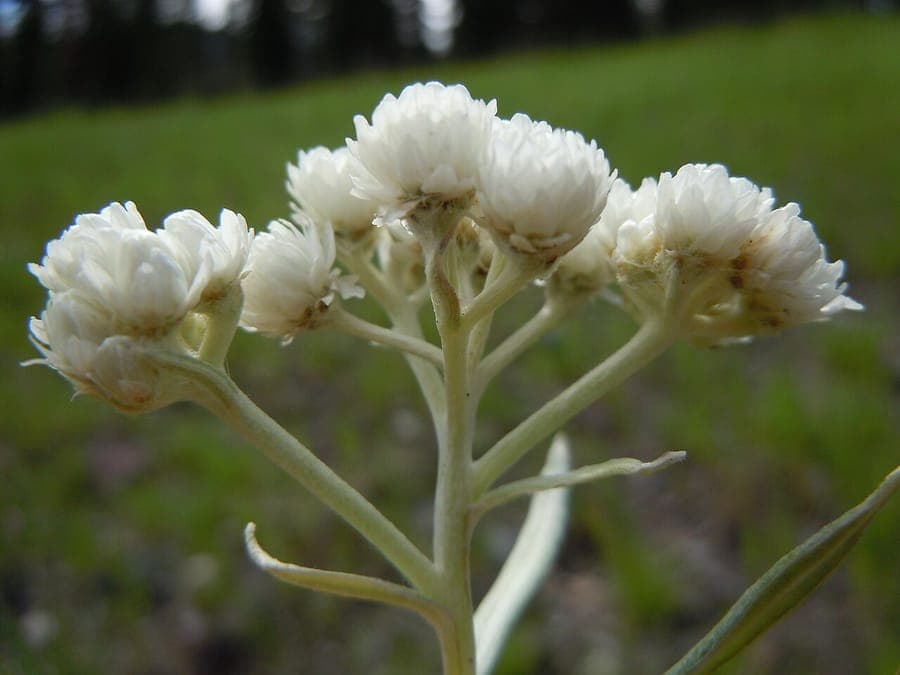
Matt Lavin from Bozeman, Montana, USA / CC BY-SA 2.0, via Wikimedia Commons
Antennaria anaphaloides: complete guide
Antennaria anaphaloides
Want to see Antennaria anaphaloides: complete guide in your garden?
1 minute, no credit card
Overview
Antennaria anaphaloides, commonly known as pearly pussytoes or tall pussytoes, is a low-growing perennial herb in the family Asteraceae. First described by Rydberg in 1900, this species is native to western and central North America, ranging from Alberta and Saskatchewan in Canada south through Montana, Idaho, Wyoming, Oregon, Washington, Utah, Nevada, and Colorado in the United States.
In the wild, pearly pussytoes colonises open grasslands, rocky slopes, and forest margins at elevations from 800 to over 2,500 metres. The specific epithet 'anaphaloides' refers to the genus Anaphalis (pearly everlastings), which these plants closely resemble - both share the characteristic pearl-white, papery flower heads that make them so distinctive in a landscape planting.
For European gardeners, Antennaria anaphaloides offers a tough, drought-tolerant alternative to more conventional groundcovers. Its silvery foliage and delicate flower heads make it ideal for rock gardens, dry borders, and naturalistic plantings inspired by Rocky Mountain meadow communities. You can explore creative ways to incorporate this plant into your garden at gardenworld.app.
Appearance & bloom cycle
Antennaria anaphaloides forms multiple compact basal rosettes of lance-shaped to narrowly oblanceolate leaves. The upper leaf surfaces are grey-green to greenish, while the undersides are densely covered in a white to silvery woolly tomentum - this felt-like coating gives the plant its characteristic silky sheen and plays a functional role in reducing water loss through transpiration. Leaves typically measure 3 to 8 cm in length and up to 1.5 cm in width.
Flowering stems emerge from the basal rosettes and reach 20 to 45 cm in height, bearing the distinctive small, globose to cylindrical flower heads clustered at the top in small cyme-like arrangements. The involucral bracts (the scale-like structures surrounding each head) are white to cream-coloured with a pearly, almost papery lustre - hence the common name 'pearly pussytoes'. Bloom time runs from May through July in natural populations; in cultivation in northwestern Europe, expect flowers from late April through June.
After flowering, small wind-dispersed fruits (cypselae) develop, each tipped with a feathery pappus. The plant is dioecious, meaning male and female flowers occur on separate individuals. Seed production therefore requires plants of both sexes in proximity, though vegetative spread via rhizomes and stolons means a single plant can form a gradually expanding colony over time.
Ideal location
Full sun is the non-negotiable requirement for Antennaria anaphaloides. In its native range it experiences intense solar radiation for much of the day, and in cultivation it performs best with at least six hours of direct sun daily. A south- or southeast-facing slope is ideal: drainage is excellent and the soil warms up quickly in spring, encouraging earlier growth.
Avoid sites with standing water, heavy clay without amendment, or dense shade - any of these will lead to root rot and eventual plant loss. The species is highly tolerant of wind and actually benefits from good air circulation, which reduces the risk of fungal problems during wet periods. In garden settings, the plant fits naturally between boulders in a rock garden, as an edging plant in a gravel border, or as a carpet beneath drought-tolerant shrubs and ornamental grasses.
Container culture is entirely feasible if drainage is excellent. A blend of loam-based compost, perlite, and coarse grit in equal parts creates a suitable growing medium. Position containers in full sun and tip them slightly to encourage rainwater to drain away from the crown.
Soil requirements
This species thrives in poor to moderately fertile, sharply draining soil. On overly rich, humus-heavy ground, plants tend to produce lush growth that is more prone to disease and less true to the compact, silvery character that makes the plant desirable. Soil pH between 5.8 and 7.9 is tolerated, meaning the plant is adaptable to both slightly acid and slightly alkaline conditions.
Sandy or sandy-loam soils are ideal. Heavy clay must be significantly amended with coarse horticultural grit (at least 30% by volume) and ideally a layer of gravel 10 to 15 cm deep beneath the planting zone to ensure rapid drainage. A top dressing of fine gravel or crushed stone (1 to 2 cm deep) around the plant mimics the natural substrate, keeps the crown dry, and suppresses weeds effectively.
Avoid nitrogen-heavy fertilisers - excess nitrogen produces soft, floppy growth that diminishes both the ornamental quality and winter hardiness of the plant. If your soil is very acid (pH below 5.8), a light application of ground limestone (50 g per m²) will help bring conditions closer to the optimum range.
Free design
Want to see Antennaria anaphaloides: complete guide in your garden? Make a free design now.
Watering
Once established - typically after one full growing season - Antennaria anaphaloides is remarkably drought-tolerant and requires minimal irrigation. During the first three to four weeks after planting, water two to three times per week to encourage root establishment. Deep, infrequent watering (soaking to 20 cm depth) is far preferable to shallow daily watering, which encourages surface rooting and reduces long-term drought tolerance.
In established plantings, one deep watering per week during dry summer spells is usually sufficient. In wetter years or on moisture-retentive soils, no supplemental irrigation may be needed at all. Avoid watering in the evening to keep foliage dry and reduce the risk of Botrytis (grey mould). Drip irrigation targeted at the base of the plant is the most efficient method.
In autumn and winter, cease watering entirely. Excess moisture during the cold months is the primary cause of crown rot in this species - far more damaging than frost. Well-draining soil is the best insurance against winter losses.
Pruning
Antennaria anaphaloides requires minimal intervention. The main task is to remove spent flower stalks after bloom (June to August) to keep the plant tidy and prevent unwanted self-seeding. Cut stems back to rosette level using clean, sharp secateurs. This also redirects energy back into the foliage and root system for the rest of the growing season.
In early spring (March), inspect the plant for winter damage and trim away any dead or damaged leaves back to healthy tissue. This encourages fresh growth from the rosettes. Do not cut the plant back hard - the basal rosettes are the perennial crown of the plant and must be preserved.
If after several years the plant becomes overcrowded or too extensive, lift and divide sections in spring. Each rosette with a section of rhizome can be replanted or passed on. Division also rejuvenates old, congested clumps and restores vigour.
Maintenance calendar
January – February: Minimal care. Check that plants are not sitting in waterlogged conditions. Remove any debris that may be trapping moisture against the rosettes.
March: Remove dead and damaged foliage. Top-dress with a thin layer of fine grit if not already done. No fertiliser.
April: The growing season begins. Remove any weeds around plants before they establish. Check for late frost damage.
May – June: Peak bloom period. The pearly flower heads are at their best. Water once a week in dry spells.
July – August: Remove spent flower stalks. Water during extended drought (more than three consecutive weeks without significant rainfall).
September – October: Divide or transplant rooted sections if needed. Stop watering. Reduce any excessive spread of runners.
November – December: Established plants need no winter protection in USDA zones 6–8. First-year plants benefit from a light covering of pine branches during hard frosts.
Winter hardiness
Antennaria anaphaloides is exceptionally cold-hardy, surviving temperatures of -25 °C and below without damage - corresponding to USDA hardiness zone 3. In the Netherlands, Belgium, and Germany (zones 6–8), the plant is fully hardy and requires no winter protection once established.
The primary winter threat in northwest European gardens is not frost but rather persistent winter wetness at mild temperatures, which can trigger crown rot. On well-draining soil this risk is negligible. On heavier ground, applying a 2-cm layer of coarse gravel around the crown in autumn will help deflect excess moisture. First-year plants benefit from a light cover of spruce or pine branches during prolonged hard frost (below -10 °C).
Companion plants
Antennaria anaphaloides pairs naturally with other drought-tolerant, sun-loving species. Excellent combinations include:
- Festuca glauca 'Elijah Blue' - the blue-grey, fine-textured foliage echoes the silvery tones of the Antennaria perfectly.
- Sedum (Hylotelephium) 'Herbstfreude' - rich pink to ruby flower heads in August–October create a striking contrast with the silver carpet below.
- Stachys byzantina 'Silver Carpet' - a similarly woolly, mat-forming perennial that shares the same site requirements.
- Thymus serpyllum - creeping thyme fills gaps between rosettes, adds fragrance, and attracts pollinators through the summer.
- Allium cristophii - the large, violet-blue star-shaped flower heads rising above the low silver carpet in May–June are a spectacular combination.
- Dianthus gratianopolitanus - compact pinks with grey-blue foliage and fragrant flowers are natural companions in any dry, sunny situation.
Avoid pairing with moisture-demanding plants such as hostas, astilbes, or ferns - these require fundamentally different growing conditions.
Closing
Antennaria anaphaloides is a rewarding, low-maintenance perennial for anyone seeking to add a naturalistic, silvery texture to dry, sunny areas of the garden. Its pearl-white flower heads, drought tolerance, and exceptional cold hardiness make it a plant that earns its place year after year without demanding much in return.
Ready to design a garden that makes the most of plants like this? Visit gardenworld.app for tailored garden design inspiration and detailed planting advice for dry and challenging sites.
Want to see Antennaria anaphaloides: complete guide in your garden? Make a free design now.
Upload a photo, pick a style, and get a photorealistic design with plant list in under a minute.
10,000+ gardens designed already
No credit card required


Similar plants
Calendula stellata: complete guide
Calendula stellata
Complete guide to Calendula stellata, the star-flowered marigold from Sicily: location, soil, watering and companion planting tips.
Korean chrysanthemum: complete guide
Chrysanthemum x rubellum
Chrysanthemum x rubellum is a hardy autumn perennial with single pink to copper flowers from August to November. Care and combinations.
Helianthus divaricatus: complete guide
Helianthus divaricatus
Helianthus divaricatus is a North American woodland sunflower with yellow summer blooms, ideal for naturalistic borders and shady edges.