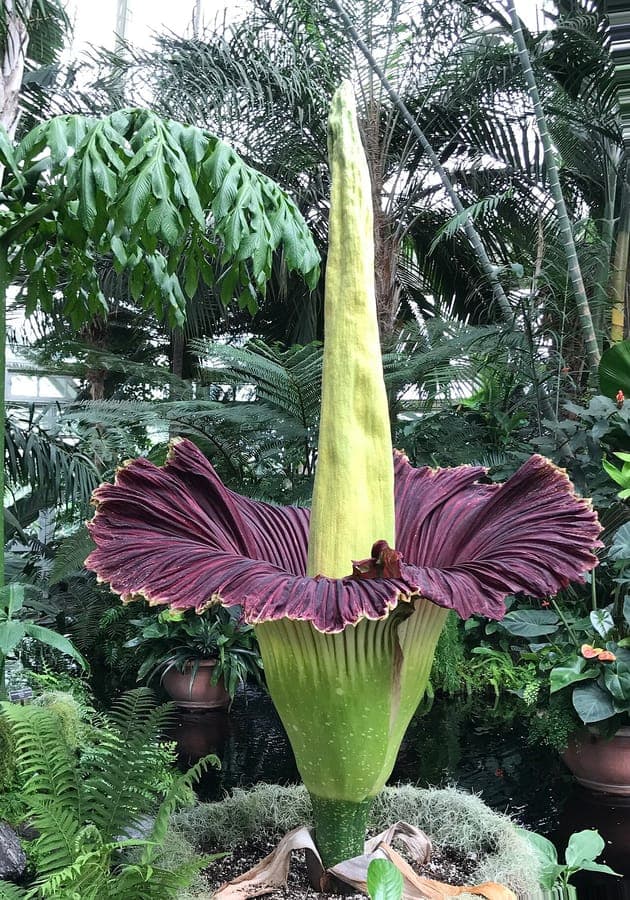
Sailing moose / CC BY-SA 4.0, via Wikimedia Commons
Titan arum: complete guide
Amorphophallus titanum
Want to see Titan arum: complete guide in your garden?
Full design in HD: €7.99
Look after your Titan arum with the GardenWorld app
Identify plants with your camera and get a care calendar with reminders for this plant.


Overview
Titan arum (Amorphophallus titanum), also called the Corpse Flower, is one of the most fascinating and bizarre plants in the world. The plant is famous for its colossal inflorescence, one of the largest unbranched floral structures known. It produces a characteristic strong putrid odor resembling rotting flesh. The plant is native to the rainforests of western Sumatra. It is a rare plant typically cultivated only in botanical gardens and by serious enthusiasts.
Appearance and Bloom
Titan arum produces the world's largest unbranched inflorescence, sometimes exceeding 3 meters in height. The floral structure consists of a massive dark purple to burgundy spathe surrounding a thick spadix column. Prior to flowering, the plant produces gigantic deeply lobed triangular leaves reaching 4-6 meters in height. The inflorescence emits a powerful stench resembling rotting flesh and carrion, which attracts carrion-feeding flies and beetles for pollination. The bloom lasts only hours to a maximum of two days.
Ideal Location
Titan arum thrives only in consistently warm, very humid tropical conditions: minimum 20-25C. This is strictly a greenhouse plant in temperate climates. The plant tolerates shade and prefers rainforest-like conditions with very high humidity. Provide ample space for the enormous growth.
Free preview
Want to see Titan arum: complete guide in your garden? Make a free preview of your design.
Soil
Use well-draining potting soil with abundant humus, peat, and compost. Ensure perfect drainage. Large containers required: 100L+ minimum. Slightly acidic to neutral pH preferred.
Watering
During active growth: keep soil consistently moist but never waterlogged. Mist foliage regularly. During dormancy (winter): reduce watering almost entirely.
Pruning
No pruning necessary. Remove only dead leaves.
Maintenance Calendar
- March/April: Corm awakens, begin watering
- May-September: Active growth period, maximum water and humidity
- October/November: Gradually reduce watering
- December-February: Dormancy, minimal water, cool conditions
Winter Hardiness
Titan arum is strictly tropical and cannot tolerate cold. Winter cultivation requires heated greenhouse or indoor conditions.
Companion Plants
This is best grown as a solitary specimen where it can dominate. It is extremely challenging to cultivate at home and better suited to botanical gardens.
Closing
Titan arum is for the most dedicated plant enthusiasts! Discover more exotic rarities at gardenworld.app and design your extraordinary garden today!
Frequently asked questions about Titan arum
Is Titan arum winter hardy?
Titan arum is strictly tropical and cannot tolerate cold. Winter cultivation requires heated greenhouse or indoor conditions.
How much water does Titan arum need?
During active growth: keep soil consistently moist but never waterlogged. Mist foliage regularly.
Where does Titan arum grow best?
Titan arum thrives only in consistently warm, very humid tropical conditions: minimum 20-25C. This is strictly a greenhouse plant in temperate climates.
What soil does Titan arum need?
Use well-draining potting soil with abundant humus, peat, and compost. Ensure perfect drainage.

See it in your garden
See Titan arum in your garden
One photo of your garden and a few questions. You see the result in about a minute.
Try it with a photoIdentify this plant in your own garden. Identify a plant
Similar plants
Velvet cardboard anthurium (Anthurium clarinervium): care
Anthurium clarinervium
Grow Anthurium clarinervium, the velvet cardboard anthurium: light, watering, humidity, an airy aroid mix, propagation and toxicity to pets.
Crystal anthurium: caring for a velvet-leaved houseplant
Anthurium crystallinum
Crystal anthurium (Anthurium crystallinum) indoors: light, high humidity, an airy potting mix, watering, propagation and why it is toxic to cats and dogs.
Golden pothos (Epipremnum aureum): complete guide
Epipremnum aureum
Everything about golden pothos (Epipremnum aureum): position indoors, watering, repotting, rooting cuttings in water and toxicity to cats and dogs.
