
Dcrjsr / CC BY 3.0, via Wikimedia Commons
Allegheny serviceberry: complete guide
Amelanchier arborea
Want to see Allegheny serviceberry: complete guide in your garden?
1 minute, no credit card
Overview
The Allegheny serviceberry (Amelanchier arborea) is one of the most rewarding small trees a gardener can plant. Native to eastern North America - from the Allegheny Mountains through the Great Lakes region to southern Quebec - it has been winning over European gardeners for decades with a charm that manifests differently in every season. In early spring, before any competing shrub has gathered courage, it erupts into clouds of pure white blossom. By June the branches weigh with sweet blue-black berries. Come autumn, the foliage ignites in a spectrum running from clear yellow through orange to deep scarlet, rivalling Japanese maples at a fraction of the cost. Even in winter the smooth, grey-streaked bark provides sculptural beauty. It belongs to the rose family (Rosaceae) and shares a lineage with pear, apple and hawthorn. On gardenworld.app, garden designers regularly feature this serviceberry as a centrepiece in naturalistic and contemporary planting schemes.
The species is also known as downy serviceberry, juneberry, shadblow and Allegheny serviceberry - the last name referring to its stronghold in the Allegheny Mountains of West Virginia, Pennsylvania and western North Carolina. In the wild it grows as an understorey tree at woodland margins, along stream banks and on rocky ridges, typically reaching 6 to 12 metres under good conditions. In garden cultivation it rarely exceeds 8 metres and responds well to light shaping.
Appearance and bloom cycle
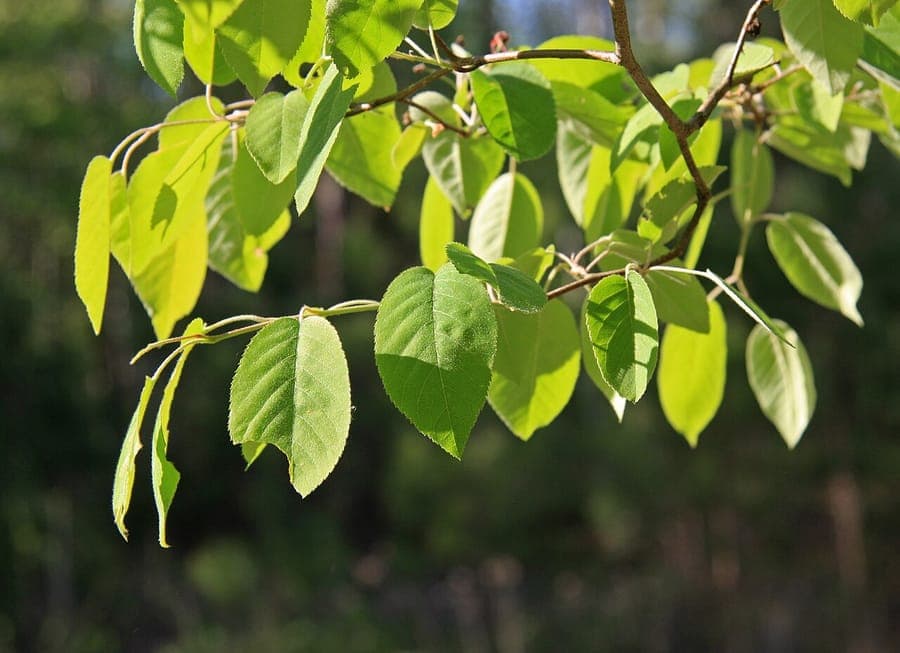
In cultivation Amelanchier arborea typically forms an upright to broadly vase-shaped crown, sometimes multi-stemmed, with attractive exfoliating grey-green bark marked by thin, pale vertical striations. Leaves emerge simultaneously with the flowers in a silvery-bronze flush, deepening to mid-green by early summer. Each leaf is broadly oval, 4–10 cm long, finely toothed and turns vivid orange-red in October, persisting well into November in milder years.
The flowering period falls in late March to mid-April in a temperate European climate, lasting ten to eighteen days depending on temperatures. Each flower has five narrow, strap-shaped white petals characteristic of the genus, loosely arranged in pendant racemes 5–15 cm long. The flowers are faintly fragrant with a honey-almond scent that makes them particularly attractive to early pollinators including queen bumblebees and overwintered hoverflies. The cultivar 'Robin Hill' opens blush-pink and fades to white, reaching around 8 metres, while 'Princess Diana' - sometimes listed under A. ×grandiflora - is prized for its fiery scarlet autumn colour. 'Ballerina' is a compact hybrid reaching 5–6 metres that suits smaller gardens.
Fruits ripen in June - hence the common name juneberry. They measure 6–10 mm in diameter, turning from red to blue-black when fully ripe and carrying a sweet, slightly almond-flavoured flesh that is edible raw or cooked into jams, pies and syrups. Birds, particularly blackbirds, thrushes and starlings, compete fiercely for the crop. If you want to harvest any yourself, net the branches loosely when the berries begin blushing red.
Ideal location
Allegheny serviceberry performs best in full sun to partial shade. In full sun the flowering is most abundant, the fruit set most reliable and the autumn colour most intense. In partial shade - defined as four to six hours of direct sun per day - growth is somewhat slower and the autumn display slightly less brilliant, but still very attractive. The tree tolerates exposed and windy positions well; its flexible young branches rarely suffer storm damage. Avoid deep shade under a dense evergreen canopy, where the crown will become thin and flowering poor.
As a specimen tree in lawn, as a structural plant at a border corner, or as part of a multi-layer woodland garden, the serviceberry excels. When planting as a freestanding specimen allow at least 4 metres clearance from neighbouring large shrubs or trees. For an informal screen or hedgerow plant at 2 to 2.5 metre spacings. Roots are non-invasive and will not threaten paving, walls or building foundations, making the tree suitable even for relatively small urban gardens.
Soil requirements
In its native range Amelanchier arborea occupies a wide variety of soils, from sandy loams along floodplains to thin, rocky soils on mountain ridges. In the garden it performs best on a well-drained, moderately fertile, slightly acid to neutral soil with a pH of 4.8 to 7.5. It dislikes waterlogged conditions; if your soil is heavy clay, incorporate generous amounts of coarse grit or composted bark to improve drainage before planting. On light sandy soils it benefits from regular mulching to conserve moisture.
At planting time dig a hole at least twice the diameter of the root ball and work in a full bucket of well-rotted garden compost. Backfill with the original soil mixed with compost and firm gently to eliminate air pockets. Apply a 7–10 cm layer of bark mulch over the root zone, keeping it clear of the trunk by at least 10 cm to prevent collar rot. An annual top-dressing of slow-release fertiliser in April - approximately 60–80 g per square metre of planting area - maintains vigour without causing excessive soft growth.
Free design
Want to see Allegheny serviceberry: complete guide in your garden? Make a free design now.
Watering
Newly planted trees require regular watering through their first two growing seasons: at least twice a week during dry spells, applying 10–15 litres directly at the base and allowing it to soak slowly into the root zone rather than run off. A well-established tree - three or more seasons in the ground - develops a deep, wide-spreading root system that is remarkably drought tolerant for a tree of this size. Brief dry spells of two to three weeks cause no lasting harm.
Longer droughts in August and September can reduce the brilliance of autumn colour because the plant produces fewer anthocyanins when moisture-stressed. Yellowing rather than orange-red leaves in autumn is often a sign of late-summer water stress. A drip-irrigation line laid in a ring 40 cm from the base of the trunk is a low-maintenance solution for gardens that are left unattended for extended periods.
Pruning
One of the great virtues of the Allegheny serviceberry is that it requires minimal pruning. Restrict regular maintenance to two or three targeted interventions each year. In late winter - January to February - remove any dead, diseased or crossing branches to open up the canopy and improve air circulation. This reduces the risk of powdery mildew and fire blight (Erwinia amylovora), both of which are occasional problems in warm, humid summers.
After flowering in April or May you can shorten any overlong shoots by up to one-third to keep the desired shape. Avoid pruning after mid-July because flower buds for the following season begin forming in late summer. For a tree that has been neglected and become congested, a three-year renovation programme - removing one-third of the oldest stems each winter - will rejuvenate it without causing shock. Always use sharp, clean secateurs or loppers, disinfecting between cuts if fire blight is suspected. On gardenworld.app you can find garden designs that incorporate the serviceberry as a trained multi-stem specimen or as an airy espaliered form against a wall.
Maintenance calendar
January–February: remove dead wood; inspect bark for frost cracks; light structural pruning. March: replenish mulch layer around the base; watch for emerging flower buds. April: full bloom; stake newly planted trees if needed. May: post-bloom light shaping; apply slow-release fertiliser. June: harvest berries before the birds take them all; water deeply in dry spells. July–August: minimal maintenance; monitor for fire blight symptoms (scorched-looking shoot tips). September: autumn colour begins; cease fertilising. October–November: spectacular leaf display; rake fallen leaves to compost. December: dormant season; good time to assess structure.
Winter hardiness
Allegheny serviceberry is rated to USDA hardiness zone 4, tolerating minimum temperatures of around -34 °C. In practice this means it overwinters without protection throughout the United Kingdom, the Netherlands, Belgium, Germany and most of Scandinavia. Young trees under 60 cm in height can benefit from a light mulch over their root zone in their first winter, but this is rarely essential. Early-blooming cultivars may suffer superficial flower damage during late frosts at -3 °C or below, which is a cosmetic setback with no lasting effect on the tree's health.
Companion plants
The serviceberry provides a superb backbone for mixed planting schemes. Beneath its canopy, early-spring bulbs thrive in the dappled light before the leaves fully expand: try Narcissus 'Thalia', grape hyacinths (Muscari armeniacum) in violet-blue, or the species tulip Tulipa sylvestris in soft yellow. For ground cover, Waldsteinia ternata and Geranium macrorrhizum 'Album' create a weed-suppressing mat that complements the white spring blossom.
At shrub level, Fothergilla gardenii adds fragrant white bottlebrush flowers in spring and fiery autumn colour, amplifying the serviceberry's own display. Viburnum plicatum 'Mariesii' provides layered horizontal branches with white lace-cap flowers. For wildlife-friendly planting, combine with elder (Sambucus nigra 'Black Lace'), hawthorn (Crataegus monogyna) and rowan (Sorbus aucuparia) to create a year-round food source for birds. In a contemporary scheme, a multi-stem serviceberry underplanted with Calamagrostis × acutiflora 'Karl Foerster' and Festuca glauca 'Elijah Blue' creates a refined, low-maintenance planting.
Closing thoughts
Few trees deliver as much beauty across all four seasons as the Allegheny serviceberry. From its breathtaking white blossom in earliest spring through its edible summer berries to the blazing autumn foliage and elegant winter bark, it justifies every square metre it occupies. It is available at good garden centres as a container-grown specimen or as a bare-root tree in winter. Visit gardenworld.app to explore how the serviceberry could transform your own front garden with a tailor-made planting design.
Want to see Allegheny serviceberry: complete guide in your garden? Make a free design now.
Upload a photo, pick a style, and get a photorealistic design with plant list in under a minute.
10,000+ gardens designed already
No credit card required


Similar plants
Siberian crab apple: complete guide
Malus x robusta
Complete guide to the Siberian crab apple (Malus x robusta): location, soil, pruning, winter hardiness and the best companion plants for your garden.
Chinese flowering crabapple (Malus x spectabilis): complete guide
Malus x spectabilis
Meet the Chinese flowering crabapple (Malus x spectabilis): a classic spring bloomer with carmine buds and pink blossom.
Potentilla crassinervia: complete guide
Potentilla crassinervia
Potentilla crassinervia, the Corsican cinquefoil, grows wild on Corsica and Sardinia's peaks. Discover how to grow this hardy alpine rock garden gem.