
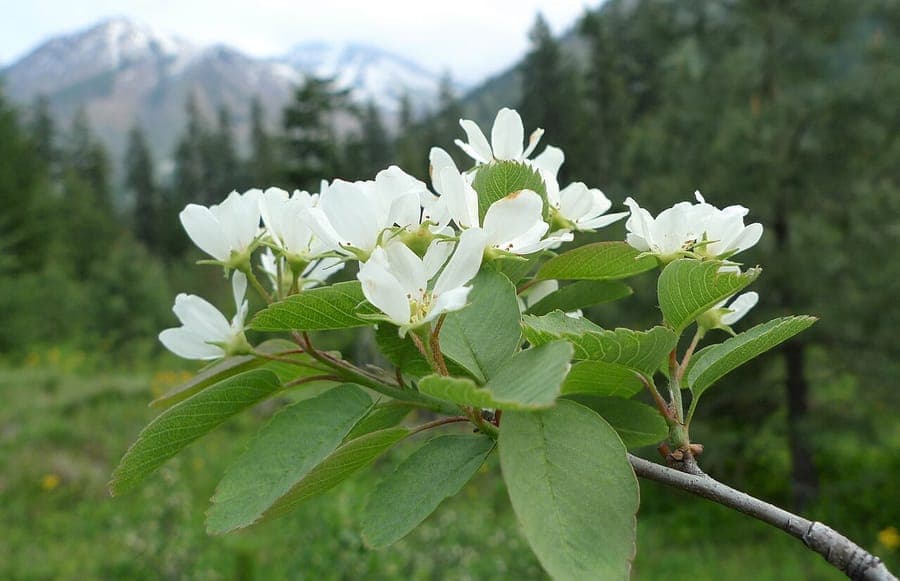
Thayne Tuason / CC BY-SA 4.0, via Wikimedia Commons
Amelanchier alnifolia: complete guide
Amelanchier alnifolia
Want to see Amelanchier alnifolia: complete guide in your garden?
1 minute, no credit card
Overview
Amelanchier alnifolia, also known as Saskatoon serviceberry, juneberry, or saskatoon berry, is a fast-growing native North American shrub from the Rosaceae family. This hardy shrub grows naturally in forests and meadows from Canada through western USA. Amelanchier is celebrated for its three-season appeal: fragrant white flowers in spring; gleaming green foliage in summer; and brilliant gold-orange foliage with edible dark purple berries in autumn.
The plant thrives on diverse soil types and climates, from dry to wet, full sun to partial shade. This makes it extremely adaptable and useful in many gardens. In Europe, it's gaining popularity for its multi-season interest, wildlife benefits, and low-maintenance nature.
Appearance and bloom
Amelanchier alnifolia grows as a shrub 3 to 6 meters tall, depending on conditions and cultural practices. The plant develops naturally in an informal, attractive shape requiring minimal pruning. Stems are dark brown to black, smooth or lightly hairy.
Leaves are fine-textured and alternate, approximately 3 to 5 centimeters long, dark green in summer. In autumn, they display brilliant orange, gold, or red tones depending on season and growing conditions.
In spring (April-May), fragrant white flowers appear in clusters at branch tips. Each flower is about 1 centimeter in diameter; the sheer abundance creates a stunning white display across the entire shrub.
Fruit appears June-July as dark blue to black berries, approximately 1 centimeter in diameter. These berries are sweet-tart and edible, eagerly consumed by birds and humans alike. Nutritional value is high - berries are packed with antioxidants, vitamins C and A.
Ideal location
Amelanchier alnifolia thrives in full sun to partial shade. Plant where it receives at least 4 to 6 hours of sun daily. In very warm climates, afternoon shade is appreciated.
The plant is very winter-hardy and grows in USDA zones 3 to 9, making it suitable for almost all European climates, from Scandinavia to the Mediterranean.
Ensure good air circulation around the plant to prevent fungal infections, but protect from very strong coastal winds that damage tender shoots.
Soil
Amelanchier alnifolia is remarkably flexible regarding soil type and thrives on virtually all soil types, from acidic to alkaline, sand to clay. Once established, the plant is drought-tolerant but grows faster in moist soil. Add compost or well-rotted manure when planting for a better start.
The plant even grows in poor soil and doesn't need excessive feeding. Too much nitrogen promotes leaf growth at the expense of flowers and fruit. Good drainage is important; the plant doesn't thrive in permanently waterlogged soil.
Free design
Want to see Amelanchier alnifolia: complete guide in your garden? Make a free design now.
Watering
Water regularly during the first growing year, especially during dry periods. Once established (after about two years), the plant is reasonably drought-tolerant and needs less frequent watering.
Water deeply but infrequently - this encourages deeper roots. Avoid shallow, frequent watering. Mulch around the plant with 5 to 7 centimeters of organic matter to promote moisture retention and keep root temperature consistent.
Pruning
Pruning is usually unnecessary; Amelanchier naturally develops an attractive shape. You can remove dead branches or improve structure by cutting a few older stems to ground level.
The plant responds well to pruning and regrows quickly, so you can shape it if desired. Prune especially after flowering, not in autumn, to avoid damaging next spring's buds.
Also remove root suckers growing at the plant's base.
Maintenance calendar
January to March: Winter dormancy. No maintenance needed. Plant can be established during this period.
April to May: Flowering. White flowers appear abundantly. Begin light pruning if needed.
June to July: Fruit set. Berries develop. Water regularly, especially in dry weather.
August to October: Autumn color. Berries ripen to dark color. Reduce feeding.
November to December: Leaf drop. Plant prepares for rest.
Winter hardiness
Amelanchier alnifolia is very winter-hardy and tolerates temperatures to minus 40 degrees Celsius. It grows in USDA zones 3 to 9, making it suitable for nearly all Europe. Even in Scandinavia and northern Russia it thrives well.
The plant suffers no damage from frosty days, snowfall, or extreme cold winters. This is an advantage in many European gardens.
Companion plants
Amelanchier alnifolia makes a stunning specimen plant but combines beautifully with:
- Other North American shrubs (Aronia, winterberry)
- Low to medium trees (hazel, birch)
- Heaths and heathy plants
- Ornamental grasses for contrast
White flowers and dark fruit provide beautiful contrast with dark-leaved plants or evergreen conifers.
Closing
Amelanchier alnifolia is a highly functional, winter-hardy, low-maintenance shrub offering three seasons of beauty. Plant in spring or autumn, and with minimal care it will flower, fruit, and feed wildlife for years. It suits small and large gardens, landscape combinations, and wildlife gardens. The edible berries are a bonus for people - perfect for jams, freezing, or pressing into juice. Garden centers stock young plants regularly. With this shrub, you bring a piece of North America into your garden.
Want to see Amelanchier alnifolia: complete guide in your garden? Make a free design now.
Upload a photo, pick a style, and get a photorealistic design with plant list in under a minute.
No credit card required


Similar plants
Siberian crab apple: complete guide
Malus x robusta
Complete guide to the Siberian crab apple (Malus x robusta): location, soil, pruning, winter hardiness and the best companion plants for your garden.
Chinese flowering crabapple (Malus x spectabilis): complete guide
Malus x spectabilis
Meet the Chinese flowering crabapple (Malus x spectabilis): a classic spring bloomer with carmine buds and pink blossom.
Potentilla crassinervia: complete guide
Potentilla crassinervia
Potentilla crassinervia, the Corsican cinquefoil, grows wild on Corsica and Sardinia's peaks. Discover how to grow this hardy alpine rock garden gem.