
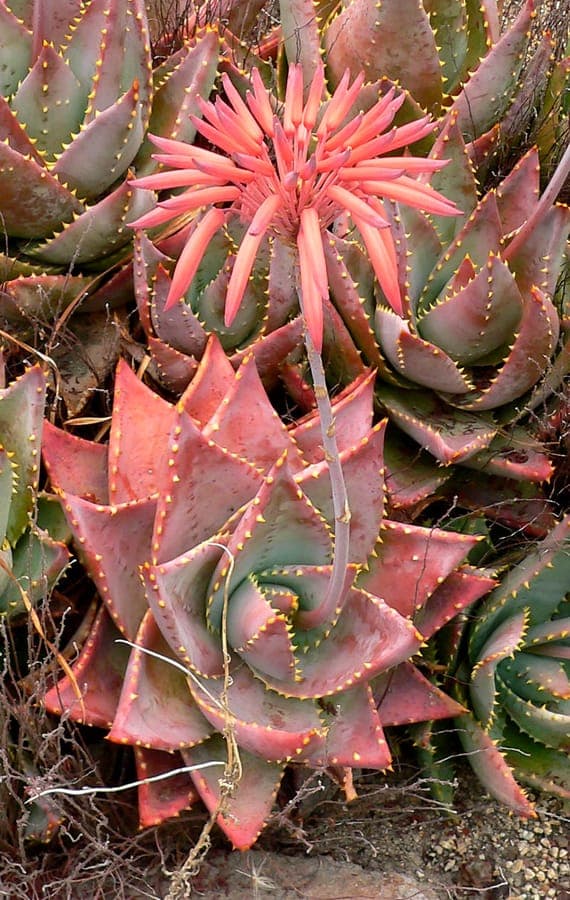
Stan Shebs / CC BY-SA 3.0, via Wikimedia Commons
Aloe distans: complete guide
Aloe distans
Want to see Aloe distans: complete guide in your garden?
1 minute, no credit card
Overview
Aloe distans, commonly known as short-leaved aloe, is a fascinating compact succulent from southwestern Cape Province, South Africa. Described by Haworth in 1812, this species has proven invaluable for landscape design. The species name distans refers to its characteristic short, spreading leaves that distinguish it from related Aloe species.
This is a plant adapted to extreme drought and rocky terrain. With its dense rosette structure and minimal water needs, Aloe distans is ideal for water-wise gardens. The plant offers interesting visual texture and attractive blooms in compact form.
Appearance and Bloom
Aloe distans forms compact, tightly packed rosettes with short, thick, firm green leaves. These are notably shorter than most other Aloe species, making this plant highly distinctive. The plant typically reaches only 25-35 centimeters in height and spread.
During spring, elegant flower stems emerge bearing tubular yellow blooms. These rise gracefully from the rosette center. The flowers are highly attractive to pollinators and persist for several weeks. Even outside blooming season, this plant offers interesting visual structure.
Ideal Location
Aloe distans grows optimally in full sun to light partial shade. The plant thrives with at least five to six hours of direct daily sunlight. In very hot climates, light afternoon shade may prevent leaf burn. Ensure good air circulation.
This is a plant for challenging locations. Plant it on slopes, in rocky beds, or places where many plants fail. The plant thrives even in rocky terrain with minimal soil. Wind presents no problem; this plant grows more vigorously in windy conditions.
Soil
Aloe distans thrives in poor, very well-draining soil. This is actually advantageous as you need not invest in expensive soil amendments. A mixture of two parts coarse sand, one part gravel, and minimal rich matter is ideal. Soil pH can be neutral to slightly acidic (6.5-7.5).
Indeed, this plant performs better in poor, mineral soils than in rich, moisture-retentive media. If you must amend native soil, add primarily sand and gravel. Ensure impeccable drainage in all planting situations.
Free design
Want to see Aloe distans: complete guide in your garden? Make a free design now.
Watering
Water very sparingly. During the growing season, water only when soil is completely dry, typically just every three to four weeks. In winter, watering is almost unnecessary. This plant is extremely drought-tolerant.
Always verify soil moisture before watering. This plant needs no feeding; rainwater suffices in most climates. Overwatering is the primary cause of problems with this species.
Pruning
Minimal pruning is needed. Remove only completely dead leaves or stems. This plant maintains its natural form without pruning work. Healthy plants need no further maintenance work.
Maintenance Calendar
Spring: Resume cautious watering. Inspect for pests. Summer: Minimal watering. Fall: Gradually reduce watering. Winter: No water.
Winter Hardiness
Aloe distans is not fully cold-hardy in European climates. In areas with winter temperatures below -5 degrees Celsius, provide protection or bring plants indoors. In southern areas of the Netherlands and Belgium, fleece protection may suffice for outdoor overwintering.
Companion Plants
Aloe distans pairs beautifully with other xerophilic, compact plants. Group with small Sedum species, Sempervivum, dwarf grasses, and compact shrubs. This plant is also suitable for succulent trough planting with other compact material. Avoid large, moisture-loving neighbors.
Closing Remarks
Aloe distans is the perfect plant for challenging garden locations and water-wise gardens. This robust, low-maintenance plant proves that beauty doesn't require rich soils. With its compact form and attractive blooms, Aloe distans delivers exceptional garden value. Find this plant through specialized nurseries. GardenWorld.app helps integrate Aloe distans into your complete garden plan.
Want to see Aloe distans: complete guide in your garden? Make a free design now.
Upload a photo, pick a style, and get a photorealistic design with plant list in under a minute.
No credit card required


Similar plants
Aloe africana: complete guide
Aloe africana Mill.
South African aloe with thick greyish-blue leaves and orange tubular flowers. Hardy to -12 degrees C, perfect for xeric gardens and arid landscapes.
Aloe petricola: complete guide
Aloe petricola
Discover Aloe petricola, the nespruit rock aloe. Care, growing tips, and design applications for this unique compact South African aloe.
Aloe reitzii: complete guide
Aloe reitzii
Discover Aloe reitzii, a refined succulent from South Africa. Complete care guide, growing tips, and landscape integration for this elegant plant.