
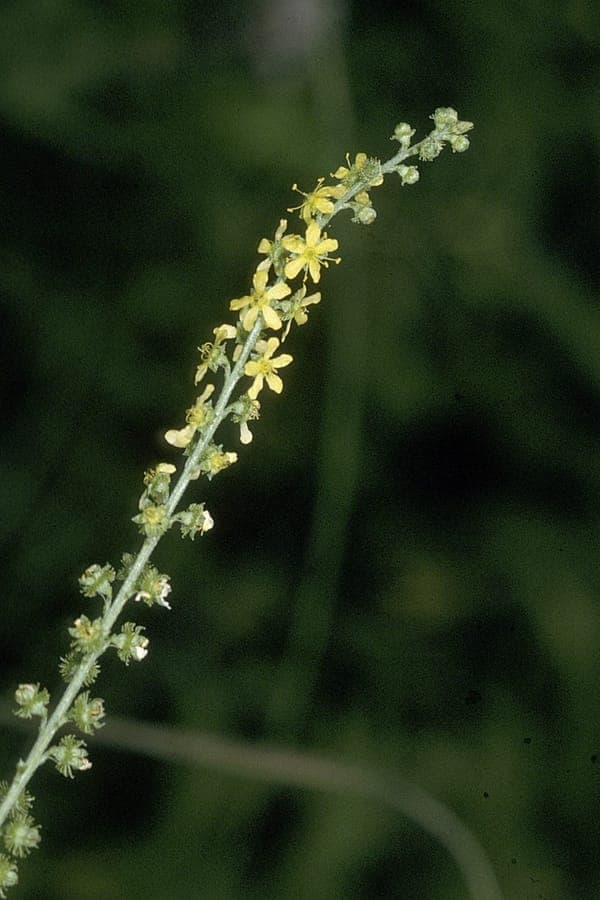
Robert H. Mohlenbrock @ USDA-NRCS PLANTS Database / USDA NRCS. 1995. Northeast wetland flora: Field office guide to plant species. Northeast National Technical Center, Chester, PA. / Public domain, via Wikimedia Commons
Roadside agrimony: complete guide
Agrimonia striata
Want to see Roadside agrimony: complete guide in your garden?
1 minute, no credit card
Overview
Agrimonia striata, commonly known as roadside agrimony or woodland agrimony, is a robust, rhizomatous perennial in the rose family (Rosaceae). It has a remarkably wide native range: across North America from Alberta, British Columbia, and Saskatchewan in the west through the Great Lakes region and Atlantic states, and separately in the Russian Far East (Amur, Khabarovsk, Primorye, Sakhalin). This transcontinental distribution reflects its adaptability to a broad range of temperate forest-edge and meadow habitats.
The species name striata refers to the prominently grooved stems - Latin for 'striped' or 'grooved'. Common English names include roadside agrimony, woodland agrimony, grooved agrimony, and Britton's agrimony. The species was formally described in 1803 by French botanist André Michaux in his Flora Boreali-Americana; synonyms include Agrimonia brittoniana E.P.Bicknell and Agrimonia striata var. campanulata Fernald. In the wild it grows on roadsides, open woodland margins, meadows, and forest edges - habitats that are straightforward to replicate in the garden.
For naturalistic and wildlife gardeners, Agrimonia striata offers a dependable, easy-care perennial with genuine ecological value. Its rhizomatous habit makes it more expansive than Agrimonia eupatoria, forming gradually spreading colonies that work well as ground cover on larger areas. The slender flower spikes attract bees, wasps, and hoverflies; the hooked fruits provide seeds for birds; and the dense foliage shelters small mammals and amphibians. Design a naturalistic planting scheme that includes woodland-edge species like this one at gardenworld.app, where you can visualise complete front garden layouts with multiple planting layers.
The plant grows at a moderate rate once established, forming multi-stemmed clumps that expand steadily via underground rhizomes. It is not edible and has no significant modern medicinal use, but its ecological contributions and long flowering season give it a valued place in wildlife-friendly gardens.
Appearance & bloom cycle
Agrimonia striata is an upright, multi-stemmed perennial reaching 60 to 120 cm in height, occasionally up to 150 cm in fertile, moist conditions. The stems are distinctly grooved - immediately distinguishing this species from the less prominently ribbed A. eupatoria - and moderately hairy with spreading hairs. Over time, the rhizomes expand laterally to form broad, vigorous clumps.
Leaves are alternately arranged and pinnately compound with an interrupted pattern: 5 to 11 pairs of large, oval to oblong, sharply toothed leaflets interspersed with smaller intermediate leaflets. The upper surface is dark green and roughly hairy; the underside is paler and more softly pubescent. The medium-textured foliage creates a lush, full appearance throughout the growing season.
Flowers are yellow, small (6 to 8 mm across), five-petalled, and borne in long, slender racemes 15 to 40 cm in length that rise prominently above the foliage. They open progressively from base to tip over two to four weeks per spike. In temperate European gardens, flowering runs from July through September. After flowering, characteristic cup-shaped achenes with strongly hooked bristles develop - these cling readily to clothing and animal fur, making this one of the most effective seed-dispersing plants in the garden and a reason to site it away from main pathways if seed spread is unwanted.
The plant has a faint, pleasant aromatic fragrance from glandular hairs on stems and leaves, similar to that of other agrimonies.
Ideal location
Agrimonia striata is considerably more adaptable in its site requirements than A. eupatoria. It tolerates both full sun and partial shade, performing best with two to four hours of direct sunlight supplemented by bright indirect light - mimicking the dappled conditions of woodland edges and hedgerow margins. In deep shade, flowering diminishes; in full, dry sun on poor soil, growth slows and the plant looks stressed.
In the garden, this species excels in a part-shade border, at the woodland garden edge, in a naturalistic meadow planting, or on a vegetated bank or slope. It establishes reliably even in challenging positions - north-facing hedge bases, dry tree-root zones with moderate soil depth, or the shaded side of walls - as long as the soil is not completely impoverished.
The rhizomatous spread makes it valuable for erosion control on slopes and banks. It competes effectively with weeds without becoming invasively dominant, a trait that makes it a practical choice for low-maintenance naturalistic schemes.
Visit gardenworld.app to explore complete garden designs that combine woodland-edge plants like Agrimonia striata with compatible shade-tolerant perennials and shrubs.
Soil requirements
Agrimonia striata is one of the least demanding of the agrimonies regarding soil. It tolerates a pH range of 5.5 to 7.5 - mildly acid to slightly alkaline - and succeeds on a wide variety of soil types: sandy loam, loam, clay-loam, and even moderately heavy clay, as long as drainage is adequate. This broad tolerance suits most temperate European garden soils without major amendment.
The ideal soil is lightly to moderately moist, humus-rich, and well-drained. Sandy loam with a reasonable organic content is excellent; clay-loam soils are fine if they do not hold standing water for extended periods. Dry, nutrient-poor sandy soils are the least suitable: the plant survives but grows slowly and blooms sparsely. Avoid permanently waterlogged conditions, which can rot the rhizomes.
Before planting, work in 6 to 8 cm of well-rotted compost or leaf mould to improve structure and moisture retention. Avoid excessive nitrogen fertiliser, which promotes lush leafy growth at the expense of flowers. An annual spring top-dressing of compost is generally sufficient. On very acid soils (pH below 5.5), a light application of garden lime will bring conditions closer to the preferred range.
Free design
Want to see Roadside agrimony: complete guide in your garden? Make a free design now.
Watering
Once established, Agrimonia striata is moderately drought-tolerant but clearly performs better with regular moisture than under prolonged dry conditions. In the temperate maritime climate of north-western Europe (650 to 900 mm annual rainfall), established plants on humus-rich soil rarely need supplemental watering except during extended dry spells.
In the first growing season after planting or sowing, regular watering is important until the rhizomes are well established. Keep the soil consistently moist (but not waterlogged) for the first four to six weeks. After that, reduce to deep watering only during dry periods exceeding two weeks: apply 10 to 15 litres per square metre to penetrate to rhizome depth.
A mulch of 6 to 8 cm of chopped leaves or bark chippings around the plant substantially extends moisture retention and is strongly recommended on lighter soils. Water in the morning to keep foliage dry and reduce the risk of powdery mildew. Overhead irrigation is less ideal; drip or soaker-hose irrigation at soil level is most efficient and avoids wetting the dense foliage.
Pruning
Pruning requirements are minimal. After flowering in August or September, cut spent flower spikes back to 10 to 15 cm above ground. If the plant is near a path, trim stems before the hooked fruits ripen fully, as the burrs cling tenaciously to clothing and can be a nuisance. If self-seeding and natural spread are welcome in a wilder part of the garden, leave spikes to disperse seeds before removing.
The plant dies back to ground level in autumn. Leave stubble through winter to provide insect hibernation habitat and mild frost protection for the rhizome zone. In late winter or early spring (March to early April), remove old stems cleanly at ground level to allow fresh shoots to emerge unobstructed.
Because the rhizomes spread gradually, check the margins of the clump annually and cut back any unwanted outward growth with a spade. This simple annual management keeps the plant contained within its intended boundaries. Every three to five years, lift and divide congested clumps in early spring to maintain vigour and generate additional planting material.
Maintenance calendar
February–March: Remove old stems at ground level; apply compost or leaf mould around the rhizome zone. Check rhizome margins and cut back any unwanted spread.
April–May: Monitor moisture; water during dry spells. Top up mulch layer. Watch for slug damage on young emerging shoots.
June–July: Plant reaches full height. Flower spikes develop. Water consistently during dry periods.
July–September: Main flowering period. Deadhead spent spikes if burr spread is unwanted. Enjoy the graceful golden wands above the lush foliage.
October–November: Cut back to 10–15 cm or leave for wildlife. Apply mulch around the rhizome zone for winter protection.
December–January: Plant fully dormant. Rhizomes overwinter safely in the soil. Minimal care required.
Winter hardiness
Agrimonia striata is exceptionally winter-hardy. Growing naturally across the harsh winters of Canada and the Russian Far East, the species tolerates temperatures of -30 °C or below without difficulty. It is fully suited to USDA hardiness zones 3 through 8, covering all of north-western Europe, including the Netherlands, Belgium, Germany, France, and the UK, with complete reliability.
The plant dies back completely to ground level in autumn; rhizomes remain fully viable in the soil and produce new shoots in April. Early spring shoots emerging in April are mildly vulnerable to late frosts (down to -3 to -5 °C); in colder, more continental regions a light mulch cover over the rhizome zone in March provides useful insurance. After any late frost event, new shoots quickly replace any damaged growth.
The primary winter risk, as with most agrimonies, is not cold but persistent waterlogging. Ensure good drainage before winter, particularly on clay soils; a gently sloping site or raised planting position allows surplus water to drain away while keeping the soil adequately moist.
Companion plants
Agrimonia striata combines naturally with plants sharing its adaptability to part shade, moderate moisture, and a wide soil pH range. Both native and non-native species work well in a woodland-edge planting scheme.
Geranium sylvaticum (wood cranesbill) and Geranium pratense (meadow cranesbill) provide blue and purple flowers that complement the yellow agrimony spikes beautifully, with overlapping bloom periods in July and August. Filipendula vulgaris (dropwort) is an excellent companion on drier woodland-edge soils.
Solidago canadensis (Canadian goldenrod) and Symphyotrichum novae-angliae (New England aster) extend the late-summer and autumn display beyond the agrimony's own season. Achillea millefolium (common yarrow) and Hypericum perforatum (St John's wort) reflect the roadside-wildflower theme and suit the naturalistic style that Agrimonia striata embodies.
For ground cover in part shade, pair with Ajuga reptans (bugle), Lamium maculatum (spotted dead-nettle), and low ferns such as Dryopteris filix-mas (male fern). Allow 50 to 70 cm between agrimony plants and their neighbours to accommodate the gradual rhizome expansion.
Closing
Roadside agrimony is a tough, versatile, and ecologically rewarding perennial for naturalistic gardens. Its adaptability to part shade, wide soil tolerance, graceful flower spikes, and low maintenance make it a strong choice for woodland borders, hedgerow-style plantings, wildflower meadows, and erosion-prone banks. Give it space to spread, keep the soil reasonably moist and humus-rich, and it will deliver dependable late-summer colour with minimal intervention year after year.
Explore how roadside agrimony and other naturalistic perennials combine in complete garden designs at gardenworld.app - personalised to your garden's size, aspect, and planting style.
Want to see Roadside agrimony: complete guide in your garden? Make a free design now.
Upload a photo, pick a style, and get a photorealistic design with plant list in under a minute.
10,000+ gardens designed already
No credit card required


Similar plants
Siberian crab apple: complete guide
Malus x robusta
Complete guide to the Siberian crab apple (Malus x robusta): location, soil, pruning, winter hardiness and the best companion plants for your garden.
Chinese flowering crabapple (Malus x spectabilis): complete guide
Malus x spectabilis
Meet the Chinese flowering crabapple (Malus x spectabilis): a classic spring bloomer with carmine buds and pink blossom.
Potentilla crassinervia: complete guide
Potentilla crassinervia
Potentilla crassinervia, the Corsican cinquefoil, grows wild on Corsica and Sardinia's peaks. Discover how to grow this hardy alpine rock garden gem.