
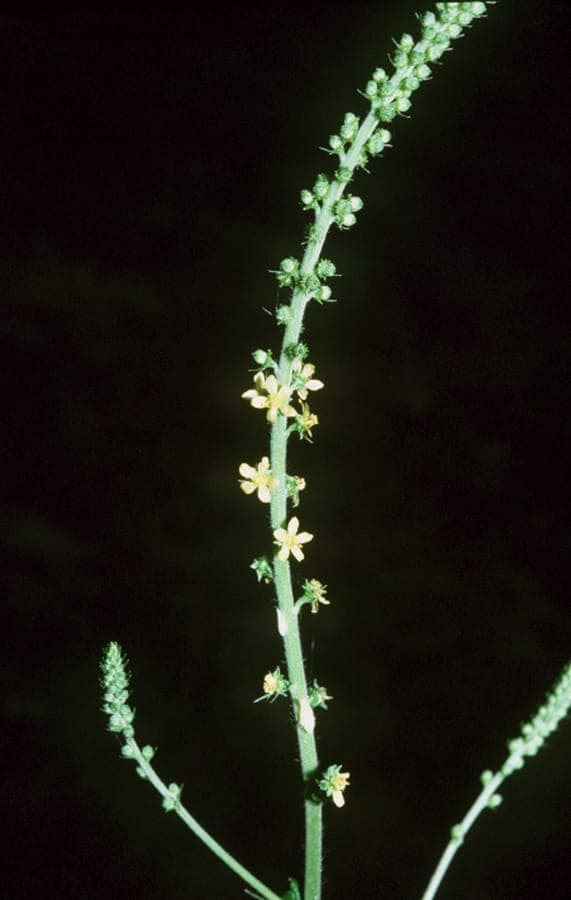
Robert H. Mohlenbrock. USDA SCS. 1989. Midwest wetland flora: Field office illustrated guide to plant species. Midwest National Technical Center, Lincoln, NE. / Public domain, via Wikimedia Commons
Small-flowered agrimony: complete guide
Agrimonia parviflora
Want to see Small-flowered agrimony: complete guide in your garden?
1 minute, no credit card
Overview
Agrimonia parviflora, known as small-flowered agrimony or swamp agrimony, is a moisture-loving perennial herb in the rose family (Rosaceae). Native to eastern and central North America - from Ontario and the Atlantic states of Connecticut, New York, and New Jersey westwards through the Midwest (Illinois, Indiana, Ohio, Michigan) and south to Alabama, Mississippi, Louisiana, Tennessee, and Texas - this plant naturally colonises moist stream banks, wet meadows, and the margins of swamp forests where soils remain consistently damp.
The genus name Agrimonia traces back to the Greek argemone, used since antiquity for medicinal plants associated with eye treatments. The species epithet parviflora is Latin for 'small-flowered', distinguishing it from the more familiar common agrimony (Agrimonia eupatoria), widespread in Europe. Synonyms include Agrimonia serrifolia Wallr. and Agrimonia polyphylla Urb.; the species was formally described in 1789 by Scottish botanist William Aiton in Hortus Kewensis. The plant grows rapidly and produces multiple stems from a central rootstock.
In European horticulture, Agrimonia parviflora remains underused despite its ornamental potential. The slender, wand-like flower spikes provide several weeks of golden-yellow bloom, and the finely divided compound leaves contribute a delicate texture to the border. At gardenworld.app, you can discover how moisture-loving perennials like this one fit into complete naturalistic garden designs, paired with compatible wetland plants and ornamental grasses.
The plant has no edible parts and no significant medicinal tradition in modern horticulture, but its hooked fruits (burrs) do demonstrate one of nature's most effective seed-dispersal strategies - clinging readily to clothing and animal fur.
Appearance & bloom cycle
Agrimonia parviflora grows as an upright, multi-stemmed perennial, typically reaching 60 to 120 cm in height, occasionally taller (up to 150 cm) in optimally moist conditions. Stems are erect and lightly hairy, sturdy enough to stand without staking. The leaves are alternately arranged and pinnately compound, with 9 to 19 pairs of large, sharply serrated leaflets interspersed with smaller intermediate leaflets - this interrupted pinnate pattern is characteristic of the genus. The upper leaf surface is dark green and lightly hairy; the underside is paler and more densely hairy.
Flowers are small, five-petalled, golden-yellow, and produced in long, slender, wand-like racemes 15 to 35 cm in length. They open progressively from the base upwards over two to four weeks per spike. In garden cultivation in temperate climates, the main flowering period runs from July through September. Each flower measures roughly 5 to 8 mm across - noticeably smaller than those of Agrimonia eupatoria, which gives rise to the common name. After flowering, small cup-shaped achenes with curved hooked bristles develop, clinging to passers-by and dispersing seeds across a wide area.
The plant has a faint aromatic scent from glandular hairs on stems and leaves - a trait shared by most agrimonies.
Ideal location
Agrimonia parviflora performs best in moist to wet, moderately fertile positions in full sun to part shade. In its natural habitat it grows at stream edges and in wet meadows where soils rarely dry out. In the garden it excels as a pondside planting, in a rain garden, along a damp border, or at the edge of a bog garden.
Full sun is suitable as long as adequate soil moisture is maintained; partial shade reduces moisture stress on warm summer days and is often the more practical choice in drier regions. Avoid dry, sandy, or freely draining positions - the plant will sulk, produce sparse growth, and bloom poorly. Good air circulation around the tall stems helps prevent fungal problems in humid conditions.
For garden designs that make the most of moist or seasonally wet areas, visit gardenworld.app to see how wetland-tolerant perennials combine into cohesive, attractive front garden schemes.
Soil requirements
The preferred soil is moisture-retentive, moderately to highly fertile, with a pH of 6.0 to 8.0 - from neutral to mildly alkaline. Clay and loam soils with good water-holding capacity are ideal. On lighter, sandy soils, incorporate generous amounts of organic matter (10 to 15 cm of well-rotted compost or leaf mould worked into the top 30 cm) before planting to improve water retention.
Prolonged waterlogging - where the root zone stays completely saturated for weeks - can cause crown rot, so some drainage is preferable even for this moisture-loving species. A gentle slope that allows excess water to drain away while keeping the soil consistently damp is the ideal arrangement. Avoid thin, nutrient-poor soils; apply a generous top-dressing of compost each spring to maintain soil fertility and moisture-holding capacity.
The species does not require highly acidic conditions and actually tolerates slightly alkaline soils well - a useful trait for gardens on chalky substrates.
Free design
Want to see Small-flowered agrimony: complete guide in your garden? Make a free design now.
Watering
Consistent moisture is the key to success with Agrimonia parviflora. On heavy clay soils in a temperate climate with regular rainfall, supplemental watering may be minimal. On lighter or free-draining soils, deep watering at least once a week during the growing season is essential.
Water in the morning, applying 15 to 20 litres per square metre to wet the root zone to a depth of 30 cm. A generous mulch layer (8 to 10 cm of chopped leaves, straw, or bark chippings) at the plant's base significantly reduces evaporation and keeps soil temperature stable - essential on hot summer days. Rewater when the top 5 cm of soil feels dry to the touch.
In wet years with high rainfall, little or no supplemental watering is needed. During extended dry spells (more than two weeks without significant rain), drip irrigation at soil level - keeping foliage dry - is the most efficient approach. Avoid overhead sprinklers, which can promote fungal leaf diseases on the dense foliage.
Pruning
Agrimonia parviflora requires minimal pruning. After flowering in late summer or autumn, cut back spent flower spikes to 10 to 15 cm above the ground. The hooked bristles on ripe fruits cling to clothing easily; if the plant is positioned near a path or seating area, cut the spikes before fruits fully ripen to avoid an inconvenience.
The plant dies back to ground level in autumn. Leave the stubs standing through winter to provide overwintering habitat for beneficial insects and some frost protection for the crown. In March or early April, remove old stems cleanly at ground level to allow fresh new growth to emerge unobstructed. Every three to four years, lift and divide congested clumps in early spring - this rejuvenates the plant, maintains vigour, and provides additional specimens for new plantings.
Maintenance calendar
February–March: Remove old stems and dead leaf debris. Apply well-rotted compost or slow-release organic fertiliser around the crown. Check for slug damage on emerging new shoots.
April–May: Monitor soil moisture and water during dry spells. Top up mulch if the layer has thinned. Divide congested clumps if required.
June–July: Plant reaches full height. First flower spikes emerge in late June. Water consistently - at least once a week deeply - if weather is dry.
July–September: Main flowering period. Enjoy the graceful yellow wands. Deadhead spent spikes if self-seeding or burr production is not desired.
October–November: Cut back to 10–15 cm or leave standing for wildlife. Apply a generous mulch to protect the crown over winter.
December–January: Plant is dormant below ground. Minimal care needed.
Winter hardiness
Agrimonia parviflora is fully winter-hardy across temperate Europe. It grows naturally in areas of North America where temperatures regularly drop to -25 °C, making it reliably hardy in USDA zones 3 through 8. The Netherlands, Belgium, France, and most of Germany present no challenge; even in colder northern regions the plant overwinters comfortably as long as the root zone does not remain permanently waterlogged.
The plant dies completely to ground level each autumn and regenerates from the rootstock in spring. On light, freely draining soils, apply a mulch (8 to 10 cm of leaf mould or bark) over the crown zone to buffer against severe freeze-thaw cycles. On heavy clay soils keep the mulch somewhat thinner to avoid smothering the crown. After cold winters, new growth emerges somewhat later - typically by late April - but recovery is rapid and the plant usually reaches full flowering height by July.
Companion plants
Agrimonia parviflora combines naturally with plants sharing its preference for moist soils and full sun to part shade. Classic North American wetland pairings work particularly well.
Eupatorium perfoliatum (boneset) and Lobelia cardinalis (cardinal flower) are complementary American woodland-edge plants: the intense red of cardinal flower and the white clusters of boneset create striking colour contrasts with the golden-yellow of the agrimony spikes. Iris pseudacorus (yellow flag iris) and Iris versicolor (blue flag iris) provide bold structural accents at the pond or stream edge.
Filipendula ulmaria (meadowsweet) shares the wet habitat and contributes foamy white flowers in summer. Lythrum salicaria (purple loosestrife) and Lysimachia punctata (dotted loosestrife) extend the palette of yellow and pink-purple through summer and into early autumn. On the drier margins of the moist zone, Geranium and Astrantia species provide lower-growing companions that bridge the gap to the conventional border.
Closing
Small-flowered agrimony is a graceful, ecologically valuable perennial for moist garden situations. Its slender golden flower wands, insect-attracting blooms, and finely textured foliage make it an excellent choice for rain gardens, pondside plantings, damp borders, and naturalistic wetland margins. Give it consistently moist, fertile soil, a position in sun or part shade, and it will reward you with weeks of reliable late-summer colour.
Discover how to integrate moisture-loving perennials like Agrimonia parviflora into your front garden design at gardenworld.app - complete with personalised plant combinations suited to your garden's specific conditions.
Want to see Small-flowered agrimony: complete guide in your garden? Make a free design now.
Upload a photo, pick a style, and get a photorealistic design with plant list in under a minute.
10,000+ gardens designed already
No credit card required


Similar plants
Siberian crab apple: complete guide
Malus x robusta
Complete guide to the Siberian crab apple (Malus x robusta): location, soil, pruning, winter hardiness and the best companion plants for your garden.
Chinese flowering crabapple (Malus x spectabilis): complete guide
Malus x spectabilis
Meet the Chinese flowering crabapple (Malus x spectabilis): a classic spring bloomer with carmine buds and pink blossom.
Potentilla crassinervia: complete guide
Potentilla crassinervia
Potentilla crassinervia, the Corsican cinquefoil, grows wild on Corsica and Sardinia's peaks. Discover how to grow this hardy alpine rock garden gem.