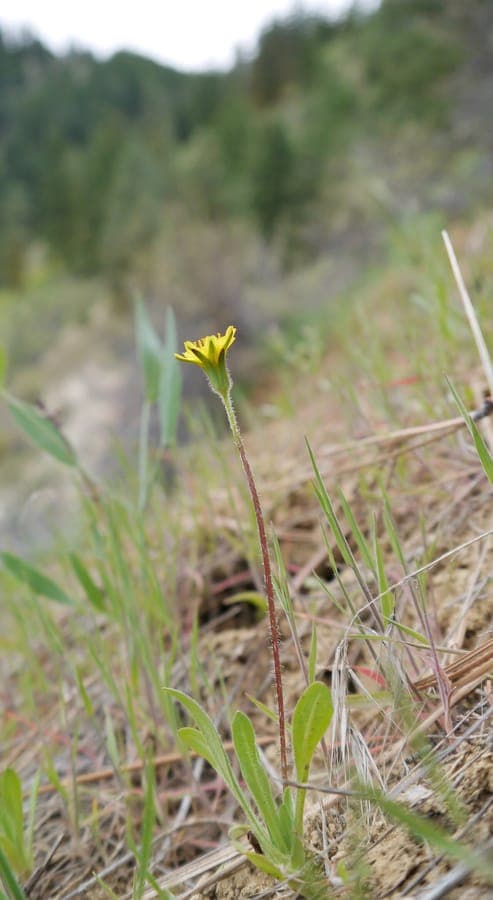
Thayne Tuason / CC BY-SA 4.0, via Wikimedia Commons
Annual agoseris: complete guide
Agoseris heterophylla
Want to see Annual agoseris: complete guide in your garden?
Full design in HD: €7.99
Look after your Annual agoseris with the GardenWorld app
Identify plants with your camera and get a care calendar with reminders for this plant.


Overview
Annual Agoseris (Agoseris heterophylla), also known as Annual False-Dandelion, is a charming annual wildflower from western North America. This plant is widely found on dry slopes, grasslands, and mountain regions from Canada to Mexico. The plant grows to approximately 40 centimeters and produces yellow flowers resembling small dandelion heads.
Appearance and Bloom
Agoseris heterophylla forms a rosette of dark green, linear leaves when young. The leaves can be smooth or slightly toothed, depending on the form. The flower stalk is slender and yellow. Flowers are yellow, small, daisy-like flower heads on long stems. Seeds have white plumes like dandelions. The entire plant is hairless or lightly hairy.
Ideal Location
Agoseris heterophylla grows best in full sun. This plant thrives on warm, dry mountain slopes. South or west-facing plantings work well. The plant tolerates windy locations excellently. This wildflower is perfect for xeriscaping and dry garden designs.
Soil
The plant grows on diverse soil types. Well-draining, poor to moderately nutrient-rich soil is preferred. Mixing sand, gravel, or small stones helps drainage. The plant tolerates very dry conditions. pH can be acidic to neutral. Planting in extremely well-draining soil is preferred.
Watering
Once established, Annual Agoseris requires very little water. This wildflower grows well with rainfall only. Young plants can benefit from growing-season watering until well-established. Mature specimens are extremely drought tolerant. Overwatering can cause root rot.
Free preview
Want to see Annual agoseris: complete guide in your garden? Make a free preview of your design.
Pruning
Minimal maintenance is needed. Remove dead flowers to encourage more blooms. This is called "deadheading." Also remove dead or damaged leaves. The self-seeding plant can be deadheaded if you don't want more flowers next year.
Maintenance Calendar
Spring: Direct sow seed in soil after last frost. Water gently until germination. Summer: Deadhead flowers for more blooms. Minimal watering in dry periods. Autumn: Let seeds ripen and fall for self-seeding. Winter: No maintenance. Seeds can overwinter.
Winter Hardiness
Agoseris heterophylla is an annual wildflower. In mild climates, it can self-seed and return for many years. In harsh winters, new seed is needed. This wildflower is not frost-hardy as a plant, but seeds overwinter easily in many climates.
Companion Plants
Agoseris heterophylla combines well with other wildflowers and drought plants. Lupines, Indian paintbrush, and other alpine plants fit well. Ornamental grasses add texture. Plant in groups for more impact. Works well in wildflower mixes.
Closing
Annual Agoseris is an excellent choice for native and xeriscape gardens. This charming wildflower brings early yellow color to mountain meadows. With minimal maintenance, it blooms faithfully each year. Visit gardenworld.app for inspiration on wildflower garden design.
Order Annual Agoseris seeds from native plant specialists. Gardenworld.app helps you create natural wildflower gardens.
Frequently asked questions about Annual agoseris
Is Annual agoseris winter hardy?
Agoseris heterophylla is an annual wildflower. In mild climates, it can self-seed and return for many years.
When and how do you prune Annual agoseris?
Minimal maintenance is needed. Remove dead flowers to encourage more blooms.
How much water does Annual agoseris need?
Once established, Annual Agoseris requires very little water. This wildflower grows well with rainfall only.
Where does Annual agoseris grow best?
Agoseris heterophylla grows best in full sun. This plant thrives on warm, dry mountain slopes.
What soil does Annual agoseris need?
The plant grows on diverse soil types. Well-draining, poor to moderately nutrient-rich soil is preferred.

See it in your garden
See Annual agoseris in your garden
One photo of your garden and a few questions. You see the result in about a minute.
Try it with a photoIdentify this plant in your own garden. Identify a plant
Similar plants
Frikart's aster (Aster × frikartii): complete guide
Aster × frikartii
Everything about Frikart's aster (Aster × frikartii): position, soil, pruning and hardiness of the aster that flowers lavender-blue from July to October.
False aster (Boltonia asteroides): complete guide
Boltonia asteroides
False aster (Boltonia asteroides) covers itself in white daisies from late August to October. How to plant, cut back and combine this tough, tall perennial.
Daisy bush (Brachyglottis greyi): care guide
Brachyglottis greyi
Brachyglottis greyi, formerly Senecio greyi, pairs silver felted leaves with yellow summer daisies. Advice on position, soil, pruning, hardiness and companions.
