
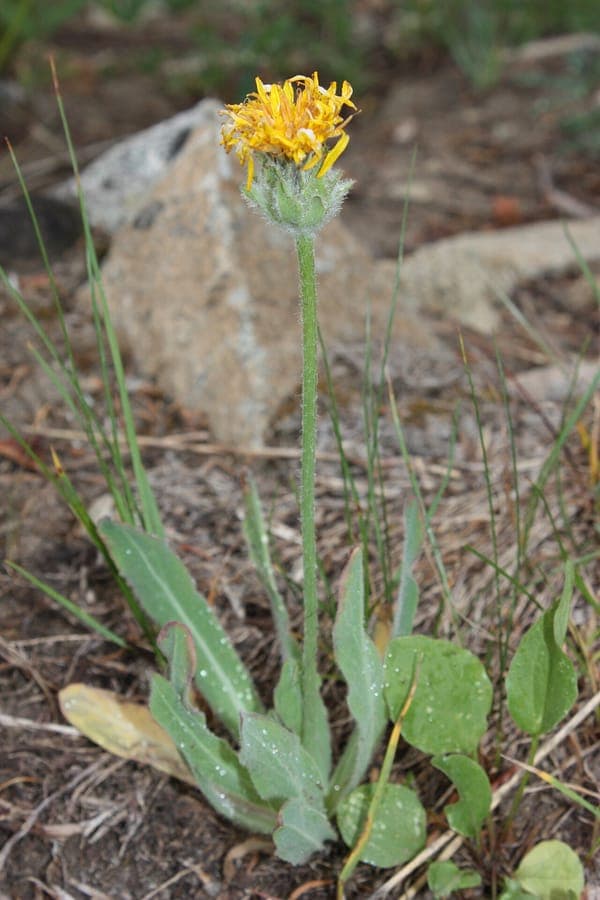
Walter Siegmund (talk) / CC BY-SA 3.0, via Wikimedia Commons
Prairie agoseris: complete guide
Agoseris glauca
Want to see Prairie agoseris: complete guide in your garden?
1 minute, no credit card
Overview
Agoseris glauca, commonly known as prairie agoseris, pale agoseris, or prairie dandelion, is a robust perennial wildflower in the family Asteraceae. It belongs to the genus Agoseris, which comprises around twenty closely related species all native to western North America. Agoseris glauca is the most widely distributed species in the genus: its range covers the entire western half of Canada (British Columbia, Alberta, Saskatchewan, Manitoba, Yukon, and Northwest Territories) south through the western United States from Montana and Idaho to Arizona and New Mexico, and extends eastward as far as Michigan and Minnesota. This vast range spans an exceptionally broad climatic profile, from subarctic to semi-arid temperate.
The species has a long history of human use. Various indigenous peoples of the Great Plains valued the gum-like milky latex as an adhesive and used the cooked roots as food. The leaves were sometimes eaten raw or brewed as a medicinal tea. In botanical circles, the species is sometimes divided into two varieties: var. glauca (smooth-leaved, prairie habitats) and var. dasycephala (woolly-headed, mountain habitats), though this distinction is not universally accepted.
In ornamental horticulture, Agoseris glauca is still a relatively unfamiliar name, but it is gaining traction among designers of naturalistic borders, prairie gardens, and rock gardens. Its pale lemon-yellow flower heads, which strongly resemble large dandelions but sit atop taller, more elegant stems, bring a relaxed wilderness feel to the garden. After blooming, each head develops into a beautiful white puff ball of feathered seeds similar to a dandelion clock, adding a second season of interest. The plant self-sows gently without becoming invasive, making it easy to establish a naturalised colony of basal rosettes over several years.
A distinctive characteristic is the single-crown growth habit from a thickened taproot. This makes it less suitable for creating dense ground-covering masses but ideal as a specimen plant in an open prairie border or among low-growing ornamental grasses and sedges. The glaucous, blue-grey foliage - the epithet 'glauca' refers to this waxy, blue-grey bloom on the leaf surface - provides an attractive and subtle counterpoint to the warm colours of companion prairie species like Gaillardia, Ratibida, and Rudbeckia.
Appearance & bloom cycle
Agoseris glauca forms a basal rosette of lance-shaped to oblanceolate leaves that vary considerably in length: 10–40 cm depending on site moisture and elevation. Leaves may be entire (smooth-edged), shallowly toothed, or lightly pinnately lobed, with a characteristic blue-green to grey-green colour on the blade surface. The waxy appearance is caused by a thin layer of epicuticular wax (cuticle pruinosity), which reduces moisture loss - an adaptation to dry habitats. The underside of the leaf is paler and slightly more matte.
One or occasionally two hollow, leafless flower stems rise from the centre of the rosette, growing to between 15 and 70 cm in height depending on growing conditions. In dry, exposed sites the stems remain short; in moist, sheltered spots they can become substantially taller. When a stem is broken, white milky latex flows freely and dries to a pale cream-yellow colour - characteristic of the Cichorioideae subfamily, shared with dandelion, chicory, and lettuce.
Each flower head consists of numerous ray florets radiating outward like a dandelion. The colour is a clear lemon-yellow to pale gold - noticeably paler than the intense yellows of Rudbeckia or Gaillardia - which gives the plant a subtle, naturalistic appearance that blends seamlessly into meadow plantings. In a European garden at lower elevations, blooming typically begins in May and continues through July, with the possibility of a second flush in August to September. The flower heads are 2.5–4 cm in diameter; they open in sufficient light and warmth and close in overcast conditions or during the afternoon, a typical behaviour among Lactuceae composites.
After flowering, each head transforms into a spherical seed puff 3–4 cm across, composed of numerous small achenes tipped with long, white, feathery pappus bristles. Wind disperses seeds over distances of tens of metres. A healthy rosette produces dozens to over a hundred seeds annually.
Ideal location
Agoseris glauca thrives best in an open, sunny to lightly shaded position in the garden. The species is native to open grasslands and mountain meadows with high light intensity. Full sun for at least six hours daily is the optimum. In warmer European gardens, some afternoon shade during the hottest weeks can reduce leaf scorch and extend the flowering period.
Best results are obtained on raised beds, dry slopes, rock gardens, or prairie-inspired open borders. The deep taproot makes the plant remarkably resilient to drought on well-drained soils. Sites with prolonged waterlogging must be strictly avoided: the combination of wet soil and cold winters rapidly attacks the taproot.
The species is ideal for naturalistic borders where a loose, open planting style is intended. A planting distance of 30–45 cm allows individual rosettes to develop fully. In a rock garden or alpine setting, plant one or two rosettes as focal accents among low-flowering species such as Phlox subulata, Sedum, and creeping Thymus.
In containers, Agoseris glauca grows well in large stone troughs or terracotta pots of at least 30 cm diameter with excellent drainage. A mix of loam-based compost, coarse sharp sand, and fine grit (1:1:1) suits it well. Position the container in a sunny, open spot on a terrace or balcony.
Soil requirements
Agoseris glauca has modest soil requirements as long as drainage is excellent. The botanical data records a pH range of 6.0–8.0, indicating broad tolerance from slightly acid to moderately alkaline. This corresponds to its occurrence on calcareous prairie soils and on calcium-poor mountain slopes. It grows poorly on strongly acid soils below pH 5.5, but performs well on mildly alkaline soils up to pH 8.0 - a characteristic that makes it suitable for chalky or limy gardens.
The ideal substrate is light to moderately heavy, free-draining, and not overly rich in organic matter. Sandy loam, silica-rich prairie soil, or well-drained sandy soil are all excellent. Heavy clay soils need thorough improvement: incorporate 25–30% coarse grit or perlite and 10% fine gravel through the upper 30 cm of the planting area. Applying a mulch layer of 4–6 cm of coarse quartz grit or pea gravel around the leaf rosette keeps the crown dry and significantly reduces the risk of fungal crown rot.
Over-fertilising suppresses flowering: on excessively rich soil the leaves grow lushly but the flower stems become weak and floppy. On poor soil, a single application of a low-nitrogen alpine or rock plant fertiliser in early spring once a year is sufficient. On already fertile garden soils, no feeding is needed.
Free design
Want to see Prairie agoseris: complete guide in your garden? Make a free design now.
Watering
The prairie agoseris is naturally drought-tolerant thanks to its deep, water-storing taproot. In its native range on prairies and mountain meadows, water availability is seasonal: abundant during snowmelt in spring and during occasional summer thunderstorms, but declining sharply in late summer. In a European garden on well-drained soil, supplementary watering in an average year is not generally needed except during extended dry spells lasting more than three weeks. When watering becomes necessary, give a thorough soaking at the root zone once weekly and allow the soil to dry completely before watering again.
In containers, the substrate dries out more quickly, particularly in summer sun. Check moisture levels twice a week: water when the top 3–5 cm of substrate feels dry. Never water during cold, overcast weather or during winter dormancy - the plant tolerates extended dry spells in winter without issue.
During the overwintering period (November to March) the plant needs virtually no water. The taproot remains alive in dry conditions; wet winters are by far the greatest threat to long-term cultivation of Agoseris in European gardens with heavier, less permeable soil types. A dry root zone in winter is far preferable to a moist one.
Pruning
Agoseris glauca demands a minimum of attention. The main task is removing spent flower stems after seed ripening and dispersal in August to September. If you want to prevent excessive self-sowing, remove seed heads before the puff balls open fully. Otherwise, leave the decorative seed puffs standing for autumn interest and as food for seed-eating birds.
The leaf rosette remains intact for most of the year. In early spring you can trim away any dead or tattered leaf margins to freshen the rosette, though this is purely cosmetic and entirely optional. Use clean secateurs to minimise disease transmission. The main structural feature - the taproot and growing crown - requires no intervention whatsoever.
The plant readily produces new individuals through self-sown seed. Collect ripe seed heads in August for controlled propagation, or allow gentle naturalisation. Seeds germinate reliably after four to six weeks of cold moist stratification at 2–4 °C. Sow in February to March in a mixture of general-purpose compost and coarse sharp sand (1:1) in a cold frame or unheated glasshouse.
Maintenance calendar
January–February: No active maintenance required. Check during thaw periods that the root zone is not sitting in standing water. If necessary, loosen the grit mulch around the rosette to improve drainage.
March: Remove residual dry leaves from the previous year. Check for slug damage on newly emerging shoots - prairie agoseris is not a primary target but young rosettes can be damaged. Apply one light dressing of low-nitrogen alpine fertiliser if the soil is very poor.
April: Rosettes fully develop. Check for aphid infestations. Water if the top soil layer has been dry for two consecutive weeks.
May–June: Flower stems begin rising. First lemon-yellow flower heads appear at lower-elevation sites. Enjoy the ornamental seed puff balls that form after the initial flowers fade.
July–August: Peak flowering on most sites. Seed development and dispersal. Harvest seed heads for propagation or leave for self-sowing and birds.
September: Wind dispersal of seeds. Remove dry flower stems if desired. Possible second flush of flowers during warm, settled weather.
October–November: Rosettes remain green until hard frost. Apply a coarse grit mulch around the rosette on heavy clay soils as a moisture buffer.
December: Complete dormancy. No water, no feed. Check monthly for waterlogging at the root crown.
Winter hardiness
Agoseris glauca is exceptionally cold-hardy. As a native of the subarctic Canadian prairies (Yukon, Northwest Territories) and the high-alpine meadows of the Rocky Mountains, the species survives temperatures down to -35 °C or below without difficulty. USDA hardiness zones 3 to 8 are applicable, meaning the plant overwinters without any protection throughout all of Europe, including Scandinavia and alpine regions.
The fleshy taproot functions as a nutrient and energy store that protects the plant against extreme cold. Repeated freeze-thaw cycles do not cause permanent damage: the leaf rosette may freeze completely and the plant recovers in early spring from the living taproot. This recovery is remarkably rapid; new leaves appear as soon as soil temperatures rise above 4–5 °C.
The only winter risk is not frost but rot from standing water. On clay or loam soils with poor drainage, a coarse grit mulch around the rosette is the simplest solution. In regions with heavy winter rainfall (over 700 mm annually), a temporary pane of glass propped above the rosette or a 5 cm layer of coarse grit applied directly to the crown can significantly improve survival rates on particularly wet soil types.
At gardenworld.app, you can create a garden design featuring cold-hardy perennials and see immediately how prairie species like Agoseris glauca combine with other plants in a cohesive planting scheme.
Companion plants
Agoseris glauca is well suited to prairie borders, rock gardens, and naturalistic plantings. Recommended companion species sharing comparable site requirements:
- Penstemon angustifolius (Plains penstemon): lilac to blue-purple tubular flowers from May to July; elegant colour contrast with the lemon-yellow of Agoseris.
- Gaillardia aristata (Blanket flower): orange-red with yellow, blooms through to September, comparable preference for poor, dry soil.
- Ratibida columnifera (Prairie coneflower): yellow to mahogany-bronze drooping petals around a tall central cone; authentic prairie atmosphere.
- Erigeron speciosus (Showy fleabane): purple-pink to white daisy-like flowers, long-blooming from June to August, low to medium height.
- Liatris punctata (Dotted gayfeather): vivid purple plumes in August–September, compact corm-geophyte, excellent for dry prairie borders.
- Bouteloua gracilis (Blue grama grass): low ornamental grass, 20–30 cm tall, with distinctive horizontal seed combs; lightweight, transparent filler around Agoseris rosettes.
For a finer-scale rock garden, combine Agoseris glauca with Draba, Saxifraga, and low-growing Sedum species. For a larger prairie border, the combination with Stipa tenuissima (Mexican feather grass) and Salvia nemorosa is particularly attractive: the swaying grasses and blue sage spikes contrast beautifully with the pale yellow flower heads of Agoseris.
Conclusion
Agoseris glauca is an understated but charming perennial that earns its place through quiet elegance. Its lemon-yellow flower heads, decorative white seed puffs, glaucous basal rosette, and outstanding cold-hardiness make it a reliable and attractive choice for anyone wanting an authentic prairie atmosphere or a low-maintenance rock garden. It asks little, gives a great deal, and adapts to a wide range of soils as long as drainage is good.
For more plant guides, design inspiration, and the interactive garden planning tool, visit gardenworld.app - your resource for planning beautiful and distinctive garden plantings.
Want to see Prairie agoseris: complete guide in your garden? Make a free design now.
Upload a photo, pick a style, and get a photorealistic design with plant list in under a minute.
10,000+ gardens designed already
No credit card required


Similar plants
Calendula stellata: complete guide
Calendula stellata
Complete guide to Calendula stellata, the star-flowered marigold from Sicily: location, soil, watering and companion planting tips.
Korean chrysanthemum: complete guide
Chrysanthemum x rubellum
Chrysanthemum x rubellum is a hardy autumn perennial with single pink to copper flowers from August to November. Care and combinations.
Helianthus divaricatus: complete guide
Helianthus divaricatus
Helianthus divaricatus is a North American woodland sunflower with yellow summer blooms, ideal for naturalistic borders and shady edges.