
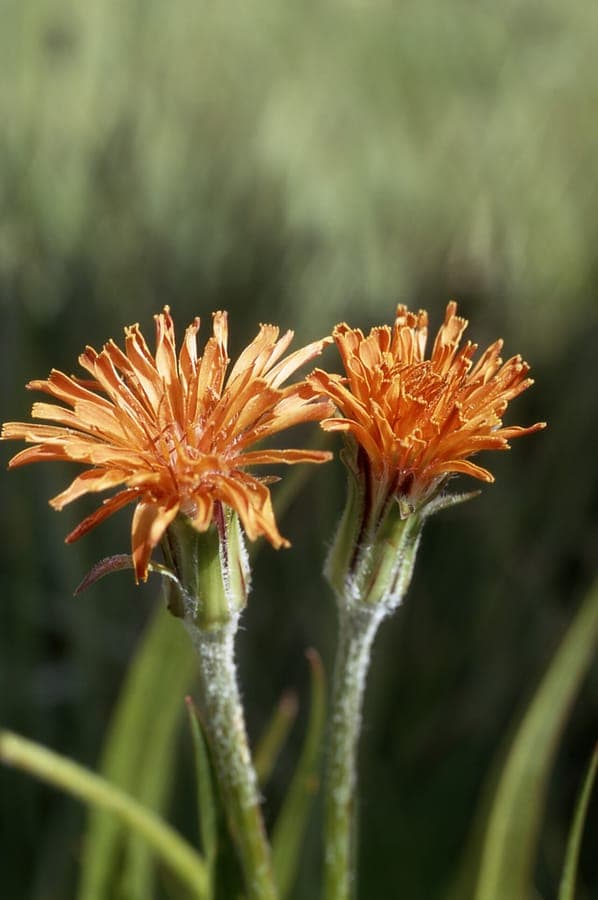
JW Stockert / Public domain, via Wikimedia Commons
Orange agoseris: complete guide
Agoseris aurantiaca
Want to see Orange agoseris: complete guide in your garden?
1 minute, no credit card
Overview
Agoseris aurantiaca, commonly called orange agoseris or orange false-dandelion, is a striking perennial wildflower in the family Asteraceae. It belongs to the genus Agoseris, which encompasses around twenty closely related species all native to western North America. Agoseris aurantiaca stands apart from its relatives because of its unmistakably orange to red-orange flower heads - a colour that is exceptional within the genus, as most Agoseris species bloom yellow. This warm-hued bloom rises above a rosette of toothed leaves on a slender, hollow stem that exudes white milky latex when broken, just like a common dandelion.
The species is native to a sweeping territory extending from Alaska and the Yukon in the north to Arizona and New Mexico in the south, and from the Pacific coast to the western edge of the Great Plains. It occupies subalpine meadows, forest margins, rocky slopes, and open conifer forests at elevations between 1,500 and over 3,500 metres. At those altitudes the growing season is short, which has shaped the plant into a compact, vigorous perennial that moves rapidly from germination to bloom.
In garden cultivation, Agoseris aurantiaca is still a relatively unknown plant, but it is gaining recognition among designers of wilderness gardens, rock gardens, and prairie borders. Its vivid orange colour creates a spectacular contrast with yellow- and purple-flowering perennials. The flower heads resemble large dandelions - 3–5 cm across - and after blooming transform into decorative white puff balls of feathery seed plumes, adding a second season of ornamental interest. The plant self-sows gently without becoming invasive, making it easy to establish a naturalised colony over time.
A notable characteristic is its adaptation to short growing seasons at low temperatures. When cultivated at lower elevations in a European garden, it begins growth early in spring as soon as the soil thaws, and plants come into flower as early as May to June. This early flowering season makes it a valuable contributor to the spring and early summer garden before many other perennials have fully emerged.
Appearance & bloom cycle
Agoseris aurantiaca forms a basal rosette of yellow-green leaves that vary considerably in shape: they may be smooth-edged, shallowly toothed, or deeply lobed like dandelion leaves, with individual leaf lengths ranging from 10 to 35 cm. The leaf texture is moderately thick and slightly hairy along the margins and undersurface. Young leaves are shiny green on the upper surface; older leaves become somewhat duller. During dry spells, leaf margins may curl slightly inward to reduce water loss.
One or several hollow, leafless flower stems rise from the centre of the rosette. These stems stand 15–60 cm tall depending on site conditions and soil moisture, and each carries a single flower head at its tip. When a stem is snapped, white, sticky latex oozes out and dries to a yellowish colour on exposure to air.
The flower heads are composed of numerous ray florets, all radiating outward like a dandelion. The colour is vivid orange to red-orange, sometimes with a faint purplish tint on the back of the outer ray florets. Flowering typically occurs from June to August at lower elevations, and from July to September at higher altitudes. Individual flower heads open in the morning and close in the afternoon or during overcast periods - a behaviour common among members of the Lactuceae tribe in the daisy family.
After flowering, the head develops into a spherical structure of achenes tipped with long, feathery pappus hairs, identical in appearance to a dandelion clock. Seeds are dispersed by wind. A mature plant produces dozens to several hundred seeds per flowering season depending on growing conditions and local pollinators.
Ideal location
In the garden, Agoseris aurantiaca thrives best in an open, sunny to lightly shaded position. The species is native to open mountain landscapes with intense solar radiation, so full sun for at least six hours daily is ideal. In warmer, low-elevation gardens, a position with some afternoon shade protects the foliage from scorching during the hottest weeks of summer and significantly extends the flowering period.
The plant excels in rock gardens and on well-drained slopes or raised beds. In flat borders it works well as a mid-border plant alongside low-growing ground covers. It is not suited to positions with prolonged waterlogging or to the base of walls where rainwater collects. Because Agoseris aurantiaca naturally grows in open meadows, it performs best where overhead shrubs or trees do not create persistently high air humidity around the rosette.
Frost pockets - low-lying areas where cold air pools in early spring - are not a concern in terms of frost damage (the plant is very cold-hardy), but the combination of stagnant cold air and wet soil in such spots can promote root rot. Good drainage is the single most important site requirement.
In containers, orange agoseris grows successfully in large troughs, stone sinks, or alpine pans that give a naturalistic mountain feel. Pair it in a trough with Penstemon, Erigeron, and low-growing Achillea for an authentic montane planting.
Soil requirements
Agoseris aurantiaca is undemanding about soil type as long as drainage is excellent. In its natural habitat it grows on thin, lean mountain soils that are mineral-rich but low in organic matter: low in nitrogen and phosphate but relatively high in calcium and potassium. Based on the botanical data, the preferred pH range is 6.6–7.5, from slightly acidic to neutral-alkaline. The plant grows poorly on strongly acid soils below pH 5.5.
In the garden, a light, dry to moderately moist soil of sandy loam or gravelly texture is ideal. Avoid heavy clay soils or highly organic composts with strong moisture retention; on such substrates the taproot and root system are prone to rotting, particularly combined with wet, cold winters. If your soil is heavy, carry out deep soil preparation and incorporate coarse grit, sharp sand, and small pebbles through the upper 30–40 cm. Applying a mulch layer of 5–8 cm of coarse quartz grit around the leaf rosette keeps the foliage dry and prevents crown rot.
Over-fertilising is counterproductive: on excessively rich soil the leaves grow lush but the stems become weak and lodge easily. No annual feeding is needed; on poor soil a single application of a low-nitrogen alpine or rock plant fertiliser in early spring is sufficient.
Free design
Want to see Orange agoseris: complete guide in your garden? Make a free design now.
Watering
In its natural range, the orange false-dandelion is accustomed to snowmelt in spring and intermittent summer rains followed by dry periods. Moderate moisture during the growing season is all that is needed; do not overwater. In an average western European summer, supplementary watering is generally unnecessary if the soil is well-drained. Water during extended dry spells lasting more than two to three weeks: a deep, thorough soaking once weekly is sufficient.
In containers and rock gardens the substrate dries out faster. Check twice a week and water when the top 3–5 cm of substrate feels completely dry. Never water during cold, overcast weather or during the winter rest period - the plant tolerates extended dry spells in winter without any harm.
Excess moisture in winter is the most common cultivation mistake. The plant overwinters successfully with a dry root zone and a light covering of dry grit, but wet winter conditions lead rapidly to crown and root rot. In high-rainfall regions, a pane of glass propped above the rosette or a mulch of coarse grit directly around the crown is a useful precaution.
Pruning
Agoseris aurantiaca requires minimal attention. Remove spent flower stems after seed dispersal in August to September if you do not want self-sown seedlings, or leave the feathery seed heads standing for decorative effect in the autumn and early winter garden. The dried material also provides seeds for seed-eating birds.
Before winter, you can remove the dead leaves or leave them in place as a light protective layer around the rosette. The fleshy taproot and growing point survive frost without any protection. In early spring, as new shoots emerge, remove residual dry foliage to encourage growth and to reduce slugs sheltering beneath it.
Gentle self-sowing does occur: allow a few ripe seed heads to release naturally, or collect seed for new plantings. Seeds germinate well after stratification of four to six weeks at 2–5 °C. Sow in a mixture of loam-based compost and coarse sand (1:1) in cold frames or unheated glasshouses in early spring.
Maintenance calendar
January–February: No active maintenance needed. Check that the rosette is not sitting in a waterlogged hollow; improve drainage if necessary to prevent rotting.
March: Remove dead leaves from the previous year. Check for slug damage on newly emerging shoots. Apply one light dressing of a slow-release alpine plant fertiliser if soil is very poor.
April: The leaf rosette develops fully. Check for aphid or whitefly infestations. Water if the top layer of soil has been dry for two weeks.
May–June: Flowering begins at lower-elevation sites. Enjoy the vivid orange flower heads. Do not remove side stems - a vigorous plant can carry several flower stems simultaneously.
July–August: Peak flowering. Seed development follows. Remove seed heads promptly if you want to limit self-sowing, or leave them for naturalised spread.
September: Wind dispersal of seeds. Collect ripe seed for propagation or allow to self-sow. Remove dry flower stems.
October–November: The rosette remains largely green until hard frost. Apply a protective layer of fine grit around the rosette on heavy clay soils.
December: Complete dormancy. No water, no feed.
Winter hardiness
Agoseris aurantiaca is exceptionally cold-hardy. As a native of subarctic mountain meadows and high-alpine grasslands, the species survives temperatures down to -30 °C and below. USDA hardiness zones 3 to 8 apply, covering virtually all of Europe including Scandinavia. No winter protection is required in the Netherlands, Belgium, France, or Germany.
The plant survives repeated freeze-thaw cycles as long as the taproot remains intact. The fleshy root functions as an energy reservoir that drives rapid new growth in early spring. On heavy clay or loam soils with poor drainage, the risk to the plant in winter is not frost per se but the combination of moisture and cold that promotes crown rot. Ensure good drainage if your garden soil is heavy.
Sites with prolonged snow cover provide natural insulation; the rosette survives perfectly beneath snow. In gardens where winter snow is rare and rain is frequent, a mulch of coarse grit or sharp sand applied directly around the crown acts as an effective moisture buffer.
Using gardenworld.app you can design a rock garden or prairie border and explore how cold-hardy species like Agoseris aurantiaca fit within a year-round planting scheme.
Companion plants
Agoseris aurantiaca is well suited to wilderness gardens and rock gardens and pairs well with species sharing similar site requirements:
- Penstemon strictus (Rocky Mountain penstemon): blue-purple spikes in June–July, comparable drought tolerance; the blue-purple contrasts beautifully with orange Agoseris.
- Erigeron compositus (Dwarf mountain fleabane): small white to lilac daisy-like flowers, low and compact, an ideal rock garden neighbour.
- Achillea millefolium (Common yarrow): white to pink flat-topped flower clusters, a summer-bloomer with comparable drought tolerance.
- Lupinus argenteus (Silvery lupine): blue spikes, nitrogen-fixing, native to the same mountain meadow communities.
- Geum triflorum (Prairie smoke): warm pink, plume-like seed heads after flowering, remarkably decorative in autumn.
- Mertensia ciliata (Mountain bluebells): blue-turquoise hanging bells, a compact perennial for moister microsites in the rock garden.
For a prairie border in flat gardens, combine Agoseris aurantiaca with Rudbeckia hirta, Gaillardia aristata, and Ratibida columnaris for a fully western North American prairie look from late June through September.
Conclusion
Agoseris aurantiaca is a rare beauty that remains underappreciated despite its considerable garden virtues. Its vivid orange flowers, modest size, outstanding cold-hardiness, and low maintenance requirements make it an excellent choice for rock gardens, mountain borders, and naturalistic plantings. Anyone seeking to create an authentic atmosphere with native North American prairie and alpine species will find in this distinctive composite a reliable and rewarding perennial.
Visit gardenworld.app for more inspiration on distinctive perennials and for the design tool that lets you visualise and plan your ideal plant combinations.
Want to see Orange agoseris: complete guide in your garden? Make a free design now.
Upload a photo, pick a style, and get a photorealistic design with plant list in under a minute.
10,000+ gardens designed already
No credit card required


Similar plants
Calendula stellata: complete guide
Calendula stellata
Complete guide to Calendula stellata, the star-flowered marigold from Sicily: location, soil, watering and companion planting tips.
Korean chrysanthemum: complete guide
Chrysanthemum x rubellum
Chrysanthemum x rubellum is a hardy autumn perennial with single pink to copper flowers from August to November. Care and combinations.
Helianthus divaricatus: complete guide
Helianthus divaricatus
Helianthus divaricatus is a North American woodland sunflower with yellow summer blooms, ideal for naturalistic borders and shady edges.