
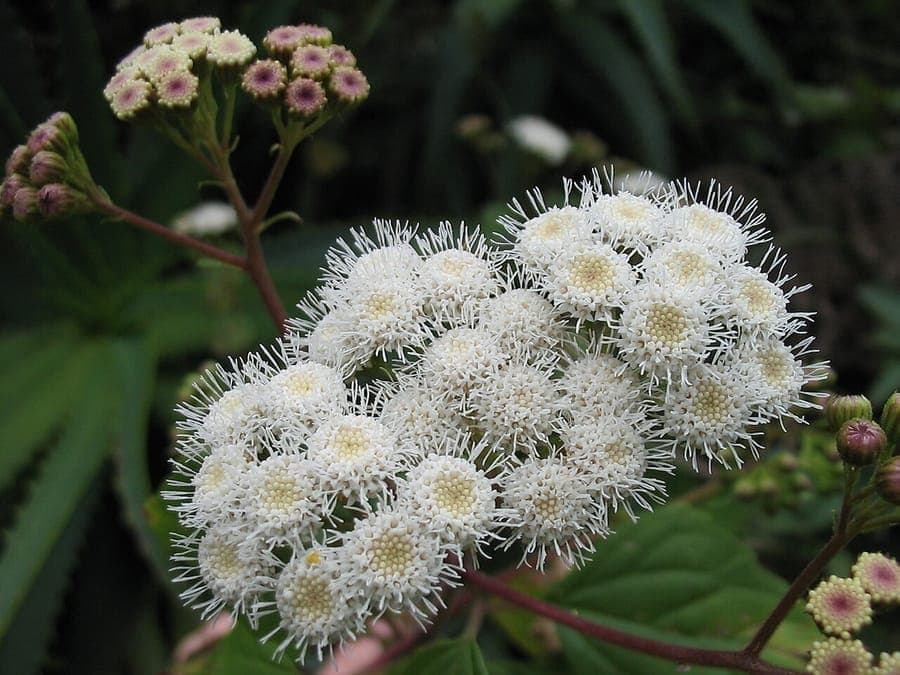
Ixitixel / CC BY-SA 3.0, via Wikimedia Commons
Maui pamakani: complete guide
Ageratina adenophora
Want to see Maui pamakani: complete guide in your garden?
1 minute, no credit card
Overview
Ageratina adenophora, commonly known as Maui pamakani, Mexican devil, or sticky snakeroot, is an attractive subshrub from the Asteraceae family (daisy family). This plant originates from Mexico and grows in mild to warm, dry conditions.
The plant is recognized for its attractive pink to purple flowers and aromatic foliage. It is perfect for sunny borders, dry gardens, and locations where drought-tolerance is essential. This plant provides beautiful color and texture to front gardens.
Appearance and Bloom
Ageratina adenophora grows as a compact to medium-sized subshrub, usually 60-120 cm tall. The plant has narrow, line-shaped leaves that are aromatic and give off a pleasant fragrance when touched.
The flowers are the star of this plant - small pink to purple flowers are produced in dense clusters from September to November. These flowers attract butterflies and other insects and provide food for birds.
Ideal Location
Use this plant in full sun to partial shade, though full sun gives the best results. The plant prefers warm, sheltered locations where it is protected from cold winds.
Perfect for sunny borders, dry hillsides, Mediterranean shrublands, and drought-tolerant planting schemes. Use it as a backdrop in borders, as a specimen plant, or in groups for extra impact.
Soil
Ageratina adenophora prefers dry, well-draining soils. It thrives in poor, sandy to gravelly soils and is highly drought-tolerant.
The plant cannot tolerate waterlogged soils and prefers lean, undernourished soils. Add sand or gravel if your soil has too much organic matter.
Watering
Once established, this plant is very drought-tolerant and requires minimal watering. In the first growing year, water regularly to encourage established roots.
Once established, water only in very dry periods. Excessive watering can lead to soft growth and plant decline.
Free design
Want to see Maui pamakani: complete guide in your garden? Make a free design now.
Pruning
Pruning is important for shape and maintenance. After flowering, prune back to keep the plant compact and encourage new growth. Heavy pruning can be done in spring.
Remove dead or damaged branches throughout the year. This helps prevent the plant from becoming leggy.
Maintenance Calendar
Spring: Heavy pruning. Begin watering. Add fertilizer. Summer: Minimal maintenance. Water in very dry periods. Fall: Bloom period. Enjoy butterflies and birds. Winter: Minimal activity. Protect against hard frost in cold regions.
Winter Hardiness
Ageratina adenophora is moderately hardy. It can tolerate temperatures down to approximately -10°C, though it thrives better in warmer climates. When growing in cold regions, protect plants against hard frost with mulch or grow in container culture.
Companion Plants
This plant combines well with other Mediterranean species such as lavender, salvias, and other drought-tolerant foliage. Group with sedums, artemisias, and grasses for texture.
Perfect with other flowering shrubs such as cistus and helichrysum.
Closing Thoughts
Ageratina adenophora is a wonderful plant for gardeners wanting to combine pink flowers and drought-tolerance. With minimal maintenance and beautiful flowers, it will provide years of beauty and insect attraction.
Perfect for front gardens, sunny borders, or dry sites, this Mexican beauty offers dramatic color and natural charm. Discover today how to integrate this attractive plant into your garden on gardenworld.app.
Looking for more information about drought-tolerant plantings? Visit gardenworld.app for inspiration and advice tailored to your front garden!
Want to see Maui pamakani: complete guide in your garden? Make a free design now.
Upload a photo, pick a style, and get a photorealistic design with plant list in under a minute.
No credit card required


Similar plants
Calendula stellata: complete guide
Calendula stellata
Complete guide to Calendula stellata, the star-flowered marigold from Sicily: location, soil, watering and companion planting tips.
Korean chrysanthemum: complete guide
Chrysanthemum x rubellum
Chrysanthemum x rubellum is a hardy autumn perennial with single pink to copper flowers from August to November. Care and combinations.
Helianthus divaricatus: complete guide
Helianthus divaricatus
Helianthus divaricatus is a North American woodland sunflower with yellow summer blooms, ideal for naturalistic borders and shady edges.