
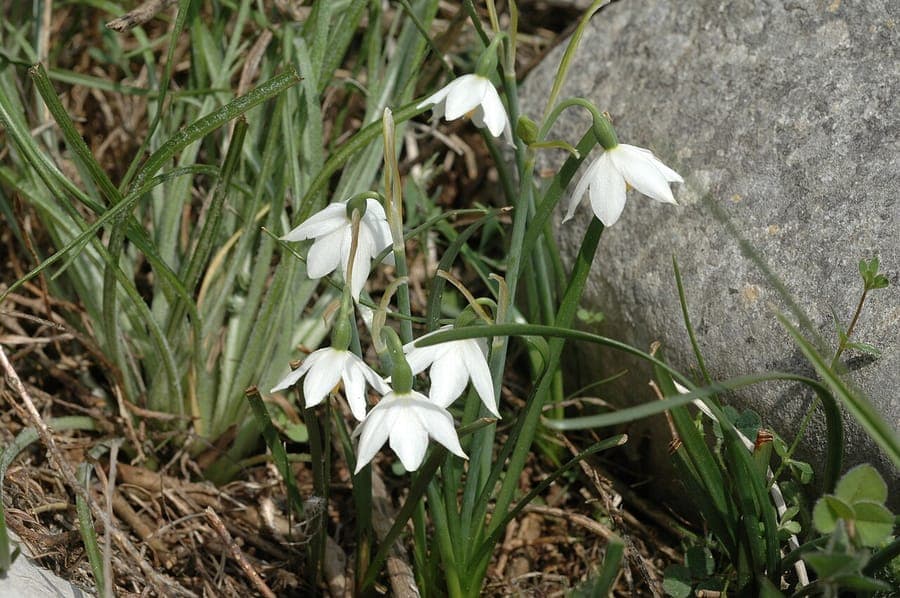
Jpaquetvence / CC BY-SA 4.0, via Wikimedia Commons
French snowflake: complete guide to Acis nicaeensis
Acis nicaeensis
Want to see French snowflake: complete guide to Acis nicaeensis in your garden?
1 minute, no credit card
Overview
Acis nicaeensis, commonly called French snowflake, is a rare and charming bulbous plant in the family Amaryllidaceae. This small bulb is native to the extreme southeastern corner of France, in the area around Nice and the neighbouring Alpes-Maritimes, where it grows on rocky limestone slopes close to the Mediterranean coast. The species was originally described as Leucojum nicaeense and was transferred to the genus Acis in 2004. Its closest relatives are spring snowflake (Leucojum vernum) and the common snowdrops of the genus Galanthus, but Acis nicaeensis flowers later - in March to April - and requires a warmer, drier position than either of those familiar bulbs.
For gardeners in northern Europe, this is a collector's plant that rewards those willing to provide the specific conditions it needs. A sunny, sheltered spot on free-draining, calcareous soil is essential. Those with a Mediterranean-style border, a south-facing rock garden or a warm, sheltered corner against a sunny wall are best placed to succeed. Visit gardenworld.app for inspiration on Mediterranean-style garden designs where specialist bulbs like Acis nicaeensis fit naturally.
Appearance and bloom season
Acis nicaeensis is a small bulbous plant reaching 10 to 15 cm in height. The leaves are narrow, linear and deep green, similar in texture to snowdrop leaves. They emerge in early spring and remain present through the blooming period. The flowers are the main attraction: small, pendant, bell-shaped blooms in clean white, carried on slender, arching stems. They closely resemble snowdrop flowers but are slightly larger and borne on longer, more graceful stems.
The bloom period falls in March to April, well after common snowdrops but ahead of most late-spring bulbs. In its native habitat on the rocky slopes of the Alpes-Maritimes, the plant flowers during the mild Mediterranean spring. In northern European gardens with cooler springs, flowering may extend into late April. The fragrance is subtle but pleasant, reminiscent of other members of the Amaryllidaceae family. Both the white flowers and the dark green, narrow foliage create a delicate, refined look.
Ideal location
Acis nicaeensis is a Mediterranean plant and requires a position that reflects its origins: full sun, warmth and shelter from cold winds. In its natural habitat it grows on rocky, stony slopes near Nice, on south-facing limestone formations with minimal soil development. In the garden, a comparable situation is ideal: a south-facing rock garden, the base of a warm, sunny wall, or a well-drained border in a sheltered corner.
In northern and central Europe, this is a plant for the warmest, most sheltered garden microclimates - urban gardens, walled gardens or south-facing terraces. The warmest spots offer the best chance of success. Avoid positions that remain wet in winter, as the bulbs are susceptible to rot under prolonged cold and wet conditions. A south-facing wall as a backdrop is ideal: it absorbs heat during the day and releases it at night, raising minimum temperatures and reducing the risk of frost damage.
Soil requirements
The soil is critical for success with Acis nicaeensis. The optimal pH is 7.0 to 7.5 - neutral to slightly alkaline - reflecting the calcareous, stony ground of its native range. Excellent drainage is absolutely essential: the bulbs must not sit in wet soil during summer, their natural dormancy period, when they are most vulnerable to rotting.
Amend the planting area with coarse sand or grit to improve drainage. A rock garden with limestone chippings provides naturally good drainage. Avoid peat, moisture-retentive compost or any material that holds excessive water. A lean, mineral substrate is far preferable to rich, fertile garden soil. On clay-heavy ground, raising the bed or laying a drainage layer of gravel beneath the bulbs is a sensible precaution.
Free design
Want to see French snowflake: complete guide to Acis nicaeensis in your garden? Make a free design now.
Watering
During the active growing and blooming period in early spring, Acis nicaeensis needs moderate moisture. In northern Europe, normal spring rainfall usually provides what the plant needs. In a very sheltered, dry position - such as directly beneath a wall overhang - supplementary watering may be needed during dry springs, but apply only small amounts: the bulbs are prone to rot if they sit too wet for extended periods.
After the flowers fade and the foliage dies down in May to June, the summer dormancy begins. During this period the bulbs should be kept as dry as possible. If the location receives summer rainfall and the soil does not drain rapidly, the bulbs are at risk. Gardeners on heavy or wet soils may find it safer to grow this plant in containers, which can be moved to a dry, sheltered position during the summer months.
Maintenance
Pruning does not apply to bulbous plants like Acis nicaeensis in the conventional sense. The most important rule is to allow the foliage to die down naturally after flowering: the leaves feed the bulb with the nutrients it needs for next year's bloom. Remove the leaves only once they have turned completely yellow and dry - usually in June. Deadhead the spent flowers promptly to prevent the plant from directing energy into seed production rather than bulb development.
When naturalised in small groups in a rock garden, the plants will gradually self-seed and produce offsets over the years. Allow this to happen; only divide and replant when groups become overcrowded. Container-grown plants can be repotted after the dormancy period in autumn when the bulb has outgrown its pot.
Maintenance calendar
January-February: Bulbs are dormant. Check that the planting site is not waterlogged. In cold regions, protect against severe night frost with a dry mulch. March-April: Blooming period. Enjoy the white pendant flowers. Water sparingly if spring is very dry. April-May: Foliage begins to ripen after flowering. Do not remove yet. May-June: Foliage dies down completely. Remove only when fully dry and yellow. July-August: Summer dormancy. Keep as dry as possible. Shield from prolonged summer rain if necessary. September-October: Plant new bulbs or repot container plants if needed. November-December: Dormant. No care required. Check that the soil is not excessively wet.
Winter hardiness
Acis nicaeensis is less winter-hardy than the familiar snowdrops and snowflakes. In its native range along the Cote d'Azur, winter frost is limited in duration and severity. In northern and central Europe it requires extra protection during hard winters. In mild years - zone 8 or warmer - it can overwinter outdoors in a sheltered spot with excellent drainage. Sustained frost below -8 degrees Celsius poses a genuine risk of damage to the bulbs.
In cooler areas or less sheltered gardens, it is safer to grow the bulbs in containers that can be moved to a frost-free but cool space in winter - around 5 to 10 degrees Celsius. An unheated greenhouse or cold frame provides ideal conditions: enough cold to satisfy the plant's dormancy requirement without the damage of hard frost. In our warmest, most sheltered garden positions, a layer of dry mulch in winter provides additional protection.
Companion plants
Because Acis nicaeensis needs a warm, dry summer position, the best companion plants are those with similar requirements. Small Mediterranean tulip species that also need a dry summer dormancy are excellent companions. Allium moly (yellow garlic) combines well because of the shared dormancy period. For the rock garden, Sempervivum, Sedum and small Iris species such as Iris reticulata make ideal neighbours, filling the gaps when the Acis foliage has died down and requiring minimal water.
Avoid pairing this plant with moisture-loving perennials like Hosta or Astilbe, which keep the soil too wet for the summer dormancy. Lavandula (lavender) and Thymus (thyme) are perfect neighbouring plants - same preference for sun and dry conditions, and they reinforce the Mediterranean theme of the planting. Visit gardenworld.app for ideas on creating Mediterranean bulb gardens and rock garden planting plans.
Closing thoughts
Acis nicaeensis is a specialist bulb that is not suitable for every garden, but in the right conditions it is a jewel. The delicate white flowers in March and April, the Mediterranean character and the relative rarity make it a special addition for the plant collector or lover of botanically interesting bulbous plants. Those willing to create the right conditions - warm, sunny, free-draining - are rewarded with a fragile but unmistakably charming display every spring.
Want to see French snowflake: complete guide to Acis nicaeensis in your garden? Make a free design now.
Upload a photo, pick a style, and get a photorealistic design with plant list in under a minute.
10,000+ gardens designed already
No credit card required


Similar plants
Spring snowflake: complete guide
Leucojum vernum
Spring snowflake (Leucojum vernum) is among the earliest spring bloomers, bringing refined white flowers. Learn planting, care, and ideal garden combinations for early color.
Summer snowflake: complete guide
Leucojum aestivum
Summer snowflake (Leucojum aestivum) is an elegant spring bulb with refined white flowers tipped in green. Discover planting, care, and ideal garden combinations.