
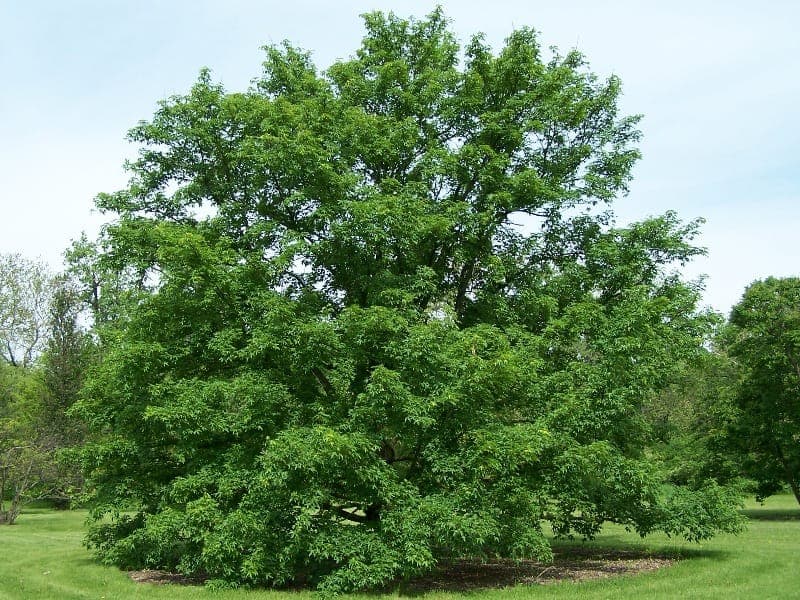
Bruce Marlin / CC BY-SA 3.0, via Wikimedia Commons
Miyabe's maple: complete guide
Acer miyabei
Want to see Miyabe's maple: complete guide in your garden?
1 minute, no credit card
Overview
Miyabe's maple (Acer miyabei), also known as black itaya, is an elegant tree native to Japan and China. This unique maple is highly valued for its ostrich-like leaves and spectacular autumn colouring. The tree grows moderately to medium-sized and provides a long-term source of beauty and structure in any garden. Its Japanese origin provides cultural historical beauty and interest.
Appearance and leaves
Miyabe's maple reaches a height of ten to fifteen metres and forms a well-shaped crown. The leaves are very characteristic: deeply lobed with sharp points, ranging from eight to twelve centimetres. The foliage is shiny green in summer. In autumn, the tree turns beautiful yellow to orange-red, creating a spectacular display. The opposite leaf arrangement and divided form are typical for maples.
Ideal location
Plant Miyabe's maple in a sunny to semi-shaded location. The tree grows best with at least four to six hours of direct sunlight. Protection from strong, dry winds is beneficial. A location where the autumn colour is clearly visible is ideal for maximum colour display.
Soil
Miyabe's maple makes reasonable demands on soil composition. Well-draining soil is essential. Heavy clay can be improved with compost. The plant feels at home on moderately moist soils. A neutral to slightly acidic pH of five point five to seven point five is ideal.
Free design
Want to see Miyabe's maple: complete guide in your garden? Make a free design now.
Watering
Watering is important, especially for young trees in the first and second year. Ensure the soil does not dry out during the growing season. In dry summer months, extra watering may be necessary. Adult trees are fairly drought-tolerant and tolerate dry periods well.
Pruning
The tree tolerates annual maintenance pruning after the growing period. Remove dead or damaged branches. Heavy pruning is not necessary; the tree naturally forms a beautiful shape. Pruning can take place in autumn after leaf fall.
Maintenance calendar
Spring: check for winter damage, add mulch around trunk. Summer: water during dry periods. Autumn: enjoy autumn colouring, remove fallen leaves. Winter: no maintenance needed for adult trees.
Winter hardiness
Miyabe's maple is hardy to about minus fifteen to minus twenty degrees Celsius. In very severe winters, young trees may benefit from jute wrapping around the trunk. Adult trees require no special winter protection.
Companion plants
The maple combines beautifully with other Japanese trees and shrubs. Underplant with shade-loving plants for texture and colour. Suitable for larger gardens where the full form can be expressed. Combines well with young birches.
Conclusion
Miyabe's maple is an exceptional choice for those looking for something special. With its unique leaves and spectacular autumn colouring, it provides years of enjoyment. Find this rare tree at specialized tree nurseries. Visit gardenworld.app for inspiration on garden design with trees. At gardenworld.app you also learn how this tree can grow together with other plants.
Want to see Miyabe's maple: complete guide in your garden? Make a free design now.
Upload a photo, pick a style, and get a photorealistic design with plant list in under a minute.
No credit card required


Similar plants
Acer pycnanthum: complete guide
Acer pycnanthum
Acer pycnanthum, the Japanese swamp maple, is a fast-growing tree with early red flowers and brilliant autumn color, ideal for damp garden settings.
Freeman maple: complete guide
Acer × freemanii
Everything about the Freeman maple (Acer x freemanii): a fast-growing shade tree with spectacular autumn colour for large gardens.
Wild ackee: complete guide
Cupania americana
A comprehensive guide to Cupania americana, a tropical tree from the Sapindaceae family with conspicuous white flowers and brown fruits, native to tropical America.