
Pedersen's cinquefoil: complete guide
Potentilla pedersenii
Want to see Pedersen's cinquefoil: complete guide in your garden?
1 minute, no credit card
Overview
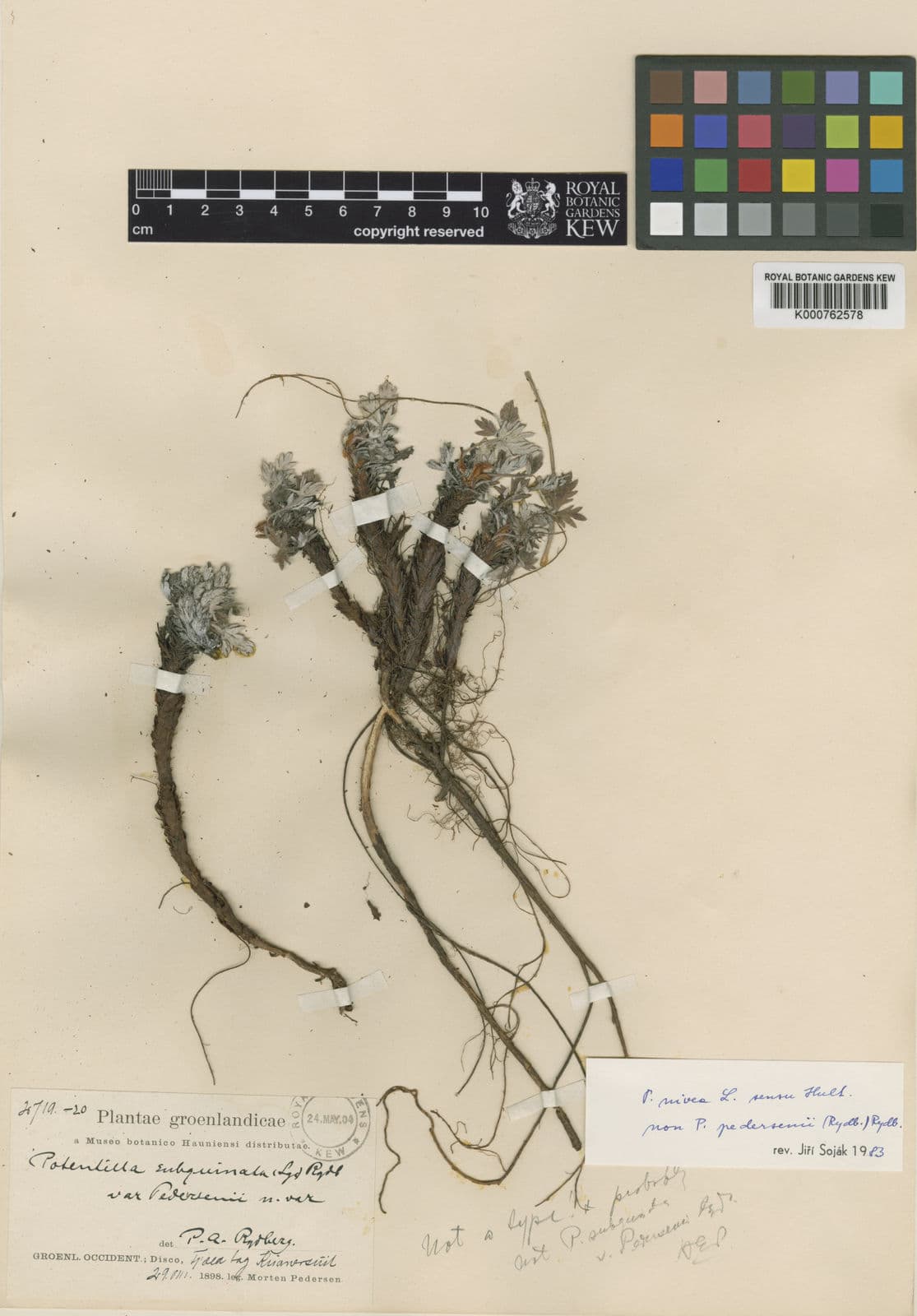
Potentilla pedersenii, known as Pedersen's cinquefoil after the botanist Pedersen, is a low-growing, exceptionally hardy plant in the rose family (Rosaceae). The species was described in 1908 and grows naturally in subarctic North America, specifically in Greenland, the Northwest Territories, and Nunavut. In the literature it is sometimes treated as a variety of the closely related Potentilla rubricaulis, reflecting the close kinship between these two arctic cinquefoils.
Pedersen's cinquefoil belongs to a group of low, cushion-forming cinquefoils adapted to the extreme conditions of the arctic tundra: short summers, prolonged frost, and lean, gravelly soils. For rock garden enthusiasts seeking genuinely authentic, unusual alpine plants, this is a fascinating if rarely available species. Through gardenworld.app you can put together a rock garden design in which true high-mountain and tundra plants like this find a logical place among stone and gravel. Botanically, the species belongs to a notoriously tricky group of closely related, variable arctic-alpine cinquefoils, within which natural hybridisation and overlapping characteristics have kept taxonomists busy for decades. For the home gardener, that detail matters less than the practical qualities on offer: a compact growth habit, a long lifespan given the right site, and striking ornamental value from the silvery foliage that lasts well beyond the short flowering season.
Appearance and bloom
The plant forms low, dense cushions or mats 5 to 15 centimetres tall, spreading roughly 15 to 25 centimetres. The leaves are palmately compound, usually with five narrow leaflets, and carry fine, silvery hairs that protect the plant from drying out in the fierce arctic wind and sun. This silvery-grey sheen gives the plant an elegant, almost woolly appearance throughout the season.
Flowering occurs during the brief arctic summer, typically from June into July. The flowers are bright yellow, five-petaled, and about 1 to 1.5 centimetres across, with a cluster of yellow stamens at the centre. They appear on short, thin stems just above the leaf cushion and attract the few pollinating insects active during this short growing season. After flowering, small dry seed capsules form and remain on the plant into autumn.
Ideal location
Pedersen's cinquefoil needs a position in full sun, ideally at least 6 hours of direct light a day; less sun results in looser, less compact growth and sparser flowering. In the rock garden, a raised bed, an alpine trough, or a scree area with excellent drainage is ideal.
Good air circulation is essential, particularly in the more humid and warmer climate of the Netherlands, Belgium, and France compared to the plant's native tundra habitat. Avoid sheltered, stuffy corners where warmth and moisture build up; this plant prefers an open, breezy spot, such as on a raised bank, a low wall, or between boulders.
Soil
In the wild this species grows on lean, gravelly, and stony soils with little organic matter. Recreate this in the garden with a mix of 50 percent coarse sand or fine gravel and 50 percent lean alpine potting compost. A pH between 6.5 and 7.5, so neutral to slightly alkaline, is ideal.
Avoid rich, moisture-retentive garden soil and heavy clay; these quickly cause root rot in a plant adapted to extremely well-drained conditions. A drainage layer of coarse gravel beneath the planting site, at least 10 centimetres deep, prevents water from standing around the roots during wet spells. If your garden lacks naturally rocky ground, the species also grows well in a shallow terracotta pot or alpine trough; provide at least three drainage holes and raise the pot slightly off the ground on pot feet during winter, so early-spring meltwater drains away immediately instead of lingering around the roots.
Free design
Want to see Pedersen's cinquefoil: complete guide in your garden? Make a free design now.
Watering
Once Pedersen's cinquefoil is well rooted, it is remarkably drought-tolerant. During the first year after planting, water regularly, especially during warm, dry spells in May and June, to help the roots establish properly.
After establishment, supplemental watering is rarely needed; in most years, natural rainfall is more than sufficient. Water only during prolonged drought of more than three weeks, and then sparingly. Excess water is by far the biggest threat to this species, far more so than too little.
Pruning
This compact cinquefoil needs almost no pruning. In autumn, around September or October, trim off dried flower stems and any discoloured foliage with scissors to keep the plant tidy.
Heavy pruning is never necessary and can even damage the plant. If the mat becomes bare in the centre after a few years, you can carefully divide and replant sections in a new spot to encourage renewed vigour.
Maintenance calendar
March-April: check for frost damage after winter, remove any rotted foliage. May-June: main growth phase, water during prolonged dry spells, no feeding needed. June-July: flowering period, enjoy the yellow blooms, otherwise minimal maintenance. August: seed formation continues, the plant remains essentially maintenance-free. September-October: trim off dried flower stems for a tidy winter appearance. November-February: full winter dormancy, no protection needed except in extremely wet winters.
Winter hardiness
Pedersen's cinquefoil is exceptionally cold hardy, corresponding to USDA zone 1 to 2 given its origins in Greenland and the Canadian Northwest Territories. Temperatures down to -45 degrees Celsius pose no problem whatsoever for this species, provided the soil stays well drained.
In the Netherlands, Belgium, and France, the plant survives every winter without any protection. The greatest risk to the plant in our climate is not frost but rather mild, wet winters in which the roots sit in waterlogged ground.
Companion plants
Combine Pedersen's cinquefoil with other genuine tundra and high-mountain plants for an authentic alpine effect: mountain avens (Dryas octopetala), purple saxifrage (Saxifraga oppositifolia), moss campion (Silene acaulis), and dwarf willows such as Salix arctica all match well in growth habit and site requirements.
Because this rare species is seldom found at mainstream garden centres, you can pair it in the same border with the much more readily available shrubby cinquefoil cultivars, such as Potentilla fruticosa 'Goldfinger' or 'Abbotswood', as a hardier complement. On gardenworld.app you can easily design a rock garden where rare alpine species and sturdier shrub planting form a coherent whole.
Closing
Pedersen's cinquefoil is a plant for the true enthusiast of arctic and alpine flora: small in stature but with an impressive ability to withstand the harshest winters. Give the plant a sunny, exceptionally well-drained spot and otherwise leave it largely alone; nature takes care of the rest. For more inspiration on authentic rock gardens and tundra-style plant combinations, gardenworld.app offers a useful starting point.
Want to see Pedersen's cinquefoil: complete guide in your garden? Make a free design now.
Upload a photo, pick a style, and get a photorealistic design with plant list in under a minute.
10,000+ gardens designed already
No credit card required


Similar plants
Siberian crab apple: complete guide
Malus x robusta
Complete guide to the Siberian crab apple (Malus x robusta): location, soil, pruning, winter hardiness and the best companion plants for your garden.
Chinese flowering crabapple (Malus x spectabilis): complete guide
Malus x spectabilis
Meet the Chinese flowering crabapple (Malus x spectabilis): a classic spring bloomer with carmine buds and pink blossom.
Potentilla crassinervia: complete guide
Potentilla crassinervia
Potentilla crassinervia, the Corsican cinquefoil, grows wild on Corsica and Sardinia's peaks. Discover how to grow this hardy alpine rock garden gem.