
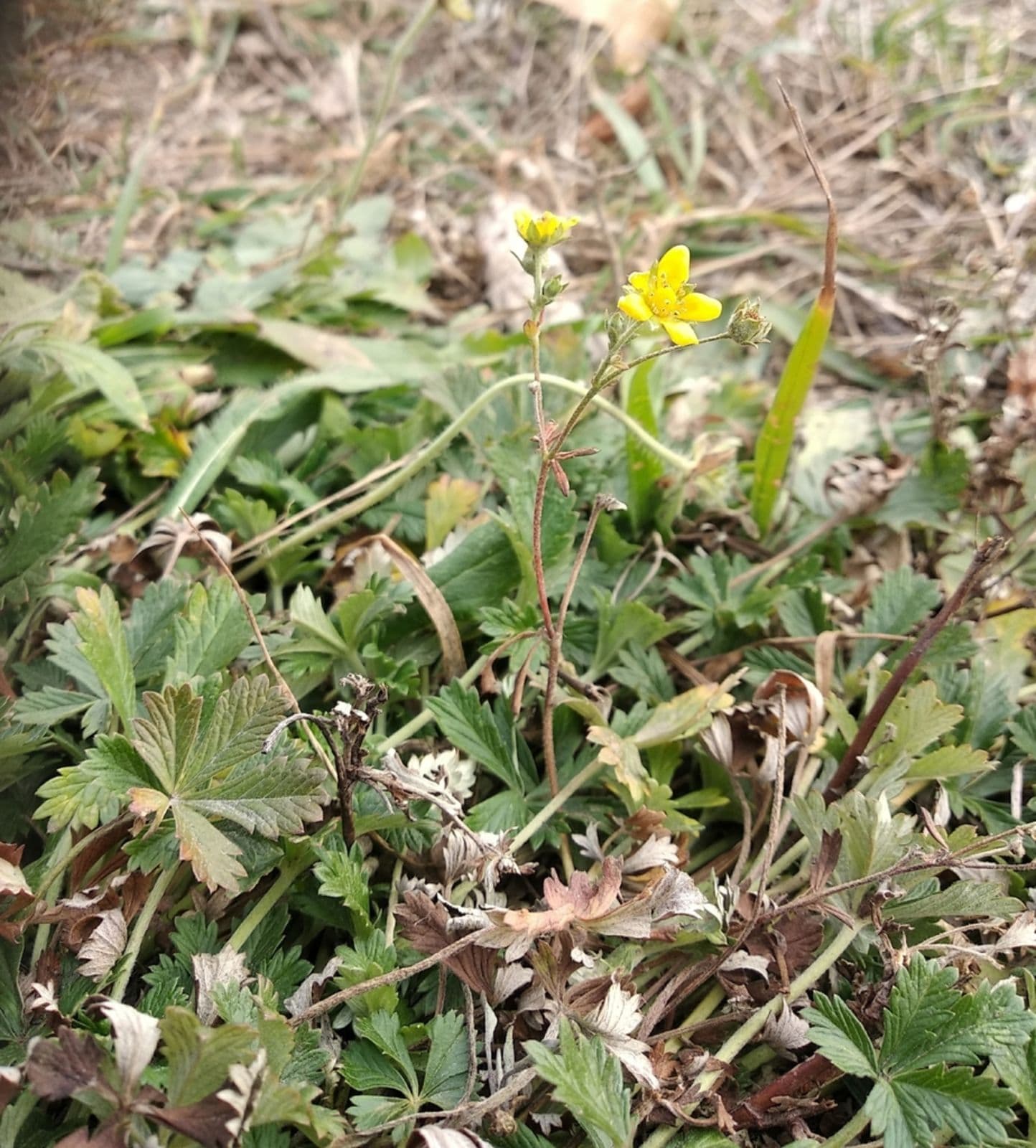
Potentilla leucopolitana: complete guide
Potentilla leucopolitana
Want to see Potentilla leucopolitana: complete guide in your garden?
1 minute, no credit card
Overview
Potentilla leucopolitana is a creeping, low-growing perennial in the rose family (Rosaceae), native to western and central Europe, with recorded populations in Belgium, France, Germany, Poland, and Switzerland. Its German common name, weissenburger fingerkraut, refers to the town of Weissenburg in Alsace, where the species was first extensively described, and to the characteristic five-part leaf that defines the entire Potentilla genus.
This plant belongs to a tricky group of closely related, often apomictic microspecies within the so-called Potentilla collina complex, meaning individuals reproduce asexually and therefore stay remarkably consistent in their traits across generations. For the gardener, that is a practical advantage: what you plant tends to stay stable in form and behavior over time.
In the wild the species grows on dry, nutrient-poor, often lime-rich grassland, rocky slopes, and old walls, precisely the conditions that define a successful spot for it in the garden. For anyone designing a drought-tolerant rock garden, gravel bed, or sunny border on gardenworld.app, this low cinquefoil is an authentic, low-maintenance element that asks for almost no water once summer arrives.
Botanically, the exact boundaries of this microspecies have been debated among specialists within the Potentilla collina complex for more than a century, which makes the plant an appealing curiosity for anyone drawn to botanically obscure perennials. For the average gardener that academic debate changes nothing about its practical qualities: a compact, rewarding groundcover well suited to a collection of drought-tolerant rock garden plants.
Appearance and bloom
Potentilla leucopolitana stays compact, usually 10 to 20 centimeters tall, and gradually spreads sideways into a loose, mat-forming groundcover 30 to 50 centimeters across. The foliage is its most recognizable feature: five narrow, toothed leaflets radiating from a central point, grey-green in color and often lightly silky-haired on the underside.
Bloom falls in May, June, and sometimes a second lighter flush in July, with small, five-petaled yellow flowers 1.5 to 2 centimeters across that closely resemble a miniature buttercup. The flowers sit loosely scattered above the foliage on thin, branching stems, giving the plant a lively presence despite its modest scale for as long as the bloom lasts. After flowering, small, inconspicuous fruits form that add little ornamental value but do allow the plant to self-seed naturally in a suitable spot.
Ideal location
This species needs a fully sun-drenched position; in shade, growth becomes sparse and flowering meager or absent altogether. At least six to eight hours of direct sun daily is necessary for a compact form and good bloom.
Its natural habitats, dry lime grassland, rocky slopes, and the base of old walls, show that this plant actually thrives in spots where many other garden plants struggle. In the garden, this cinquefoil is therefore ideal for a sunny rock garden, a gravel bed, the edge of a raised border, or tucked into the joints of an old stone wall or path.
Soil
The ground needs above all to be well-drained and nutrient-poor; on overly rich, moisture-retentive soil the plant grows sparse and flowers less. The species tolerates both lime-rich and slightly acidic ground, as long as the structure stays loose and well-drained.
When planting, work coarse sand or fine grit into the existing soil to prevent compaction and waterlogging. On heavy clay, a raised bed or a thin layer of grit over the root zone is a simple way to mimic its naturally drier habitat. Avoid any form of rich feeding, which leads to lax, floppy growth at the expense of the compact habit.
Free design
Want to see Potentilla leucopolitana: complete guide in your garden? Make a free design now.
Watering
After planting, keep the root ball lightly moist for the first four to six weeks to ensure good rooting, watering roughly twice a week as a guideline during dry weather. After that, this species is remarkably self-sufficient and needs almost no supplemental water, even during longer dry spells in July and August.
Overwatering is actually more harmful than helpful for this drought-loving plant; it weakens the compact growth habit and can cause root rot on less well-drained ground. A thin layer of grit around the base rather than organic mulch keeps the crown of the plant dry and helps prevent fungal problems.
Pruning
Formal pruning is unnecessary for this low cinquefoil, but a light tidy-up after the first flush of bloom in June encourages a second, if more modest, flowering in July. Trim spent flower stems back close to the foliage at that point.
In late autumn or early spring, you can trim away any faded or browned foliage to keep the plant looking fresh for the new growing season. Major cutbacks are rarely needed, since the plant naturally stays compact and low.
Maintenance calendar
March: remove winter damage and dead foliage, check the site for weeds. May to June: main flowering period, no intervention needed beyond occasional watering during extreme drought. July: light tidy-up after the first bloom for a possible second flush. August to September: quiet period, minimal maintenance. October to February: full dormancy, check for waterlogging after heavy rain.
Winter hardiness
Potentilla leucopolitana is fully winter hardy across USDA zones 5 to 8, a range that comfortably covers the entire climate of the Netherlands, Belgium, and the United Kingdom without any winter protection at all. The plant is adapted to the temperate central European climate with cold winters and shows no sensitivity to frost damage.
Extra winter mulch is actually inadvisable for this species, since an overly moist, sheltered crown in winter tends to cause rot rather than offer protection. Keep the site as open and well-drained as possible, even during the coldest months.
Companion plants
Potentilla leucopolitana pairs excellently with other drought-loving species from rocky, nutrient-poor habitats. Sedum album forms a fleshy, low-growing companion with a similar preference for dry ground. Thymus serpyllum adds fragrance and a carpet-forming habit that blends seamlessly. Sempervivum species bring structure and winter interest, while Dianthus deltoides offers a lovely color contrast with its pink flowers during the same early summer bloom.
Closing
Potentilla leucopolitana is a modest yet resilient groundcover for the sunniest, driest corners of the garden where many other plants disappoint. Its characteristic five-part foliage, extended bloom period of small yellow flowers, and impressive drought tolerance make this species particularly valuable for rock gardens and gravel beds.
On gardenworld.app you can add this groundcover virtually to your rock garden or gravel garden design and see how its low, mat-forming habit relates to rocks, paths, and other drought-tolerant planting. At garden centers, you will typically find related ornamental cinquefoil forms such as Potentilla neumanniana as an alternative; for the true botanical species, a specialist alpine plant nursery is usually the best source.
Want to see Potentilla leucopolitana: complete guide in your garden? Make a free design now.
Upload a photo, pick a style, and get a photorealistic design with plant list in under a minute.
10,000+ gardens designed already
No credit card required


Similar plants
Siberian crab apple: complete guide
Malus x robusta
Complete guide to the Siberian crab apple (Malus x robusta): location, soil, pruning, winter hardiness and the best companion plants for your garden.
Chinese flowering crabapple (Malus x spectabilis): complete guide
Malus x spectabilis
Meet the Chinese flowering crabapple (Malus x spectabilis): a classic spring bloomer with carmine buds and pink blossom.
Potentilla crassinervia: complete guide
Potentilla crassinervia
Potentilla crassinervia, the Corsican cinquefoil, grows wild on Corsica and Sardinia's peaks. Discover how to grow this hardy alpine rock garden gem.