
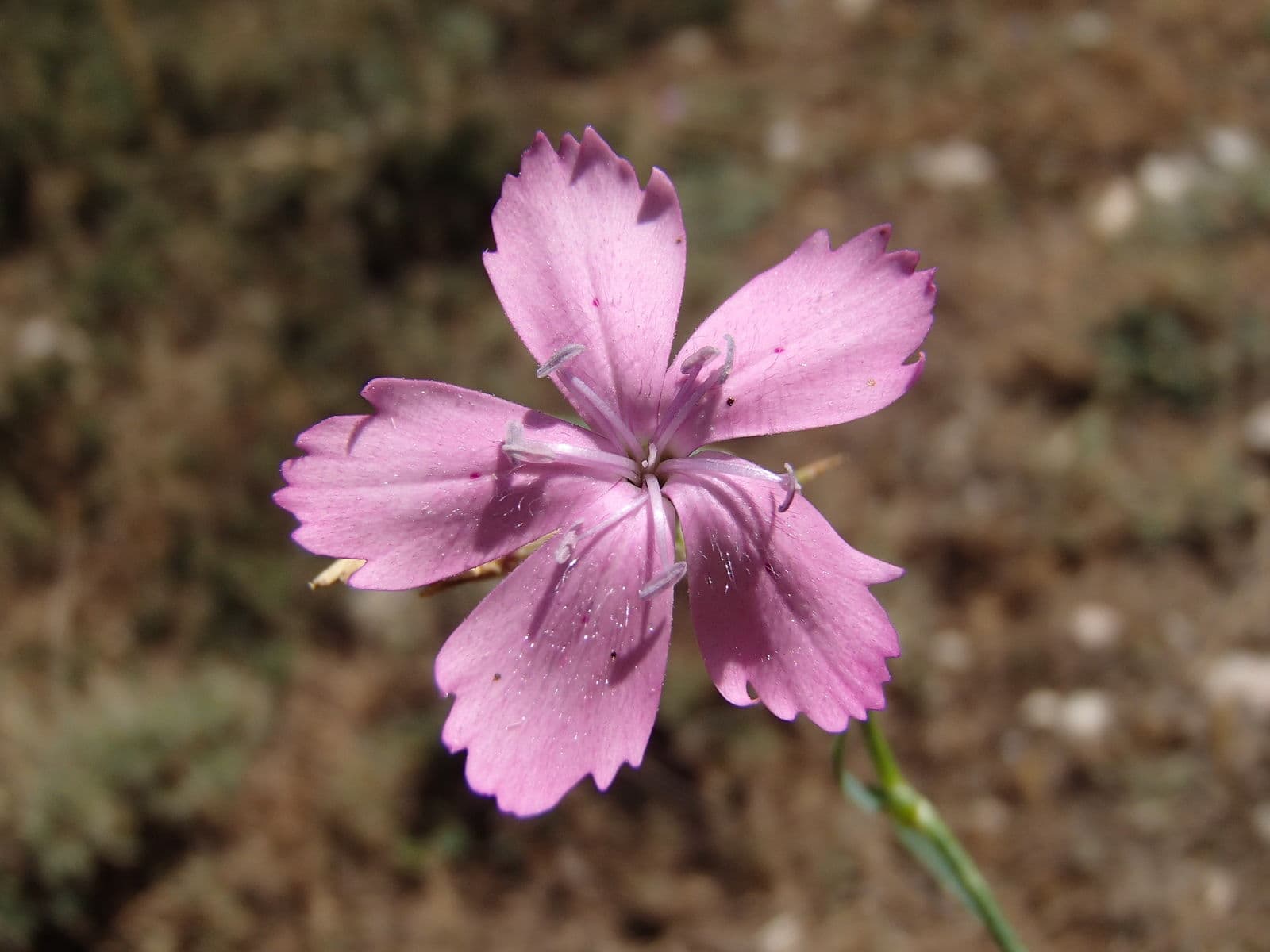
Dianthus karami: complete guide
Dianthus karami
Want to see Dianthus karami: complete guide in your garden?
1 minute, no credit card
Overview
Dianthus karami is a rare pink from the carnation family (Caryophyllaceae), native to the mountains of Lebanon and neighboring Syria. The species is named for the locality where it was first described and grows naturally on limestone rock and steep, rocky slopes at high elevation in the eastern Mediterranean. Like many of its relatives, Dianthus karami forms compact cushions of greyish-green foliage topped with small pink flowers bearing the characteristic fringed petal edge of the genus.
In gardens, this pink is prized by alpine and rock garden enthusiasts for its compact habit and surprising floral display relative to its small size. Because the species grows naturally on lean, dry rocky ground, it is particularly well suited to gravel beds, wall crevices, and raised alpine troughs. On gardenworld.app you can preview how this delicate cushion plant fits among your existing rock garden planting, which is especially useful since the species is not always easy to source commercially.
As a perennial, Dianthus karami remains in place for years, provided growing conditions are well matched to its natural preference for drought and lime-rich, sharply draining soil.
Appearance and bloom
This pink stays small and compact: the foliage cushions rarely exceed 5 to 10 cm in height, while flower stems rise to 10 to 20 cm. Leaves are narrow, linear, and greyish-green to blue-green, coated in a waxy layer that retains moisture and shields the plant from intense sun and drought.
Flowering typically occurs from May through July. Each stem carries one or a few flowers roughly 1.5 to 2 cm across, with five pink to pinkish-purple petals finely fringed at the edge, the very feature that gives the genus its common name in several languages. The flowers often release a light, spicy fragrance, comparable to other wild pinks from the region.
After flowering, small seed capsules develop that split open at maturity to release fine seed, which under suitable conditions can help the plant slowly spread on its own.
Ideal location
Dianthus karami prefers an intensely sunny, open position with at least 6 to 8 hours of direct light. In its natural habitat the plant grows on bare rock faces with no shelter whatsoever, so shade is the greatest enemy of a healthy, compact habit.
The plant is ideal for rock gardens, wall crevices, raised beds, and alpine troughs. It also performs beautifully in large containers filled with a very sharply draining substrate, making it a good choice for sunny terraces and balconies. Ensure good air circulation around the plant to prevent fungal problems.
Soil
Well-draining, lime-rich soil is essential for Dianthus karami. Ideal pH ranges from 7.0 to 8.0 (neutral to alkaline), matching the limestone soils of its native Lebanese habitat. Heavy, waterlogged clay is fatal to this species.
Mix standard garden soil with coarse sand, grit, and optionally a little dolomitic lime to improve drainage and lime content. In containers, a mix of 40 percent coarse sand or pumice, 30 percent coarse compost, and 30 percent standard potting soil works well. Avoid overly rich soil, as this makes the plant leggy and prone to fungal disease.
Free design
Want to see Dianthus karami: complete guide in your garden? Make a free design now.
Watering
Once established, Dianthus karami is highly drought tolerant. After planting, water regularly and lightly for two to three weeks to support rooting. After that, the plant can usually manage on natural rainfall, supplemented occasionally during prolonged summer drought.
The greatest risk to this species is overwatering, especially in winter. Standing water around the roots quickly leads to root rot. Always plant on a slightly raised spot or in a well-draining container, and never water 'just in case' if the soil still feels moist.
Pruning
Minimal pruning is required. Remove spent flower stems after blooming to keep the plant tidy and potentially encourage a smaller second flush of flowers. Occasionally trim away dried or dead portions of the cushion to prevent fungal buildup within the dense foliage mass.
In early spring, a light tidy-up of the cushion, removing dead leaves, benefits both the ornamental appeal and the health of the plant.
Maintenance calendar
March: check the plant after winter and remove any frost damage or dead leaves. May to July: main flowering period; enjoy the fringed pink blooms and remove spent stems. August: possible light reflowering; seed capsules ripen and can be collected for propagation. September to October: final drainage check before winter; clear excess organic debris around the crown. November to February: dormant period; avoid watering unless winter is exceptionally dry.
Winter hardiness
Dianthus karami is hardy in USDA zones 6 to 8, provided winter drainage is excellent. The greatest threat in cold, wet climates is not frost itself but moisture that lingers around the crown of the plant.
In gardens with heavy, wet winter ground, we recommend keeping the plant in a raised bed or container, possibly with a layer of grit around the crown to shed water quickly. In exceptionally severe winters (below -15 degrees Celsius), a light covering of conifer branches can offer protection without smothering the plant.
Gardeners in maritime climates with mild, damp winters, such as much of the Netherlands, Belgium, and the United Kingdom, should pay particular attention to drainage rather than cold itself, since this species tolerates low temperatures far better than it tolerates soggy roots through a long, grey winter.
Companion plants
Dianthus karami pairs beautifully with other lime-loving rock plants that share the same dry, sunny conditions:
Sempervivum (houseleek) creates a lovely contrast in form and texture next to the fine pink foliage.
Saxifraga (saxifrage) often flowers around the same time and matches this compact pink in scale perfectly.
Aurinia saxatilis (basket of gold) adds bright yellow spring color as a contrast to the pink flowers.
Iberis sempervirens (candytuft) offers evergreen foliage and white blooms as a complement.
Other Dianthus species, such as Dianthus gratianopolitanus, create a varied pink tapestry within the same border.
These combinations are well worth exploring on gardenworld.app, where you can visualize different rock garden scenarios before planting.
Closing
Dianthus karami is a true gem for alpine and rock garden enthusiasts seeking something special beyond the more familiar pink species. Its compact cushions and finely fringed pink blooms make this rare Lebanese mountain plant a valuable addition to any dry, sunny border or container garden.
On gardenworld.app you can upload a photo of your rock garden or terrace and instantly see how Dianthus karami comes together alongside other alpine species, so you can decide with confidence where this special pink fits best.
Want to see Dianthus karami: complete guide in your garden? Make a free design now.
Upload a photo, pick a style, and get a photorealistic design with plant list in under a minute.
10,000+ gardens designed already
No credit card required


Similar plants
Sicilian pink: complete guide
Dianthus siculus
Discover Dianthus siculus, an elegant purple bloomer from Sicily. Cultivation, June-September flowering and garden combinations.
Alpine mouse-ear chickweed: complete guide
Cerastium pedunculatum
Full growing guide for Cerastium pedunculatum: ideal location, soil, watering, winter hardiness, and companion plants for rock gardens.
Chaetonychia cymosa: complete guide
Chaetonychia cymosa
Full guide to Chaetonychia cymosa, a rare Mediterranean annual from the Caryophyllaceae family: location, soil, watering and care tips.