
Daucus pumilus: complete guide
Daucus pumilus
Want to see Daucus pumilus: complete guide in your garden?
1 minute, no credit card
Overview
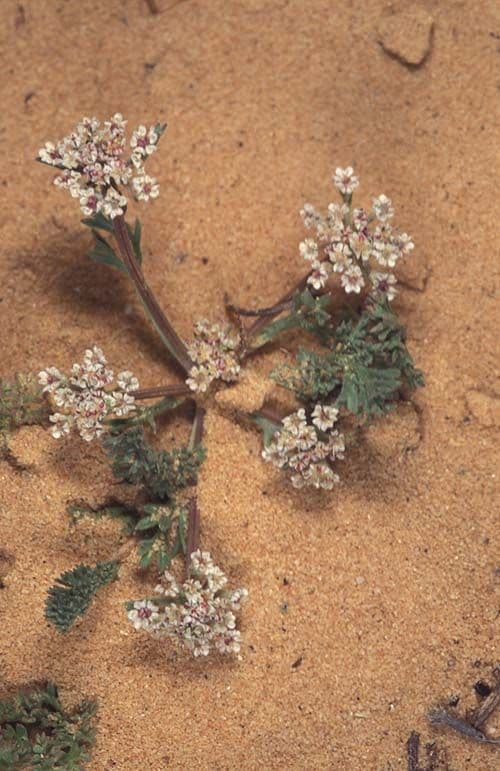
Daucus pumilus, sometimes called dwarf carrot or dune carrot, is a small relative of the familiar wild carrot (Daucus carota) in the Apiaceae, or carrot family. The species occurs naturally along Mediterranean coastlines, the Canary Islands, and parts of southern Europe and North Africa, where it grows on dunes, limestone rock, and open, sun-baked ground close to the sea. The species epithet 'pumilus' means 'small' or 'dwarf', a direct reference to the compact growth habit, which stays noticeably lower and finer than common wild carrot.
In the garden, Daucus pumilus is a surprisingly elegant choice for anyone drawn to naturalistic, drought-tolerant planting. The plant forms a finely cut rosette of foliage topped by airy, white umbels that attract hoverflies, solitary bees, and other beneficial insects. Because the species asks for very little from the soil and needs almost no supplemental water, it fits beautifully into gravel gardens, dune plantings, and Mediterranean-style borders. On gardenworld.app you can preview how this delicate umbellifer will look among your existing planting before committing a single seed to the ground.
It behaves as an annual or short-lived biennial: in the first year a foliage rosette forms, in the second year flowering and seed set follow, after which the plant dies back. In a suitably open, sunny spot, self-seeding ensures the species returns year after year without any need for repeat sowing.
Appearance and bloom
Daucus pumilus stays compact, with most specimens reaching 10 to 30 cm in height. The foliage rosette is finely divided and feathery, closely resembling carrot tops but more compact and often greyish-green thanks to a thin waxy coating that reduces water loss, a direct adaptation to the dry, windy coastal climate the species calls home.
Flowering typically begins in May and continues through July, depending on local conditions. Flowers are borne in small compound umbels 3 to 5 cm across, made up of dozens of tiny, creamy white florets. As with many Daucus species, a single dark, almost purplish-red flower often sits at the center of the umbel, thought to attract pollinators by mimicking an insect already present on the flower head. After pollination, the umbel commonly curls slightly inward, producing the familiar 'bird's nest' shape also seen in wild carrot.
Following flowering, small bristly seeds develop that cling readily to fur and clothing, a dispersal strategy that helps the species colonize new open ground.
Ideal location
This plant prefers a full-sun position with at least 6 to 8 hours of direct light daily. The sunnier and more open the spot, the more compact and sturdy the plant remains. In shade, flowering becomes sparse and the plant tends to flop over as it stretches toward light.
Daucus pumilus is exceptionally well suited to gravel gardens, dune plantings, rock gardens, and dry roadside borders. The species tolerates wind and salt-laden air very well, making it a strong choice for coastal gardens or gardens on sandy soil. Pair it with other sun-loving, drought-tolerant species for a natural, Mediterranean atmosphere.
Soil
Well-draining soil is essential. The plant grows naturally on sandy or limestone soils that shed water quickly and performs poorly on heavy, waterlogged clay. A pH between 6.5 and 7.8 (neutral to slightly alkaline) is ideal.
If your garden has clay soil, work generous amounts of coarse sand and fine gravel into the top 20 to 30 cm, or build a raised bed with a sandy, low-fertility substrate. Overly rich soil leads to floppy, overly leafy plants that flower less and lodge more easily. Lean, nutrient-poor ground actually produces the compact, sturdy habit this species is known for.
Free design
Want to see Daucus pumilus: complete guide in your garden? Make a free design now.
Watering
Once established, Daucus pumilus is highly drought tolerant and needs almost no supplemental water. After sowing or planting out, water lightly for two to three weeks to support germination and rooting. After that, natural rainfall is usually sufficient in most temperate gardens.
Only during prolonged, extreme summer drought is occasional extra watering advisable, particularly for young plants. Avoid standing water around the roots: overwatering is the fastest way to lose this species to root rot.
Pruning
Daucus pumilus needs very little pruning. Remove spent umbels as they discolor if you want to limit self-seeding, or leave them in place if you want the plant to seed itself in for next year. The dried umbels remain decorative besides, and offer overwintering shelter to small insects.
At the end of the season, once the plant has fully died back, you can clear away the remains or leave them until early spring as natural cover for soil-dwelling life.
Maintenance calendar
March to April: sow directly at the final planting site, covered with a thin layer of sand. May to July: flowering period; umbels appear and attract pollinators. July to August: seed set; leave a few umbels in place for self-seeding. September to October: plant dies back after seed drop; clear remains or leave as winter shelter. November to February: dormant period; no maintenance needed, though seedlings from self-sowing may already be germinating.
Winter hardiness
As an annual or short-lived biennial, winter hardiness in the classic sense matters less: the parent plant dies back after flowering regardless. In climates matching USDA zones 8 to 10, the species can behave as a short-lived perennial, but in the temperate climate of northwestern Europe (roughly USDA zone 7 to 8) it typically behaves as an annual.
Seedlings that germinate in autumn generally overwinter without trouble as small rosettes, provided the soil stays well drained and does not become waterlogged. Frost protection is rarely needed; it is wet feet in winter, far more than cold, that proves fatal to this species.
Companion plants
Daucus pumilus pairs beautifully with other drought-loving, coastal, or Mediterranean species:
Armeria maritima (thrift) blooms around the same period and offers a lovely color contrast with its pink pompom flowers.
Eryngium maritimum (sea holly) shares the same sandy, salt-tolerant preferences and reinforces the coastal atmosphere.
Crithmum maritimum (rock samphire) is often found growing naturally alongside Daucus species along the coast.
Limonium (sea lavender) adds silvery-blue tones to the border.
Cistus (rock rose) provides structure and volume next to the airy umbels.
These combinations are also worth exploring on gardenworld.app, where you can visualize different planting scenarios before you actually start planting.
Closing
Daucus pumilus is an underrated, elegant addition for anyone building a naturalistic, drought-tolerant garden. Its airy white umbels look wonderful among grasses and other coastal plants, while the plant asks for almost no maintenance as long as the soil drains well. For gardeners in coastal areas or on sandy soil, this is a worthwhile species to consider alongside more familiar ornamental grasses and perennials.
Want to see how Daucus pumilus fits into your own garden design? On gardenworld.app you can upload a photo of your garden and instantly visualize how this delicate umbellifer, paired with other drought-tolerant planting, comes together before you ever pick up a spade.
Want to see Daucus pumilus: complete guide in your garden? Make a free design now.
Upload a photo, pick a style, and get a photorealistic design with plant list in under a minute.
10,000+ gardens designed already
No credit card required


Similar plants
Whorled carrot: complete guide
Daucus involucratus
Daucus involucratus is a Mediterranean umbellifer with white flower heads framed by lacy bracts. Growing this gravel garden gem.
Daucus muricatus: complete guide
Daucus muricatus
Daucus muricatus, the spiny wild carrot, grows wild on Mediterranean coasts. Discover sowing, June-July bloom, and wildflower meadow use.
Canby's biscuitroot: complete guide
Lomatium canbyi
Lomatium canbyi, the drought-hardy desert parsley of the western US. Full care guide covering soil, watering, and garden use.