
Toughleaf Dogwood: complete guide
Cornus asperifolia
Want to see Toughleaf Dogwood: complete guide in your garden?
1 minute, no credit card
Overview
Toughleaf dogwood (Cornus asperifolia) is a deciduous shrub in the dogwood family, Cornaceae, native to the southeastern United States. The species grows naturally in Alabama, Florida, Georgia, Mississippi, North Carolina, and South Carolina, typically along riverbanks, in swampy woodlands, and on damp, low-lying ground. The common name refers to the firm, somewhat rough-textured leaves that distinguish this plant from some of its dogwood relatives.
This dogwood is closely related to the better-known Cornus sericea, red-osier dogwood, and was historically even treated as a variety of that species. In the garden, toughleaf dogwood is especially valuable as a suckering shrub for naturalistic hedges, streamside plantings, and wildlife-friendly schemes. Over time, the shrub forms a dense thicket that provides excellent cover and food for birds.
Although less familiar in European gardens than relatives such as Cornus alba or Cornus sericea, toughleaf dogwood deserves a place wherever natural, low-maintenance planting on damp ground is desired. The species is rarely stocked at large garden centres but is increasingly available through specialist native-plant nurseries, usually sold under its botanical name since no widely used common name exists locally.
Appearance and bloom
Toughleaf dogwood grows at a moderate rate into a shrub typically 2 to 4 metres tall, with a similar spread thanks to its suckering habit. The thicket-forming growth makes it especially useful for stabilising banks and controlling erosion along watercourses.
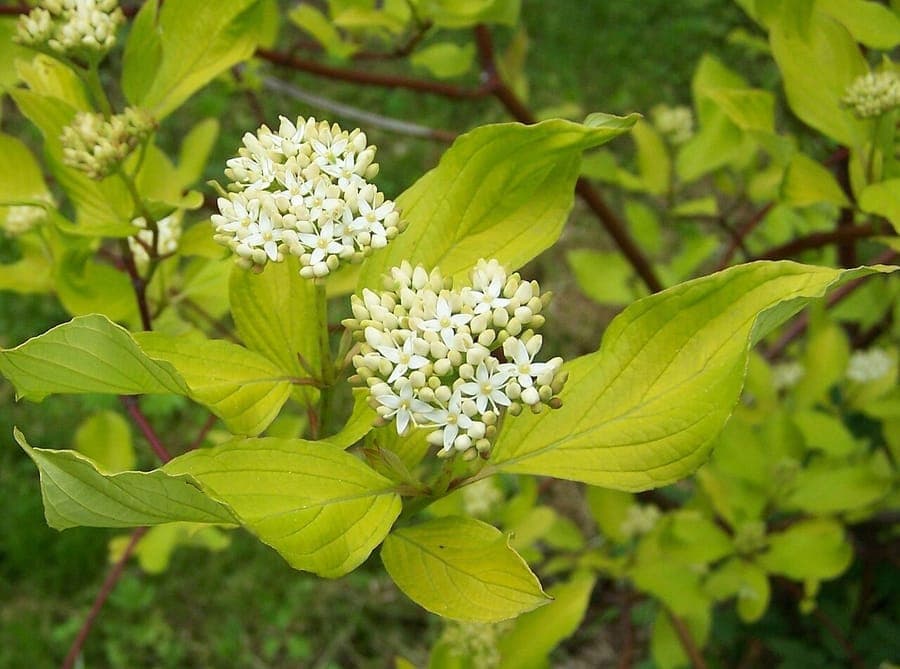
The leaves are arranged oppositely, oval in shape, and have a fine texture with a somewhat rough upper surface, which gives the species its name asperifolia, meaning "rough-leaved." In autumn, the foliage often turns deep red to purplish, giving the shrub ornamental value well beyond its flowering season.
In late spring to early summer, flat clusters of small white flowers appear, proving highly attractive to pollinating insects. After flowering, small round fruits develop, ripening from green to a whitish-blue shade in late summer and autumn, and are much sought after by birds.
Ideal location
This dogwood performs best in full sun to light partial shade. In its native habitat, the shrub often grows at woodland edges and along banks, receiving several hours of direct sun combined with shelter from taller trees. A spot with at least four to six hours of sun daily produces the best flowering and autumn colour.
The shrub is particularly well suited to damp to wet locations, such as pond margins, ditches, and low-lying parts of the garden where water tends to collect. Thanks to its suckering habit, the plant is also excellent for stabilising slopes and banks against erosion. In a mixed hedge, it combines well with other native shrubs that tolerate similarly damp conditions.
Soil
Toughleaf dogwood tolerates a wide range of soil types, from sandy to clay-rich, provided sufficient moisture is available. The ideal pH ranges from 5.8 to 7.2, from slightly acidic to neutral, matching most standard garden soils across northern Europe.
This dogwood tolerates periodic flooding better than most ornamental shrubs, making it particularly suitable for low-lying garden areas or streamside zones. When planting in ordinary, well-drained garden soil, an annual layer of compost is sufficient to support growth. Heavy, compacted clay can be improved with organic matter to encourage root development.
Free design
Want to see Toughleaf Dogwood: complete guide in your garden? Make a free design now.
Watering
Young shrubs need regular watering during their first two growing seasons to develop a deep root system, especially during dry summer spells. Water thoroughly at planting and keep the soil evenly moist for the first few months, checking twice weekly until the plant shows clear signs of new growth.
Once established, toughleaf dogwood is exceptionally tolerant of wet ground and can handle temporary standing water without harm. Unlike many other shrubs, this species has little trouble with excess moisture, although good drainage remains desirable long-term for optimal growth. During prolonged summer drought, supplemental watering is advisable, particularly on sandy soil. A thick layer of mulch around the root zone helps keep soil moisture more consistent and significantly reduces the need for manual watering.
Pruning
To keep the shrub compact and vigorous, it helps to cut the oldest stems back to ground level each year. This encourages fresh young growth and keeps the shrub dense and healthy. Prune preferably in late winter, before spring growth begins.
Because the shrub naturally suckers, periodically removing unwanted root growth may be necessary to keep the plant within desired bounds, especially in smaller gardens. Remove dead or damaged branches as soon as you notice them.
Maintenance calendar
February-March: cut back old stems; remove dead wood before the new growing season.
April-May: new foliage emerges; check for suckers spreading beyond the desired zone.
June-July: white flower clusters appear, drawing plenty of pollinating insects.
August-September: fruit ripens to a whitish-blue colour; birds begin foraging.
October-November: foliage turns autumn colours before leaf drop.
Winter hardiness
Toughleaf dogwood is hardy to roughly USDA zones 5 to 6, corresponding to the hardiness zones common across the Netherlands, Belgium, Germany, and much of France. The shrub tolerates frost down to roughly minus twenty to minus twenty-five degrees Celsius without significant damage.
Young plantings benefit from a layer of mulch around the root zone during their first winter to buffer extreme temperature swings. Once established, this dogwood is fully self-sufficient and needs no winter protection, even in harsher winters.
Companion plants
Toughleaf dogwood combines excellently with other moisture-loving native shrubs such as willows, Viburnum, and Physocarpus, which appreciate similar growing conditions. For a wildlife-friendly hedge, the shrub pairs well with elder (Sambucus) and hawthorn (Crataegus), both valuable food sources for birds.
In a streamside planting, the shrub looks lovely alongside moisture-loving perennials such as meadowsweet (Filipendula) and sedge (Carex), which tolerate similarly wet to damp soil. Garden centres in the Netherlands and Belgium occasionally stock comparable native dogwood species for naturalistic planting schemes.
For a layered, natural transition from shrub to bank, the planting can be underplanted with lower ground covers such as Lysimachia nummularia, which quickly fills bare soil beneath the shrub while helping retain soil moisture throughout the growing season.
Closing
Toughleaf dogwood is a versatile, low-maintenance shrub that thrives on damp to wet ground where many ornamental shrubs struggle. With its white spring flowers, autumn colour, and valuable fruit for birds, it is a genuine asset to any naturalistic or wildlife-friendly garden. Visit GardenWorld to see how this shrub fits into a complete garden design, and check the GardenWorld plant database for further growing details.
Want to see Toughleaf Dogwood: complete guide in your garden? Make a free design now.
Upload a photo, pick a style, and get a photorealistic design with plant list in under a minute.
10,000+ gardens designed already
No credit card required


Similar plants
Red-osier dogwood: complete guide
Cornus sericea
Everything you need to know about Cornus sericea: growth habits, care tips, winter hardiness and how to use this shrub in wet garden areas. A must for wildlife and winter interest.
Cornus amomum: complete guide
Cornus amomum
Discover the silky dogwood with white flowers and blue berries. Ideal for moist gardens and natural landscapes. Read our comprehensive care guide now.
Roughleaf dogwood: complete guide
Cornus drummondii
Everything you need to know about Cornus drummondii: siting, soil, pruning, winter hardiness and companion plants for a naturalistic garden.