
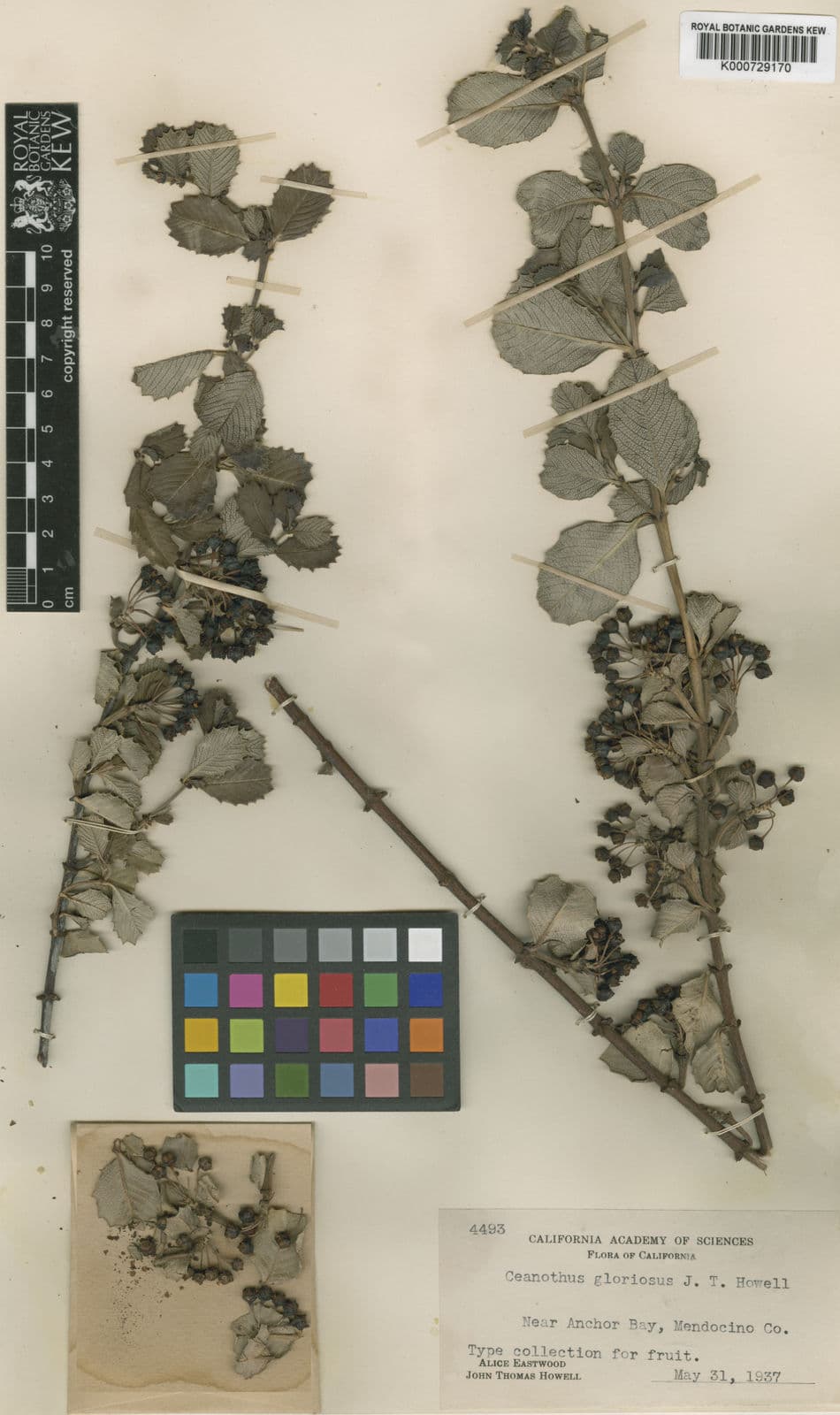
Point Reyes ceanothus: complete guide
Ceanothus gloriosus
Want to see Point Reyes ceanothus: complete guide in your garden?
1 minute, no credit card
Overview
The Point Reyes ceanothus (Ceanothus gloriosus) is an evergreen, low-growing shrub from the Rhamnaceae family, native to the coastal bluffs and scrub vegetation around Point Reyes in northwestern California. Also known as the Point Reyes creeper, the plant owes its popularity to the combination of glossy, holly-like foliage and striking blue-purple flower clusters in spring.
Within the large Ceanothus genus, also called California lilac, this species ranks among the most valued groundcover forms: low, dense, slow-growing and excellent for slopes, banks and dry, sunny borders where few other evergreen shrubs offer so much structure with so little maintenance.
What further sets the species apart from most other Ceanothus is its tolerance for lime-rich, alkaline soil: where the genus is traditionally known for preferring acidic ground, the Point Reyes ceanothus actually thrives in the neutral to slightly alkaline soil common across western Europe. That makes it one of the few evergreen Californian groundcovers usable in northern European gardens without any special soil amendment.
Appearance and bloom
The Point Reyes ceanothus grows as a low, densely branched, mat- to mound-forming shrub, usually no taller than 30 to 60 cm but spreading 2 to 3 metres wide thanks to its creeping, thicket-forming habit. The foliage is dark green, glossy and toothed like small holly leaves, about 1.5 to 2.5 cm long, and stays on the plant year-round.
In spring, typically March to May, dense clusters of small, strongly scented flowers appear in a vivid blue-purple shade, arranged in round to oval trusses that cover the entire shrub. The bloom attracts large numbers of bees and other pollinators and ranks among the earliest, most striking spring displays of any evergreen groundcover. After flowering, small triangular seed capsules form.
Ideal location
Plant the Point Reyes ceanothus in full sun to light partial shade, with at least 6 hours of direct light a day for the richest bloom. A coastal plant by nature, this species tolerates wind, salty air and lean soil extremely well, making it an ideal choice for slopes, banks and erosion-prone spots where its dense, creeping habit helps hold the soil in place.
The plant is markedly drought-tolerant once established and therefore fits perfectly into a Mediterranean gravel garden or xeriscape. Avoid shady, moist spots: there the shrub blooms considerably less and the risk of root disease increases.
Soil
Unlike many other Ceanothus species, which often demand acidic soil, the Point Reyes ceanothus remarkably tolerates neutral to alkaline ground, with a pH between 7.1 and 8.5. This makes the species well suited to the often lime-rich, slightly alkaline garden soil found across much of the Netherlands, Belgium and Germany.
The main requirement is excellent drainage: lean, sandy or gravelly soil is strongly preferred over rich, moisture-retentive garden soil. Mix coarse sand or grit into heavy clay at planting time. Feeding is essentially unnecessary and can even be harmful: too much nutrition leads to soft growth and reduced winter hardiness.
Watering
After planting, water the Point Reyes ceanothus regularly during the first year, roughly once a week, to let a deep root system develop. From the second year onward, the plant is markedly drought-tolerant and needs almost no supplemental water in summer.
Overwatering, especially combined with poorly drained soil, is the main cause of death in cultivation: root rot sets in faster than any drought-related damage. In winter, watering is almost never needed.
Free design
Want to see Point Reyes ceanothus: complete guide in your garden? Make a free design now.
Pruning
Prune the Point Reyes ceanothus lightly after flowering to maintain its compact, dense shape and remove spent flower clusters. Because of its slow growth rate, heavy pruning is rarely needed and recovery can be slow.
Avoid cutting back into old, bare wood, as Ceanothus species generally resprout poorly from it. A light annual shape-pruning right after flowering, while the plant is still actively growing, gives the best results.
Maintenance calendar
March-May: main bloom with blue-purple clusters; heavy bee activity.
June: light pruning after flowering; seed capsules form.
July-August: driest period; minimal watering for established plants.
September-October: a good time to plant new specimens or take cuttings.
November-February: winter rest; check drainage after prolonged rainfall.
Winter hardiness
The Point Reyes ceanothus suits USDA zone 8 to 9, tolerating moderate frost down to about -9°C to -12°C. In mild, coastal-influenced regions of the Netherlands, Belgium, France and Germany, the plant generally grows outdoors without trouble; in colder, more continental inland areas, hard frost can cause damage, especially to young plants.
A sheltered, south-facing spot against a wall and a winter mulch layer around the root crown considerably improve survival odds in colder gardens. Once well established, the plant is noticeably more winter-hardy than young specimens.
Companion plants
The Point Reyes ceanothus combines beautifully with other Mediterranean and drought-tolerant shrubs: Cistus species, Phlomis fruticosa, lavender and Arbutus unedo (strawberry tree). Its blue flower colour forms an attractive contrast with silver-grey plants such as Perovskia and Artemisia.
On a slope or bank, the species pairs well with ornamental grasses that appreciate the same dry, sunny conditions, such as Stipa tenuissima and Festuca glauca, for a varied, low-maintenance groundcover scheme.
Propagation
Propagation is usually by semi-ripe cuttings, taken in summer after flowering. Use a sharp, free-draining cutting medium and keep cuttings moist but not wet; rooting typically takes 6 to 10 weeks. Well-known named selections available in the trade include 'Anchor Bay' and 'Heart's Desire', both particularly low and dense-growing, and 'Point Reyes', a somewhat wider-spreading form with larger flower clusters.
Propagation from seed is possible but slow and often requires a hot-water treatment or scarification of the hard seed coat to trigger germination.
Pests and diseases
The Point Reyes ceanothus suffers little from pests and diseases in cultivation, provided drainage is adequate. Root rot from standing water is by far the biggest risk, especially on heavy clay soil.
Scale insects or spider mites can occasionally appear, particularly on plants receiving too little sun or too much water. In that case, improve growing conditions rather than resorting to chemical treatment. Grit and coarse sand for better drainage are readily available from a garden centre.
Closing
The Point Reyes ceanothus is a beautiful, low-maintenance evergreen groundcover that enriches any sunny bank or Mediterranean gravel garden with its early blue bloom and glossy foliage. As long as drainage is right and the site is sunny enough, this Californian coastal native asks for almost nothing in return. GardenWorld can help you design a drought-tolerant border featuring unusual evergreens. Visit GardenWorld for garden design and the GardenWorld plant database for more species.
Want to see Point Reyes ceanothus: complete guide in your garden? Make a free design now.
Upload a photo, pick a style, and get a photorealistic design with plant list in under a minute.
10,000+ gardens designed already
No credit card required


Similar plants
Santa Barbara ceanothus: complete guide
Ceanothus impressus
Ceanothus impressus rewards a sunny wall with deep blue flowers in March-May. Location, soil, pruning and winter protection explained.
Redstem ceanothus: complete guide
Ceanothus sanguineus
Ceanothus sanguineus is a hardy, deciduous shrub with reddish stems and creamy white flower clusters in June. Care and companions.
Redroot (Ceanothus herbaceus): complete growing guide
Ceanothus herbaceus
Learn how to grow Ceanothus herbaceus (redroot or Jersey tea). Full guide covering planting, care, soil, watering and hardiness.