
Korean astilbe: complete guide
Astilbe grandis
Want to see Korean astilbe: complete guide in your garden?
1 minute, no credit card
Overview
Despite its name, Korean astilbe (Astilbe grandis) actually originates from central and southern China, where it grows in moist woodlands, along stream banks and in shaded ravines. Its species name, 'grandis', refers to the plant's most striking feature: it grows considerably larger than the compact astilbe hybrids typically found at garden centres, and under good conditions can develop into an impressively tall, stately perennial for the shade garden.
If you are looking for a robust, tall shade plant with a long summer bloom, Korean astilbe is a rewarding choice for the edge of a pond, a stream bank or a shaded border. When working out a shade garden design on gardenworld.app, this larger astilbe species combines well with other moisture-loving shade plants for a layered, lush effect. Well-established older clumps can also be propagated by dividing the root ball in early spring, just before growth resumes; this rejuvenates the plant and immediately provides new specimens for elsewhere in the garden. Flower arrangers also value the long flower plumes as cut flowers, both fresh and dried for a winter bouquet.
Appearance and bloom
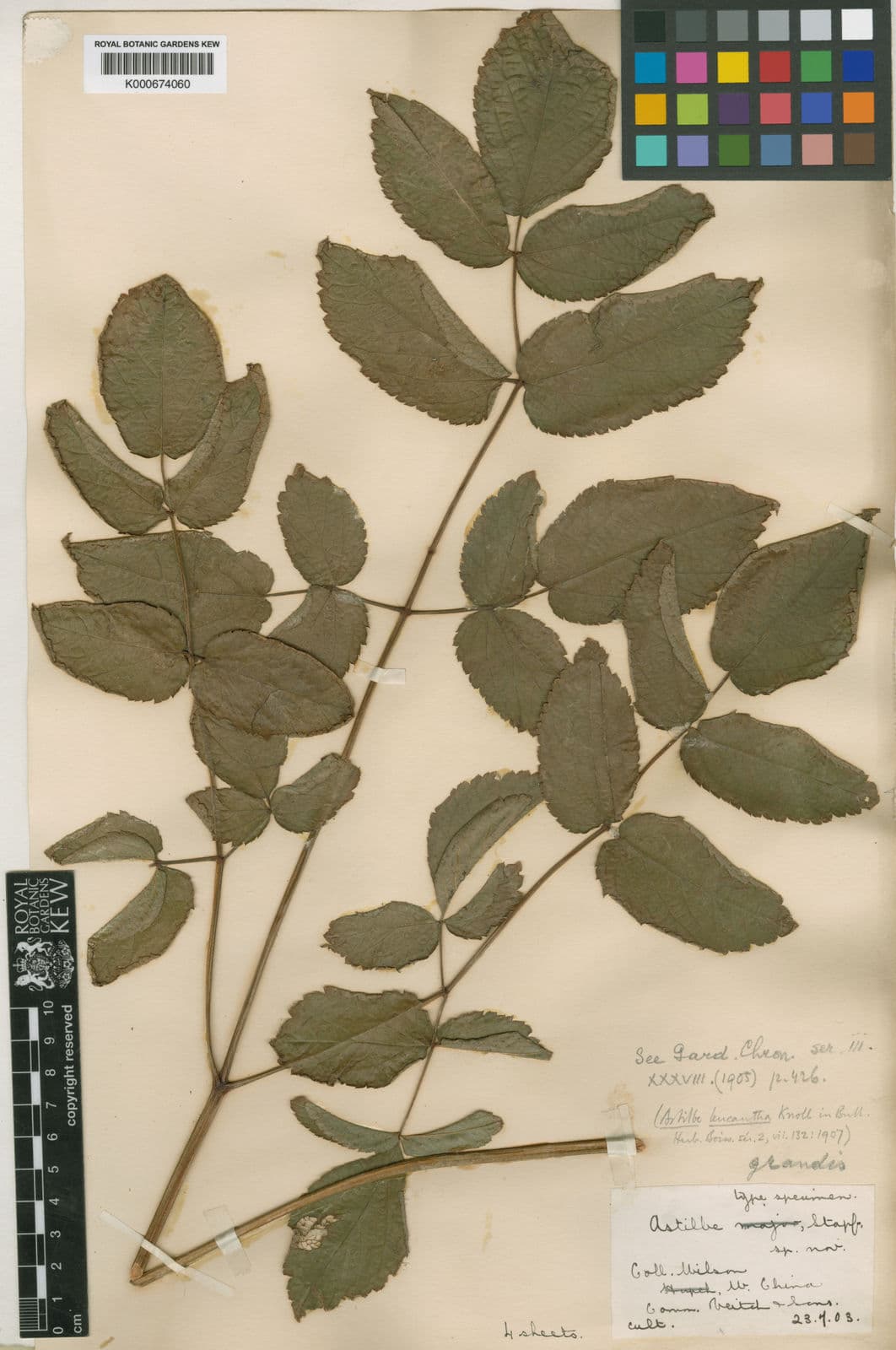
Korean astilbe forms a bushy clump of doubly to triply compound, fern-like foliage in deep green. The leaflets are ovate with toothed edges and give the plant an elegant, structural presence all season, even without flowers. Under favourable conditions, with enough moisture and nutrients, the plant can reach a height of 1.2 to as much as 2 metres, considerably taller than most common astilbe cultivars, which typically stay 60 to 90 cm.
The flower spike is a long, plume-like panicle that rises well above the foliage, made up of countless tiny, woolly-looking flowers in creamy white to very pale pink. Flowering occurs in July and August, slightly later than many other astilbe species, and with adequate moisture lasts for several weeks. After flowering, the spent plumes remain decoratively brown well into winter, adding value to the border's winter structure.
Ideal location
Korean astilbe thrives best in partial to full shade, mirroring its natural habitat along wooded stream banks. In full sun, the plant is only suitable where the soil can be kept consistently moist, for example right at the edge of a pond or watercourse; otherwise the foliage scorches quickly. A sheltered spot, out of the wind, also prevents the fine leaves from drying out. Allow a spacing of 40 to 60 cm, given the eventual size of this larger species. Korean astilbe can also be grown in a large pot or tub, provided the container is generously sized, at least 40 cm across, and watered daily during warm spells; container culture dries out much faster than open ground.
Soil
A fertile, humus-rich soil that stays consistently moist is essential for Korean astilbe. The ideal pH range is 5.5 to 6.5, slightly acidic. When planting, work in generous amounts of compost or well-rotted garden soil, available at most garden centres, to improve moisture retention. Sandy soil is less suitable unless substantially enriched with organic matter, and heavy clay can be a problem if drainage is poor in winter. An annual layer of compost in spring keeps the soil in top condition for this fairly hungry plant.
Free design
Want to see Korean astilbe: complete guide in your garden? Make a free design now.
Watering
This species tolerates drought poorly and needs consistently moist soil, especially during the active growth and flowering period from April to August. Water as soon as the top layer of soil feels dry, and in dry weather aim for two to three watering sessions per week. A thick layer of mulch, 5 to 8 cm, such as wood chips or compost, helps retain moisture and significantly reduces how often you need to water. When planted along a pond or stream, additional watering is often barely necessary, as long as the roots stay in contact with the moist bank zone.
Pruning
Pruning is minimal for Korean astilbe. Leave the spent flower plumes standing after blooming: they remain decoratively brown and provide structure and some shelter for insects over winter. Cut the entire plant back only in late winter or early spring, shortly before new growth resumes, usually in February or March. At that point, remove all old foliage and spent stems down to a few centimetres above the ground, so the new shoots can emerge unhindered.
Maintenance calendar
- January to February: dormant period; final check for frost damage to the root ball.
- March: cut back old foliage and flower stems just before new growth starts; apply compost.
- April to May: active leaf growth; keep the soil consistently moist.
- June: bud formation; extra water during warm, dry weather.
- July to August: main flowering; regular watering remains crucial.
- September to December: leave the spent plumes standing for winter structure, refresh the mulch layer.
Winter hardiness
Korean astilbe is well winter hardy, tolerating temperatures down to around -25°C to -30°C, corresponding to USDA zones 4 to 8. The rootstock survives winter without issue as long as the soil does not dry out and is not permanently waterlogged. A 5 cm layer of mulch around the root ball in late autumn offers extra protection during particularly severe winters or for young, recently planted specimens. Even a short spell of bare frost without snow cover rarely causes serious damage to a well-established plant, as long as the root ball does not dry out completely.
Companion plants
Combine Korean astilbe with other moisture-loving shade plants such as hostas, ferns, rodgersia and ligularia for a lush, layered woodland effect. At the edge of a pond, it pairs well with marginal plants such as Iris ensata or Lysichiton, which require similarly boggy conditions. Thanks to its imposing height, Korean astilbe also works excellently as a background plant in a mixed shade border, with lower astilbe cultivars or heucheras in front for a layered composition. Despite the woolly, seemingly wind-pollinated look of the flower plumes, Korean astilbe genuinely attracts bees and other pollinating insects, making it a valuable addition to a bee-friendly shade garden as well.
Closing
Korean astilbe is a surprisingly bold, stately presence for anyone wanting to fill a shade garden, pond edge or stream bank with structure and a long summer bloom. With consistently moist, fertile soil and a sheltered, shaded spot, this plant grows into an impressive highlight in the border. Use gardenworld.app to find a suitably moist, shaded spot for this larger astilbe species in your garden design.
Want to see Korean astilbe: complete guide in your garden? Make a free design now.
Upload a photo, pick a style, and get a photorealistic design with plant list in under a minute.
10,000+ gardens designed already
No credit card required


Similar plants
Japanese astilbe: complete guide
Astilbe japonica
Japanese astilbe brings elegant feathery flowers and fine foliage to shaded gardens. Perfect border perennial for moist soils and cool settings.
Thunberg's astilbe: complete guide
Astilbe thunbergii
Astilbe thunbergii is a Japanese perennial with stunning red plumes that bloom in fall. Discover care tips, ideal location, and companion planting ideas in this complete guide.
Astilbe simplicifolia: complete guide
Astilbe simplicifolia
Kleine astilbe voegt elegantie en luchtige bloemen toe aan schaduwborders.