
Drummond's anemone: complete guide
Anemone drummondii
Want to see Drummond's anemone: complete guide in your garden?
1 minute, no credit card
Overview
Drummond's anemone (Anemone drummondii) is a small alpine plant from the high mountains of western North America, ranging from Alaska through British Columbia to Washington, Oregon, Idaho and California. In the wild it grows on rocky slopes and in alpine meadows, often at elevations of 1,500 to over 3,000 metres, flowering shortly after the snow melts. Its other common name, alpine anemone, sums up the plant perfectly: a dainty, silvery-grey mountain dweller with little resemblance to the larger anemones found in ordinary borders.
For rock garden enthusiasts and alpine trough growers, Drummond's anemone is a beloved, if somewhat demanding, little gem. Gardeners in cooler climates, such as at higher elevations or in northern regions, or with a shaded, cool rock garden, stand the best chance of success. Check out gardenworld.app to see how to fit a well-drained rock garden or alpine trough into your garden design, with the right neighbours for this small mountain plant. Botanically, specialists recognise several varieties within the species, such as var. drummondii and var. lithophila, which differ slightly in hairiness and flower shape but require comparable care in cultivation. For most gardeners this distinction is mainly interesting background information; the growing requirements remain nearly identical across varieties.
Appearance and bloom
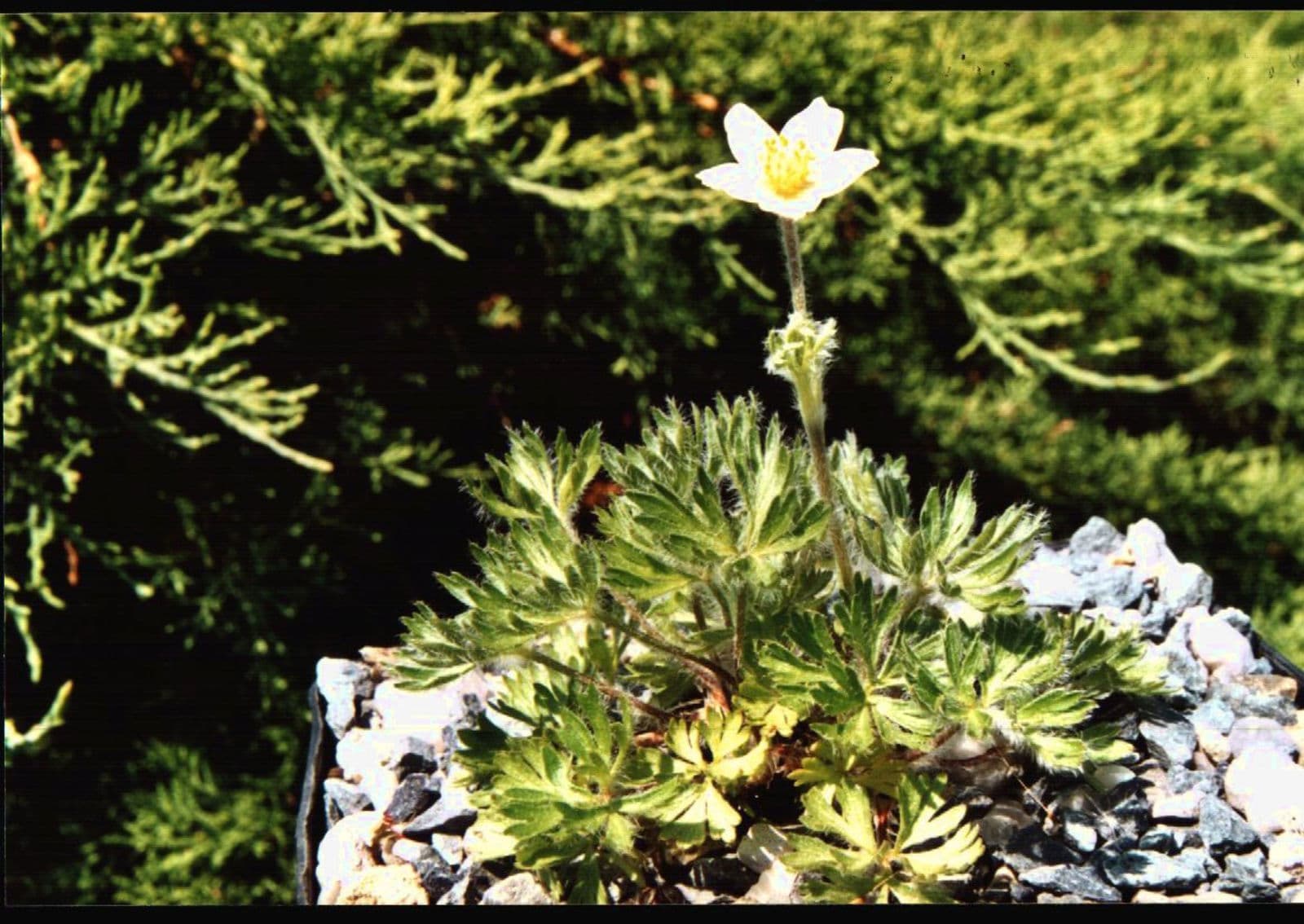
Drummond's anemone forms a compact tufted plant, typically 10 to 20 cm tall. The foliage is finely divided, almost fern-like, with a silvery-grey appearance due to dense, silky hairs, an adaptation to intense sun and wind at high altitude. Above the foliage rises a single, hairy flower stem carrying one bloom, 2 to 3 cm across.
Like all anemones, the flower has no true petals, but rather 5 to 8 petal-like sepals that take on that role. Colour ranges from pure white to very pale bluish lavender, often with a subtle blue flush on the outer surface of the sepals. A cluster of striking yellow stamens in the centre provides a lovely contrast. Flowering occurs, depending on elevation and snowmelt timing, between June and August. After flowering, a fluffy, woolly seed head develops, strongly reminiscent of the related pasque flowers (Pulsatilla).
Ideal location
Full sun is ideal, provided daytime conditions are not too hot and oppressive: Drummond's anemone is naturally accustomed to cool mountain air, even on sunny days. In warmer, more humid lowland gardens, the plant usually does better in light, cool partial shade, for example on the north side of a rock feature. A rock garden, scree bed or alpine trough with excellent drainage is the best location; avoid any spot where water pools after rain. Allow a spacing of 15 to 20 cm between plants, so the compact tufts have room to spread without crowding each other.
Soil
The soil must be lean and extremely well drained: a mix of coarse sand, grit or lava gravel with a small proportion of humus-rich but nutrient-poor soil best mimics the natural mountain ground. The ideal pH range is 6.0 to 7.5, slightly acidic to neutral. Avoid heavy, rich garden soil or fresh manure, which stimulate too much growth and make the plant prone to fungal disease. When planting in a pot or alpine trough, standard potting soil, available at most garden centres, can be mixed with at least 40 to 50% grit for the correct, fast-draining structure.
Free design
Want to see Drummond's anemone: complete guide in your garden? Make a free design now.
Watering
During the growth and flowering period in spring and early summer, Drummond's anemone likes evenly moist, but never waterlogged, soil, mimicking conditions right after mountain snowmelt. Water once the top few centimetres of soil feel dry, roughly once or twice a week in dry weather. After flowering, as the plant gradually winds down for summer rest, watering can be reduced. Always avoid prolonged wet soil in winter, since this is the main cause of root rot in this species.
Pruning
Pruning in the classic sense is not really relevant for this small alpine plant. Remove spent flower stems after blooming if you do not want to collect seed, or leave the decorative, fluffy seed heads in place for extra ornamental value into late summer. Gently remove wilted or yellowed leaves by hand or with small scissors, so as not to disturb the compact tufted shape. Heavy pruning is never needed for this fine, low-growing species. When removing foliage, it is a good idea to wear a thin gardening glove, since the fine hairs on the leaves can cause mild irritation on sensitive skin.
Maintenance calendar
- January to March: dormant period; check the rock garden or alpine trough for excess rainwater.
- April to May: first leaf growth, water moderately as the soil dries out.
- June to July: main flowering period in most locations; regular, even watering.
- August: flowering ends and fluffy seed heads form; reduce watering.
- September to October: the plant retreats for the season; last weed check around the tufts.
- November to December: winter dormancy; ensure excellent drainage against waterlogged roots.
Winter hardiness
Drummond's anemone comes from high mountains with long, snowy winters, making it excellent winter hardy, tolerating temperatures well below -30°C, corresponding to USDA zones 2 to 5. In a lowland garden, cold is not the problem, but wet winters without an insulating snow layer: prolonged cold rain and freeze-thaw cycles can damage the root crown. A layer of coarse grit around the crown of the plant, rather than organic mulch, keeps the crown dry and protects against root rot in winter.
Companion plants
Combine Drummond's anemone with other small, cool-loving rock garden plants such as saxifrages, Sedum spathulifolium, or other high-mountain anemones like Anemone multifida and Anemone parviflora. Silene acaulis and small Primula species from similar mountain regions also make good neighbours. Avoid vigorous, fast-spreading ground covers that would smother the small tuft within a single season, and instead give the plant its own clearly visible spot among rocks or in a raised trough. An added bonus is that Drummond's anemone, like most alpine plants with strongly aromatic or hairy foliage, is rarely browsed by deer or rabbits, making it an attractive choice for gardens where wildlife grazing is a recurring problem.
Closing
Drummond's anemone is not a plant for the average border, but a refined mountain gem for anyone with a cool, well-drained rock garden or alpine trough at their disposal. With the right sharply draining soil and a cool location, this dainty anemone returns year after year with its silvery-grey foliage and delicate flowers. Use gardenworld.app to determine the ideal, well-drained spot for this kind of special alpine plant in your garden design.
Want to see Drummond's anemone: complete guide in your garden? Make a free design now.
Upload a photo, pick a style, and get a photorealistic design with plant list in under a minute.
10,000+ gardens designed already
No credit card required


Similar plants
Anemone multifida: complete guide
Anemone multifida
Cut-leaf anemone from North America with enchanting flowers. Hardy and low-maintenance for alpine gardens and borders. Complete care guide.
Northern Anemone: complete guide
Anemone parviflora
Grow the delicate Northern Anemone (Anemone parviflora): ideal conditions, soil, watering and care for this alpine treasure.
Narcissus Anemone (Anemone narcissiflora): complete guide
Anemone narcissiflora
Discover the delicate white flowers of Narcissus Anemone. This alpine plant blooms in May with elegant narcissus-like blossoms. Growing guide for partial shade.