
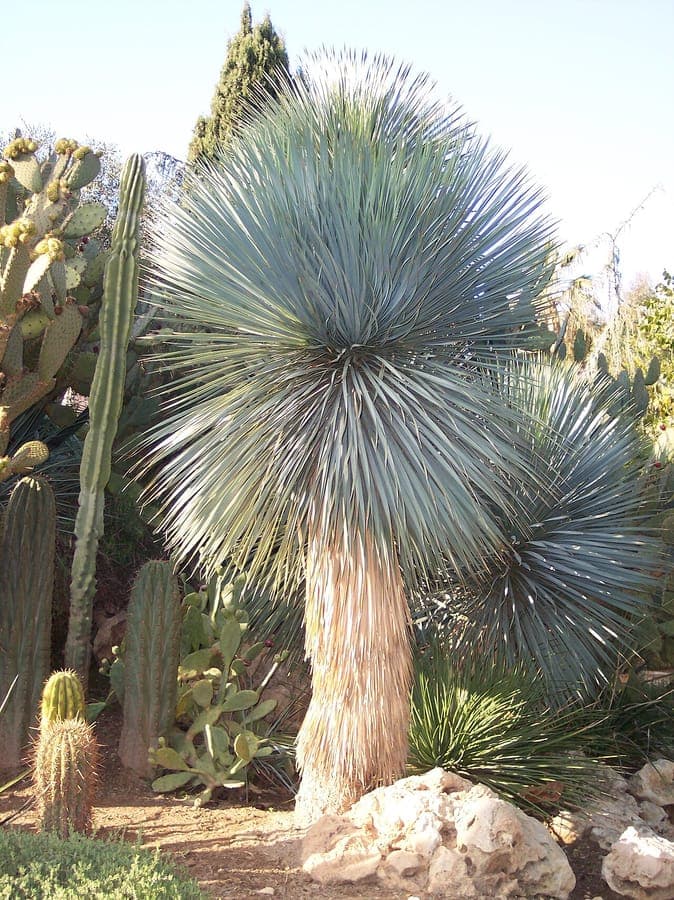
c299792458 / CC BY-SA 3.0, via Wikimedia Commons
Big Bend yucca: complete guide
Yucca rostrata
¿Quieres ver Big Bend yucca: complete guide en tu jardín?
1 minuto, sin tarjeta de crédito
Overview
Yucca rostrata, also known as Big Bend yucca or beaked yucca, is a spectacular desert plant from Texas and Mexico. This plant belongs to the Asparagaceae family and is a true architectural masterpiece. With its dense rosette of blue, narrowly-tapered foliage, it creates an unforgettable contrast in any garden. The plant grows slowly to a medium-sized tree up to 3-4 meters tall. When it finally blooms (usually after 15-20 years), elongated clusters of fragrance-free white flowers appear.
Appearance and bloom
Yucca rostrata forms a dense, spherical rosette of stiffly-erect leaves. The leaves are grey-blue in color, narrow (about 1 cm wide) and can reach 40-50 cm long. They have a subtle red or yellow margin. The leaves end in a characteristic hard point (the beak). The plant grows very slowly: only a few centimeters per year. After many years it finally develops a thick, rough trunk. Flowering occurs in late spring (May-June) with massive clusters of creamy-white, drooping flowers.
Ideal location
Choose a spot with full sun: at least 6-8 hours of direct sunlight daily. Yucca rostrata grows best in very sunny locations with warm temperatures. Avoid shaded spots where the plant grows poorly and becomes substandard. The plant tolerates heat and even extreme heat. Wind is less problematic since the plant is sturdy.
Soil
Excellent drainage is absolutely essential. Sandy, gravel or rocky soil is ideal. Add plenty of sand or gravel to regular garden soil. Heavy clay must be avoided. A neutral to slightly acidic pH works well. Minimal feeding: the plant grows on very poor desert soils. Too much feeding can lead to soft growth.
Diseño gratis
¿Quieres ver Big Bend yucca: complete guide en tu jardín? Crea un diseño gratis ahora.
Watering
Once established, Yucca rostrata is extremely drought-tolerant. Water only in very dry periods after planting. Young plants during the first season water regularly (every other week). Mature plants need no supplemental water, even in dry summers. Winter: no water. Too much water certainly leads to rot.
Pruning
Yucca rostrata requires virtually no pruning. Dead leaves can be carefully removed, but this is optional. The plant naturally forms a perfect shape. Avoid aggressive pruning as the plant grows very slowly and recovers slowly.
Maintenance calendar
MAY-JUNE: Blooming, enjoy spectacular clusters. JULY-SEPTEMBER: Warm summer period, no maintenance needed. OCTOBER-FEBRUARY: Cold period, very minimal water. MARCH-APRIL: Growth begins cautiously. WHOLE YEAR: Dead leaves optionally removed.
Winter hardiness
Yucca rostrata is surprisingly winter-hardy to at least -15 to -20 degrees Celsius. This makes it suitable for many temperate climates. In very cold areas, protection with dry leaves may help. Ensure good drainage to prevent winter rot. In very warm regions it grows without problems.
Companion plants
Yucca rostrata combines beautifully with other desert plants and xerophytic species. Lovely with agave, aloe, echeveria and other succulents. Also good with dry-soil plants like santolina, rosemary and lavender. For structure in gardens, ideal as a specimen plant. The blue foliage contrasts nicely with red or purple-leafed foliage.
Closing
Big Bend yucca is not a plant for the impatient, as growth is slow. But if you are willing to wait, it becomes a true focal plant in your garden. With its blue foliage, architectural form and extreme hardiness, it is a statement plant. Plant it centrally in xerophytic gardens or as a solitary accent. Add it to gardenworld.app designs for dramatic, low-maintenance gardens. Explore more gardenworld.app desert plant combinations for inspiration!
¿Quieres ver Big Bend yucca: complete guide en tu jardín? Crea un diseño gratis ahora.
Sube una foto, elige un estilo y obtén un diseño fotorrealista con lista de plantas en menos de un minuto.
Más de 10.000 jardines diseñados
Sin tarjeta de crédito


Plantas similares
Narrow-leaved dracaena: complete guide
Dracaena angustifolia
Everything about Dracaena angustifolia - the narrow-leaved dracaena: location, care, overwintering and use as a houseplant or patio plant.
Chaparral yucca: complete guide to Hesperoyucca whipplei
Hesperoyucca whipplei
Hesperoyucca whipplei (Our Lord's candle) is a dramatic rosette-forming plant from California that produces a towering flower spike, ideal for dry and gravel gardens.
False lily-of-the-valley: complete guide
Maianthemum dilatatum
Everything about Maianthemum dilatatum, the false lily-of-the-valley. Care, shade location, propagation and garden combinations for this popular shade ground cover.