
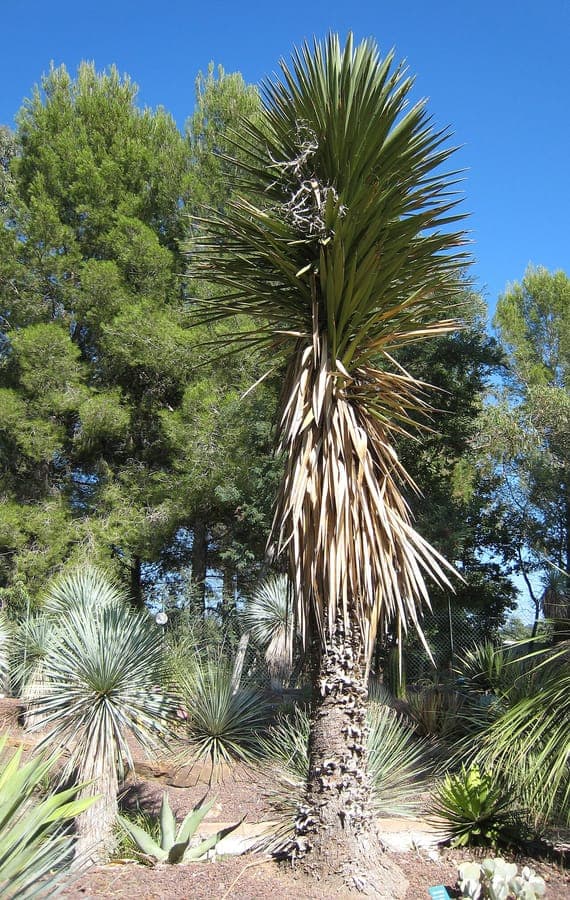
This photo has been taken by Matthieu Sontag (User:Mirgolth) and released under the licenses stated below. You are free to use it for any purpose as long as you credit me as author, Wikimedia Commons as site and follow the terms of the licenses. Could you be kind enough to leave me a message on this page to inform me about your use of this picture. / CC BY-SA 4.0, via Wikimedia Commons
Yucca filifera: complete guide
Yucca filifera
¿Quieres ver Yucca filifera: complete guide en tu jardín?
1 minuto, sin tarjeta de crédito
Overview
Yucca filifera, commonly known as Palma China yucca or St. Peter's palm, is a fascinating ornamental tree that stands out for its slow, stately growth and distinctive thread-bearing leaves. This tree originates from central Mexico, where it forms an important part of dry, rocky landscapes.
It is a plant that commands respect through its structure and texture. The name "filifera" directly refers to the thin threads that grow from the leaf edges, making this plant immediately recognizable. For gardeners seeking a statement plant with minimal maintenance requirements, this is an excellent choice.
Appearance and bloom
Yucca filifera slowly grows into a tree 3 to 5 meters high with a dense crown of blue-green leaves. Each leaf is pointed, hard, and adorned with characteristic gray-white threads that hang from the edges. These threads give the plant its unique, almost elegant appearance.
Flowers appear in late spring through early summer, in the growing area from May to July. They form in dense clusters on long stems emerging from the heart of the plant. The flowers are creamy to yellow, bell-shaped, and have a subtle fragrance. These flowers are especially fragrant at night, indicating pollination by night moths in their natural habitat.
After flowering, fruits develop: large, fleshy capsules that some botanical gardens also call "yucca apples." These are however not edible and serve mainly as seed sources.
Ideal location
Yucca filifera thrives best in locations with full sun exposure. At least 6 hours of direct sunlight daily is essential for healthy growth and flowering. The plant is very tolerant of heat and strong sun, making it ideal for dry, sunny gardens.
In colder climates, Yucca filifera can be grown in large pots and brought indoors during winter. The plant is hardy to about minus 10 degrees Celsius, but tolerates short frost periods better than prolonged freezing.
Wind exposure is not a problem - in fact, this plant maintains its form better with moderate wind exposure. However, ensure the plant stands stably, especially as it grows larger.
Soil
Yucca filifera requires well-draining soil. Waterlogging is the greatest threat to this plant, especially during winter. Use a mixture consisting of:
- 50% potting soil or garden earth
- 30% coarse sand or perlite
- 20% perlite or potshards for extra drainage
The pH should be neutral to slightly alkaline (pH 6.5 to 8.0). In fact, the plant thrives better in somewhat less nutrient-rich soil than in heavily fertilized garden beds.
Root growth is relatively shallow, so provide ample horizontal space rather than great depth. A large, wide pot (minimum 40 liters) is more suitable than a deep, narrow one.
Diseño gratis
¿Quieres ver Yucca filifera: complete guide en tu jardín? Crea un diseño gratis ahora.
Watering
This is one of the most drought-resistant plants you can grow. During the growing season (May to September), water moderately only - only when the soil feels completely dry. Check by feeling several centimeters into the soil.
In autumn and winter, decrease drastically. As long as the plant remains green, it needs very little water. Overwatering in winter is the most common cause of death.
With pot culture: water 1 to 2 times per month during the summer season, depending on temperature and humidity. In winter every 2 to 3 weeks or less.
Pruning
Pruning is rarely necessary and even not recommended for the central growth point. The plant grows naturally symmetrical and slowly.
You can however:
- Carefully remove dead or damaged leaves by pulling them close to the base
- Remove seed-bearing flower stems after flowering to save energy
- Very long leaves on the outside can carefully be shortened (not cut, but bent and removed)
Avoid central pruning - the plant grows from a single growth center.
Maintenance calendar
Spring (March-May): Preparation for growing season. Check drainage. Begin cautiously increasing watering as temperatures rise.
Summer (June-August): Growing season. Water regularly, but still minimally. Adding low-nitrogen fertilizer once every 6 weeks is optional.
Autumn (September-October): Gradually reduce water. The plant prepares for rest.
Winter (November-February): Minimal care. Almost no water, no fertilizer. Protection against frost damage (in northern regions).
Winter hardiness
Yucca filifera is moderately winter hardy. In southern parts of the Netherlands and Belgium, the plant can remain outdoors over winter if protected against frost damage. Ideal is a sheltered position against a south-facing wall.
In colder regions: bring pot-grown specimens indoors in a cool, bright room (10-15 degrees). Outdoor planted plants can be protected with a mulch layer or netting.
Protection from frost periods longer than a week is essential - prolonged freezing permanently damages the heart of the plant.
Companion plants
Yucca filifera works well with other drought-tolerant plants:
- Agapanthus
- Sedum and other succulents
- Lavender
- Ornamental grasses (Festuca, Miscanthus)
- Artemisia
- Teucrium (germander)
Avoid combinations with plants that need lots of water, as the maintenance requirement is completely different.
Closing
Yucca filifera is an exceptional plant for those who love boldness. With its striking appearance, minimal maintenance requirements, and water savings, it is not only beautiful but also practical. This Mexican ornament requires patience (it grows slowly) and respect (for its sharp leaves), but rewards the gardener with years of beautiful, almost tropical sculptural work.
Those seeking a plant that transforms their garden into a dry, peaceful island full of texture and movement will find in Yucca filifera an ideal partner. Available at Intratuin and Gamma in the Netherlands.
¿Quieres ver Yucca filifera: complete guide en tu jardín? Crea un diseño gratis ahora.
Sube una foto, elige un estilo y obtén un diseño fotorrealista con lista de plantas en menos de un minuto.
Más de 10.000 jardines diseñados
Sin tarjeta de crédito


Plantas similares
Narrow-leaved dracaena: complete guide
Dracaena angustifolia
Everything about Dracaena angustifolia - the narrow-leaved dracaena: location, care, overwintering and use as a houseplant or patio plant.
Chaparral yucca: complete guide to Hesperoyucca whipplei
Hesperoyucca whipplei
Hesperoyucca whipplei (Our Lord's candle) is a dramatic rosette-forming plant from California that produces a towering flower spike, ideal for dry and gravel gardens.
False lily-of-the-valley: complete guide
Maianthemum dilatatum
Everything about Maianthemum dilatatum, the false lily-of-the-valley. Care, shade location, propagation and garden combinations for this popular shade ground cover.