
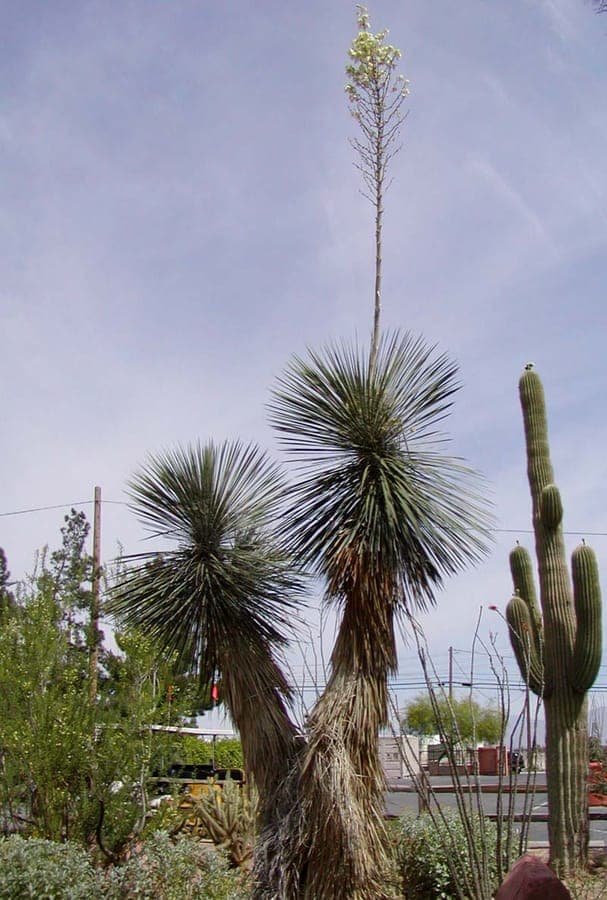
Stan Shebs / CC BY-SA 3.0, via Wikimedia Commons
Soaptree Yucca: complete guide
Yucca elata
¿Quieres ver Soaptree Yucca: complete guide en tu jardín?
1 minuto, sin tarjeta de crédito
Overview
The Soaptree Yucca (Yucca elata), also called Soapweed or Izote forrajero, is a spectacular succulent from arid mountainous regions of Arizona, New Mexico, western Texas, and northern Mexico. This species belongs to the Asparagaceae family and is celebrated for its dramatic architectural form, dense bundle of long narrow leaves, and impressive towering flower spikes with white bell flowers. Growing 5-8 feet tall, this unique plant is perfect for arid gardens, desert landscapes, and as a bold specimen plant.
Soaptree Yucca is an extremely drought-tolerant plant ideal for areas with limited water availability and warm climates.
Appearance & Bloom
Soaptree Yucca grows into characteristic form: a compact, dense rosette of long slender leaves 24-36 inches long. Leaves are dark green to bluish-green, stiff and pointed, with natural gray waxy coating giving silvery appearance. The leaves form strong architectural form striking even without flowers.
The bloom is truly spectacular. In May-June emerges tall flower spike 5-6.5 feet high, studded with small, intensely fragrant white or cream-colored bell flowers. These flowers are sweetly scented to attract pollinators. After flowering, black seed capsules develop.
Ideal Location
Soaptree Yucca requires full sun and warm climate. Ensure at least 6-8 hours direct sun daily. This plant thrives in warm, dry climate with very well-draining soil. It is not suitable for humid or cold climates.
Plant Soaptree Yucca in open, sunny locations where dramatic form can shine. This plant creates impact in desert gardens, Mediterranean gardens, and as specimen planting.
Soil
Very well-draining soil is absolutely essential. The plant cannot grow in humid or clay soils without rotting. Sandy, gravelly, or rocky soil is ideal with pH 7.0-8.5 (neutral to alkaline).
In containers use cactus soil mix and sand. Add extra perlite or gravel for maximum drainage. The plant tolerates poor soils without issue.
Diseño gratis
¿Quieres ver Soaptree Yucca: complete guide en tu jardín? Crea un diseño gratis ahora.
Watering
Soaptree Yucca is extremely drought-tolerant once established. Minimal watering is needed; actually the plant grows better with very little water. During first growing season water cautiously but very sparingly; only if extreme drought occurs.
Established plants need almost no watering except in extreme drought situations. Overwatering leads to stem rot and death. This is a minimal-water plant.
Pruning
Soaptree Yucca requires virtually no pruning. Remove any dead or damaged leaves if desired. After flowering the flower spike can be cut once it dries. Beyond this minimal maintenance, let the plant grow in its natural form.
Maintenance Calendar
- March-April: Inspect for winter damage (only in colder areas)
- May-June: Spectacular bloom; enjoy it
- July-August: After flowering; flower spike can be removed
- September-October: Growth slows; no watering
- November-March: Completely dormant; no attention
Winter Hardiness
Soaptree Yucca is moderately cold-hardy; it tolerates frost to about 14F (-10C) in dry conditions. In humid or wet conditions damage is worse. In areas with regular frost or snow protection from extreme cold is important. In mild areas it grows outdoors without protection.
Companion Plants
Soaptree Yucca combines beautifully with:
- Other desert plants: Yucca rostrata, Agave, Aloe
- Drought-tolerant shrubs: Salvia, Artemisia
- Grasses: Fine-textured yellow grasses
- Gravel and stone mulch for desert garden effect
Avoid moisture-loving plants nearby; Soaptree Yucca thrives with other drought-tolerant species.
Conclusion
Soaptree Yucca is a spectacular, architectural plant for warm, dry climates. With dramatic form and impressive flowering, it offers year-round impact in landscape. Minimal maintenance and water make it ideal for ecologically responsible gardens. Plant this desert flower and create striking, water-free landscape full of dramatic beauty.
¿Quieres ver Soaptree Yucca: complete guide en tu jardín? Crea un diseño gratis ahora.
Sube una foto, elige un estilo y obtén un diseño fotorrealista con lista de plantas en menos de un minuto.
Más de 10.000 jardines diseñados
Sin tarjeta de crédito


Plantas similares
Narrow-leaved dracaena: complete guide
Dracaena angustifolia
Everything about Dracaena angustifolia - the narrow-leaved dracaena: location, care, overwintering and use as a houseplant or patio plant.
Chaparral yucca: complete guide to Hesperoyucca whipplei
Hesperoyucca whipplei
Hesperoyucca whipplei (Our Lord's candle) is a dramatic rosette-forming plant from California that produces a towering flower spike, ideal for dry and gravel gardens.
False lily-of-the-valley: complete guide
Maianthemum dilatatum
Everything about Maianthemum dilatatum, the false lily-of-the-valley. Care, shade location, propagation and garden combinations for this popular shade ground cover.