
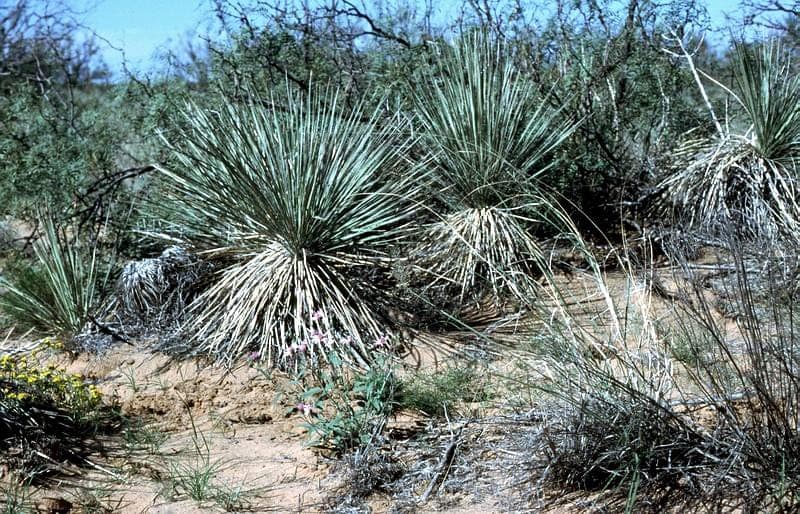
Rebou / CC BY-SA 3.0, via Wikimedia Commons
Yucca campestris: complete guide
Yucca campestris
¿Quieres ver Yucca campestris: complete guide en tu jardín?
1 minuto, sin tarjeta de crédito
Overview
Yucca campestris, commonly known as Plains yucca, is a compact succulent native to the borderlands between New Mexico and Texas. This hardy plant forms stiff, blue-green leaves that radiate outward, creating a dramatic desert aesthetic for any front yard. The natural growth habit makes it an excellent focal point without requiring constant attention.
Plains yucca typically reaches 60-90 centimeters in height and spread, making it suitable for smaller yards and containers. It withstands temperatures down to approximately -15 degrees Celsius, allowing outdoor year-round cultivation in most northern European climates.
Appearance and Bloom
The distinctive form of Plains yucca consists of upright leaves that curve gently inward, creating a compact rosette. Foliage is rigid, gray-green, and spans approximately 30-40 centimeters in length. During summer months, cream-colored flowers emerge on a thick inflorescence rising above the leaf mass.
The flowers are small, tube-shaped, and mildly fragrant, particularly in the evening. They attract various pollinators and eventually produce elongated seed capsules that provide visual interest throughout the season.
Ideal Location
Plains yucca requires full sun exposure. Aim for at least six hours of direct sunlight daily for optimal growth and flowering. In front yard designs, position the plant in the sunniest available spot.
Frost protection is unnecessary in most northern European regions, but protecting against heavy wet snow is advisable. Avoid planting beneath roof edges where melting snow slides onto the foliage, as this causes ice accumulation that damages leaves.
Soil Requirements
Drainage is the critical factor for Plains yucca success. The plant cannot tolerate waterlogging. Use soil with excellent drainage characteristics: mix standard potting soil with 50% sand, grit, or bark chips.
In front yards, position the plant on slightly elevated ground with constructed drainage paths. Soil pH between 6.0 and 7.5 is acceptable. The plant makes minimal nutrient demands.
Watering
Once established, Plains yucca exhibits exceptional drought tolerance. Water only when soil feels completely dry. In front yard settings, remember: too dry is always better than too wet.
During the growing season (May through September), water once every two weeks during dry spells. Cease watering entirely in winter. Container-grown plants require more frequent moisture monitoring; water only when the top 5 centimeters feel dry.
Diseño gratis
¿Quieres ver Yucca campestris: complete guide en tu jardín? Crea un diseño gratis ahora.
Pruning
Pruning is essentially unnecessary. Plains yucca maintains an attractive natural form. Remove only dead or damaged leaves by gently pulling them off at the base.
After flowering, cut spent flower stalks. This doesn't stimulate reblooming but improves appearance. Use a sharp, sterilized knife or pruning shears when moving between plants.
Maintenance Calendar
May through July: Monitor for drought conditions; water during dry periods. August: Possible flowering; no special care required. September through October: Gradually reduce watering frequency. November through February: No watering; monitor for excessive moisture. March through April: Prepare for the growing season.
Winter Hardiness
Plains yucca exhibits excellent winter hardiness. Temperatures to -15 degrees Celsius present no problem. Extreme frosts around -20 degrees may cause damage, especially if plants overwintered in wet conditions.
In regions with significant snowfall, gently shake accumulated snow from foliage. Avoid allowing snow to pile atop the plant. A lightweight, breathable cover provides protection during extreme winters.
Companion Plants
Plains yucca combines effectively with other drought-tolerant species. Sedum varieties, Euphorbia, and ornamental grasses such as Festuca integrate perfectly. This combination requires minimal maintenance input.
Avoid pairing with plants requiring frequent moisture in the same bed. They compete for water resources, and excess moisture damages the yucca.
Closing
Plains yucca is a straightforward plant for front yard designs. It demands minimal attention, maintains visual interest year-round, and blooms reliably in summer. For gardeners appreciating drought tolerance and bold forms, this is the ideal selection.
Purchase Plains yucca from garden retailers; knowledgeable staff provide solid advice. Position in full sun with excellent drainage, then allow the plant to establish itself. Your front yard will appear fresher and require significantly less maintenance. Visit gardenworld.app for additional applications of this striking plant in your landscape design. Gardenworld.app also helps you develop planting schemes for your entire front yard.
¿Quieres ver Yucca campestris: complete guide en tu jardín? Crea un diseño gratis ahora.
Sube una foto, elige un estilo y obtén un diseño fotorrealista con lista de plantas en menos de un minuto.
Más de 10.000 jardines diseñados
Sin tarjeta de crédito


Plantas similares
Narrow-leaved dracaena: complete guide
Dracaena angustifolia
Everything about Dracaena angustifolia - the narrow-leaved dracaena: location, care, overwintering and use as a houseplant or patio plant.
Chaparral yucca: complete guide to Hesperoyucca whipplei
Hesperoyucca whipplei
Hesperoyucca whipplei (Our Lord's candle) is a dramatic rosette-forming plant from California that produces a towering flower spike, ideal for dry and gravel gardens.
False lily-of-the-valley: complete guide
Maianthemum dilatatum
Everything about Maianthemum dilatatum, the false lily-of-the-valley. Care, shade location, propagation and garden combinations for this popular shade ground cover.