
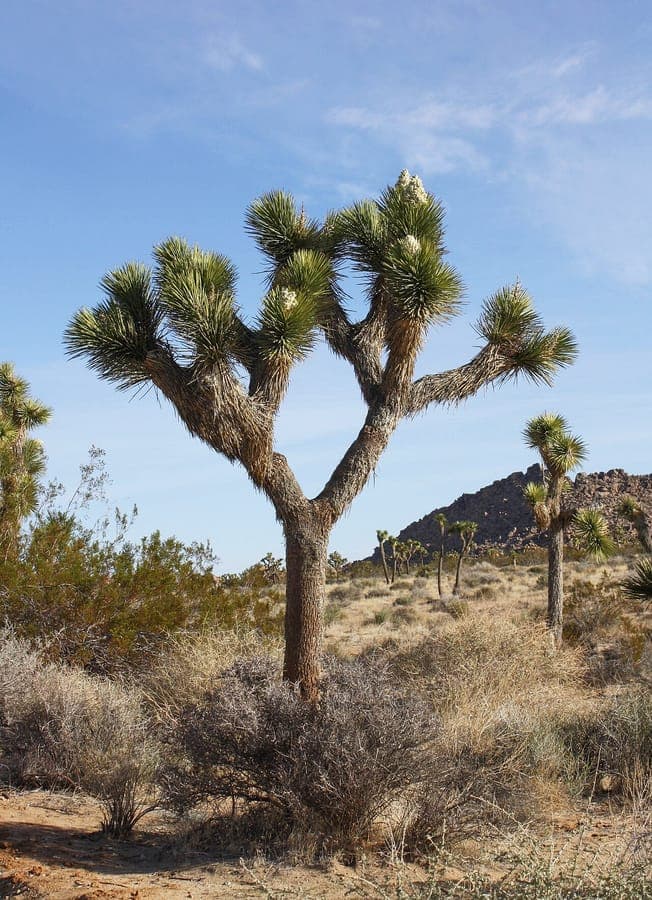
Bernard Gagnon / CC BY-SA 3.0, via Wikimedia Commons
Joshua tree: complete guide
Yucca brevifolia
¿Quieres ver Joshua tree: complete guide en tu jardín?
1 minuto, sin tarjeta de crédito
Overview
The Joshua tree (Yucca brevifolia) is an iconic shrub from the Mojave Desert of southwestern America. Despite its name, it is not a true tree but rather a member of the Yucca family with a uniquely sculptural form. With its twisted, gnarled branch structure and pointed leaves, this plant creates instant visual drama in any landscape. The Joshua tree grows slowly to approximately 10-15 meters tall in its natural habitat, but remains much smaller in cultivation.
These plants are incredibly tough and forgiving. They thrive in hot, dry environments with minimal care. The Joshua tree is ideal for landscapes where you want something wild and unconventional.
Appearance and Bloom
The Joshua tree has a highly distinctive form with gnarled, irregularly branched arms. The leaves are long, narrow, and pointed with a gray-green hue, growing in clusters at branch tips. In spring, typically April through May, the tree produces small white flowers in dense, knobby clusters with a subtle, pleasant fragrance especially noticeable at dusk.
The plant may go years without flowering in cultivation, particularly when young. Once established, you'll likely enjoy beautiful flowering displays.
Ideal Location
The Joshua tree requires full sun to thrive. Plant it where it receives minimum six to eight hours of direct sunlight daily. More sun is always better for this species.
This tree is frost-hardy to about -10 to -5 degrees Celsius, depending on variety. In colder regions, place it in a sheltered location. A southeast position is ideal in temperate climates.
Soil
Excellent drainage is essential. The Joshua tree cannot tolerate wet feet and will quickly rot in poorly draining soil. Sand, gravel, or cactus compost work perfectly. Mixtures of one-third coarse sand, one-third perlite, and one-third standard garden soil yield excellent results.
If using garden soil, add 40-50% extra sand. pH can be neutral to slightly acidic. Avoid adding organic material that retains excessive moisture.
Diseño gratis
¿Quieres ver Joshua tree: complete guide en tu jardín? Crea un diseño gratis ahora.
Watering
Once established, the Joshua tree is extremely drought-tolerant. Young plants need somewhat more water during their first growing season. Water moderately until the soil is 10 centimeters dry, then resume watering.
In winter (October through March), drastically reduce watering frequency. Many Californian gardeners provide their Joshua tree with minimal water from January through March. Overwatering is this plant's greatest enemy.
Pruning
Pruning is typically unnecessary. The Joshua tree is most beautiful in its natural form. Remove only dead branches or damaged foliage.
If you wish to remove lower leaves to clean up the appearance, you may do so. Always use clean, sharp pruning tools.
Maintenance Calendar
FEBRUARY-MARCH: Minimal watering. Check soil drainage. APRIL-MAY: Bloom appears. Enjoy! Water remains minimal. JUNE-SEPTEMBER: Growing season. Water every 2-3 weeks if particularly warm. OCTOBER: Gradually reduce watering frequency. NOVEMBER-JANUARY: Almost no water. Only water during very dry periods.
Winter Hardiness
The Joshua tree is frost-hardy to about -10 to -5 degrees Celsius. Some varieties (herbertii and jaegeriana) tolerate slightly colder conditions. In regions with harsher winters (below -15 degrees), protection is needed.
Gravel or mulch around the base provides some protection. Avoid organic mulches that retain moisture.
Companion Plants
The Joshua tree pairs well with other desert plants and succulents:
- Various Agave species
- Other Yucca varieties
- Beautiful Sempervivum selections
- Lavender (Lavandula)
- Ornamental grasses
- Iberis
Closing
The Joshua tree brings Southwest glamour to your garden without fuss. This tough, long-lived plant with dramatic form is perfect for anyone wanting something extraordinary without becoming a demanding plant parent. With minimal watering needs and powerful aesthetics, the Joshua tree deserves a place in any dry climate garden.
Available at garden centers. Discover more garden inspiration on gardenworld.app.
¿Quieres ver Joshua tree: complete guide en tu jardín? Crea un diseño gratis ahora.
Sube una foto, elige un estilo y obtén un diseño fotorrealista con lista de plantas en menos de un minuto.
Más de 10.000 jardines diseñados
Sin tarjeta de crédito


Plantas similares
Narrow-leaved dracaena: complete guide
Dracaena angustifolia
Everything about Dracaena angustifolia - the narrow-leaved dracaena: location, care, overwintering and use as a houseplant or patio plant.
Chaparral yucca: complete guide to Hesperoyucca whipplei
Hesperoyucca whipplei
Hesperoyucca whipplei (Our Lord's candle) is a dramatic rosette-forming plant from California that produces a towering flower spike, ideal for dry and gravel gardens.
False lily-of-the-valley: complete guide
Maianthemum dilatatum
Everything about Maianthemum dilatatum, the false lily-of-the-valley. Care, shade location, propagation and garden combinations for this popular shade ground cover.