
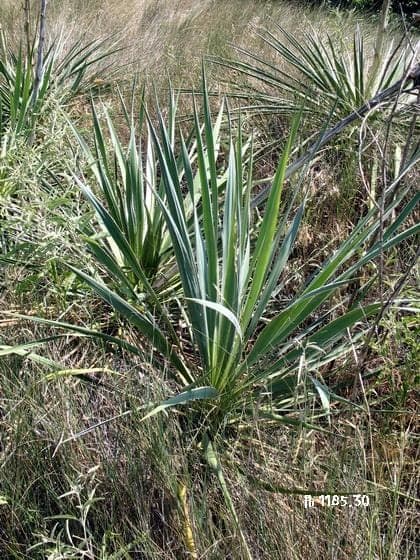
Rebou at German Wikipedia / CC BY-SA 3.0, via Wikimedia Commons
Yucca Arkansana: complete guide
Yucca arkansana
¿Quieres ver Yucca Arkansana: complete guide en tu jardín?
1 minuto, sin tarjeta de crédito
Overview
Yucca arkansana, known as Arkansas yucca, is an imposing desert plant native from Kansas to Texas. This dramatic specimen is distinguished by its coarse-textured, blue-gray rosettes and spectacular flower spikes that tower above the foliage. For southern dry gardens seeking maximum impact, Arkansas yucca delivers unmatched architectural drama.
Appearance and Bloom
This striking semi-succulent forms large rosettes of stiff, blue-gray leaves reaching 18-48 inches long, often with wavy or ribbed edges. The plant grows massive - typically 3-6 feet tall and up to 6 feet wide. In April-July, impressive flower spikes emerge 10-13 feet tall, densely packed with large, bell-shaped white flowers with pink or yellow tinges. These blooms attract hummingbirds, moths, and day-flying insects.
Ideal Location
Yucca arkansana demands full sun - 8+ hours of direct daily light. Position prominently where the blue-gray foliage can sparkle in sunlight. Allow ample space - 10-13 feet clearance from structures and other plants to accommodate mature width.
Soil
Extremely well-draining soil is essential. Arkansas yucca thrives in sand, gravel, rocky soils, and chalky earth. Avoid heavy clay; amend with coarse sand, gravel, or pumice. This plant accepts broad pH (5.0-8.5) and is highly alkaline-tolerant.
Diseño gratis
¿Quieres ver Yucca Arkansana: complete guide en tu jardín? Crea un diseño gratis ahora.
Watering
Once established, Yucca arkansana is extremely drought-tolerant. Water regularly during active growth, but sparingly thereafter. This plant tolerates extended periods without supplemental water. In wet winters, excellent drainage is critical to prevent root rot.
Pruning
Minimal pruning needed. Remove dead basal leaves and damaged foliage. After flowering, spent spikes may be cut when they begin to wither. Young pups may be carefully separated and planted independently.
Maintenance Calendar
- March-April: Resume watering
- April-July: Enjoy spectacular towering blooms
- August-October: Minimal care
- November-February: Winter dormancy
- Year-round: Remove dead basal leaves
Winter Hardiness
Yucca arkansana is hardy to USDA zone 4, tolerating temperatures to -30 deg F (-35 deg C). This makes it far colder-hardy than many yucca species, suitable for northern regions.
Companion Plants
Pair Yucca arkansana with:
- Large agave specimens for drama
- Prairie grasses: Panicum, Andropogon
- Desert shrubs: Artemisia, Salvia
- Large boulders for architectural landscape
This creates an authentically dramatic dry-climate landscape.
Closing
Yucca arkansana is for gardeners unafraid of drama and architectural extremes. Its blue-gray rosettes and towering flower columns provide unmistakable impact. This is not a delicate plant - it demands prominent placement and excellent drainage, but the visual rewards are spectacularly worth it. Discover how Arkansas yucca transforms dry garden designs at Gardenworld.app.
¿Quieres ver Yucca Arkansana: complete guide en tu jardín? Crea un diseño gratis ahora.
Sube una foto, elige un estilo y obtén un diseño fotorrealista con lista de plantas en menos de un minuto.
Más de 10.000 jardines diseñados
Sin tarjeta de crédito


Plantas similares
Narrow-leaved dracaena: complete guide
Dracaena angustifolia
Everything about Dracaena angustifolia - the narrow-leaved dracaena: location, care, overwintering and use as a houseplant or patio plant.
Chaparral yucca: complete guide to Hesperoyucca whipplei
Hesperoyucca whipplei
Hesperoyucca whipplei (Our Lord's candle) is a dramatic rosette-forming plant from California that produces a towering flower spike, ideal for dry and gravel gardens.
False lily-of-the-valley: complete guide
Maianthemum dilatatum
Everything about Maianthemum dilatatum, the false lily-of-the-valley. Care, shade location, propagation and garden combinations for this popular shade ground cover.