
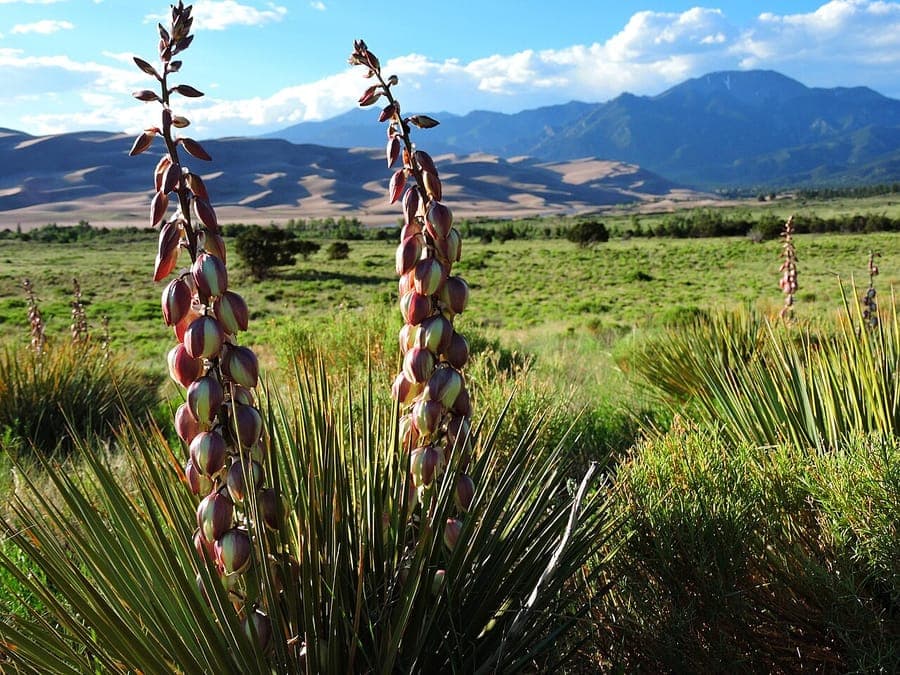
Great Sand Dunes National Park and Preserve / Public domain, via Wikimedia Commons
Yucca Angustissima: complete guide
Yucca angustissima
¿Quieres ver Yucca Angustissima: complete guide en tu jardín?
1 minuto, sin tarjeta de crédito
Overview
Yucca angustissima, commonly known as narrow-leaf yucca, is a compact desert plant native to Utah, New Mexico, and Arizona. This distinctive plant brings remarkable structure to dry gardens with its elegant narrow foliage and spectacular tall flower spikes of creamy-white bells - ideal for xeriscape designs and Mediterranean gardens.
Appearance and Bloom
This semi-succulent forms tight rosettes of slender, gray-green leaves typically 12-24 inches long and only 0.5-1 inch wide. The plant grows slowly into a compact mound 24 inches tall and 1.5-3 feet wide. In late May and June, impressive flower spikes emerge to 3-5 feet tall, crowded with creamy-white, bell-shaped flowers that attract hummingbirds and night-blooming pollinators.
Ideal Location
Yucca angustissima demands full sun - 6-8 hours direct daily sunlight minimum. Position prominently to showcase the dramatic white flower spikes against blue sky. Protect from strong winds that might topple the flowering spike.
Soil
Extremely well-draining soil is essential. This plant thrives in sand, gravel, rocky soils, and chalky earth. Avoid heavy clay; amend with sand, gravel, or coarse compost. pH tolerance is broad (5.5-8.5); it's highly alkaline-tolerant.
Watering
Once established, Yucca angustissima is exceptionally drought-tolerant. Water regularly during active growth (spring-summer), but sparingly thereafter. Overwatering causes root rot - ensure soil dries between waterings. In wet winters, extra drainage is critical.
Diseño gratis
¿Quieres ver Yucca Angustissima: complete guide en tu jardín? Crea un diseño gratis ahora.
Pruning
Minimal pruning needed. Remove dead basal leaves and damaged foliage. After flowering, cut spent flower spikes near the base. Young offsets may be carefully separated and propagated separately.
Maintenance Calendar
- April-May: Resume watering after winter
- May-June: Enjoy spectacular tall blooms
- July-September: Minimal care; water only during extreme drought
- October-March: Winter rest; water only in excessively wet periods
- Year-round: Remove dead basal leaves
Winter Hardiness
Yucca angustissima is winter-hardy to USDA zone 5, tolerating temperatures to -13 deg F (-25 deg C). In colder regions, winter protection (dry mulch, windbreak) helps against wet winters, which are more damaging than cold.
Companion Plants
Pair Yucca angustissima with:
- Other drought-tolerant specimens: Agave, Sempervivum
- Desert ornamental grasses: Bouteloua, Festuca
- Aromatic perennials: Salvia, Lavender
- Rocks and gravel for authentic backdrop
This creates an authentic dry-climate landscape.
Closing
Yucca angustissima excels in water-wise gardens and xeriscape designs. Its slender gray-green rosettes and tall white flowers provide striking architectural interest without demanding water. Perfect for the modern dry garden and Mediterranean patio. Explore Gardenworld.app for inspiration on incorporating this desert gem into your design.
¿Quieres ver Yucca Angustissima: complete guide en tu jardín? Crea un diseño gratis ahora.
Sube una foto, elige un estilo y obtén un diseño fotorrealista con lista de plantas en menos de un minuto.
Más de 10.000 jardines diseñados
Sin tarjeta de crédito


Plantas similares
Narrow-leaved dracaena: complete guide
Dracaena angustifolia
Everything about Dracaena angustifolia - the narrow-leaved dracaena: location, care, overwintering and use as a houseplant or patio plant.
Chaparral yucca: complete guide to Hesperoyucca whipplei
Hesperoyucca whipplei
Hesperoyucca whipplei (Our Lord's candle) is a dramatic rosette-forming plant from California that produces a towering flower spike, ideal for dry and gravel gardens.
False lily-of-the-valley: complete guide
Maianthemum dilatatum
Everything about Maianthemum dilatatum, the false lily-of-the-valley. Care, shade location, propagation and garden combinations for this popular shade ground cover.