
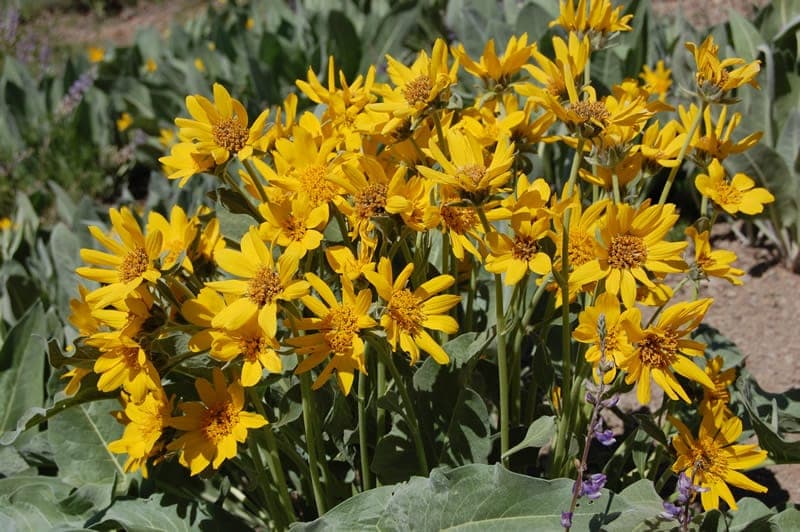
Matt Brown / Public domain, via Wikimedia Commons
Woolly mule-ears: complete guide to Wyethia mollis
Wyethia mollis
¿Quieres ver Woolly mule-ears: complete guide to Wyethia mollis en tu jardín?
1 minuto, sin tarjeta de crédito
Overview
Wyethia mollis, the woolly mule-ears, is a distinctive perennial in the Asteraceae family. Native to Oregon, Nevada, and California, it is closely related to Wyethia amplexicaulis but stands apart through its densely hairy, grey-green to silvery-white leaves - the specific name 'mollis' means soft or woolly, describing the leaf texture perfectly.
The plant was described by Asa Gray in 1865. It grows in wooded foothills, open mountain meadows, and dry hillsides within its relatively limited range. Gardenworld.app can show you how silver-foliage plants like this one contribute year-round texture and colour to a front garden design.
Growth form is bunchgrass-like, and growth rate is slow. This is a patient plant: a new specimen takes a few years to reach its full potential, but once established it persists for a long time with minimal fuss.
Appearance and bloom
The leaves are the defining feature. They are broad and elongated, similar in shape to those of Wyethia amplexicaulis, but densely covered in soft white hairs that give them a grey to silvery hue. This woolliness makes the plant immediately recognisable and gives it a distinctive character in any planting. The grey foliage catches the light beautifully and remains attractive all season.
Flowers are white, which is unusual in the Wyethia genus - most relatives have yellow flowers. The white ray petals surround a yellow central disc. Stems are firm, reaching 30 to 50 cm. Bloom time is late spring. Seeds are brown at maturity.
The combination of silver-grey leaves and white flowers gives Wyethia mollis an elegant, restrained appearance that works well in both modern and cottage-style gardens.
Ideal location
Full sun is essential. The silver-grey leaf hairiness is an adaptation to intense sunlight: the hairs reflect light and reduce water loss. In shade, the leaves perform poorly and the plant loses its characteristic silver tone. Dry, sunny positions suit it perfectly: a slope, a rock garden, or an open warm terrace all work well.
The slower growth and somewhat more compact habit compared to Wyethia amplexicaulis makes it suitable for medium-sized borders where the larger species would overwhelm.
Soil
Preferred pH range is 6.5 to 8.5, a fairly wide tolerance from neutral to alkaline. The plant is well adapted to poor, dry soils. Calcareous soil is not a problem. Good drainage is essential: permanent soil moisture causes root problems. Rocky, lean, sandy or gravelly soil is ideal. On overly fertile beds, the plant grows more lushly but blooms less freely.
Watering
The woolly silver leaf surface signals this plant's drought tolerance. Wyethia mollis is well adapted to dry summers and uses very little water compared to most garden plants. Some supplemental watering is useful in the first growing season. After establishment, normal Western European rainfall generally meets the plant's needs.
Water deeply and infrequently. Frequent shallow watering produces shallow roots and reduces drought resistance. Allow the soil to dry out completely between waterings.
Pruning
Minimal pruning needed. Remove spent flower stalks after blooming or leave them standing. The large leaves die back naturally in autumn; remove dead material at season's end or in early spring. The slow growth rate means shaping is rarely necessary. Allow the plant to maintain its natural habit.
Diseño gratis
¿Quieres ver Woolly mule-ears: complete guide to Wyethia mollis en tu jardín? Crea un diseño gratis ahora.
Maintenance calendar
- March: Remove last season's dead leaves. New silvery-white shoots emerge.
- April: Leaf canopy develops. Water if soil is completely dry after a dry winter.
- May/June: Bloom period. White flowers above silver-grey foliage. No intervention needed.
- July: Seeds ripen. Leave or remove as preferred.
- August: Drought period. Plant handles this well. No supplemental watering needed for established plants.
- September: Leaves begin dying back.
- October: Remove dead leaf material if desired.
- November to February: Dormant period. No action needed.
Winter hardiness
Wyethia mollis is reasonably cold-hardy, suited to USDA zones 5 to 8. It is adapted to the variable winters of Oregon, Nevada, and California. Above-ground parts die back in autumn; the rootstock survives underground. In Western European climates it is reliably hardy. Keep soil as dry as possible in winter: wet cold is more damaging to this plant than dry frost.
Companion plants
The silvery leaves of Wyethia mollis are a special element in garden combinations. They work perfectly with other grey-silver plants: Artemisia, Stachys byzantina, and Anaphalis for a coherent silver-white theme. The white flowers pair with lavender-blue Catananche or Nepeta for a fresh colour combination.
In a dry rock garden, combine with Phlomis, Cistus, and low-growing Helianthemum. The woolly leaf texture creates a natural connection with other felty or hairy-leaved plants.
Propagation
Like its glossy-leaved cousin, woolly mules ears is raised from seed alone; the taproot rules out division entirely. Gather seed from the browned heads in late summer and give it eight to ten weeks of cold stratification, for instance in damp sand in the refrigerator. Sow afterwards into deep pots and keep the nursery area cool and bright. Seedlings spend their first year building underground reserves, so little appears to happen above ground; resist the urge to coddle them with feed or extra water. Plant out in their second spring at 50 to 60 cm spacing in the permanent position, and never disturb the roots again. Raisers who sow several provenances will notice marked variation in felting and blade size between populations.
Common problems and solutions
The silvery felted foliage acts as built-in sunscreen and renders the plant close to drought-proof, yet the same adaptation makes it intolerant of prolonged wet: in heavy, cold clay the crown rots without appeal. Work in generous grit at planting time or use a raised bed. Slugs largely ignore the hairy leaves, and deer walk straight past. The biggest drawback is cosmetic: foliage withdraws early after flowering, leaving a bare patch until spring, so site late-rising grasses or autumn bloomers nearby to fill the gap. On gardenworld.app you can stage exactly that succession in a photo of your own border before you commit to a layout.
Closing thoughts
Wyethia mollis is a rare but rewarding perennial for dry, sunny gardens. Its silvery leaf coating makes it decorative throughout the year, not only in bloom. For gardeners seeking something with distinctive texture and quiet character for the dry border, this is a fine choice. Visit gardenworld.app to see how silver-foliage plants like Wyethia mollis can lift an entire garden design.
¿Quieres ver Woolly mule-ears: complete guide to Wyethia mollis en tu jardín? Crea un diseño gratis ahora.
Sube una foto, elige un estilo y obtén un diseño fotorrealista con lista de plantas en menos de un minuto.
Más de 10.000 jardines diseñados
Sin tarjeta de crédito

