
Alex Abair / CC BY 4.0, via Wikimedia Commons
Chinese chastetree: complete guide
Vitex negundo
¿Quieres ver Chinese chastetree: complete guide en tu jardín?
1 minuto, sin tarjeta de crédito
Overview
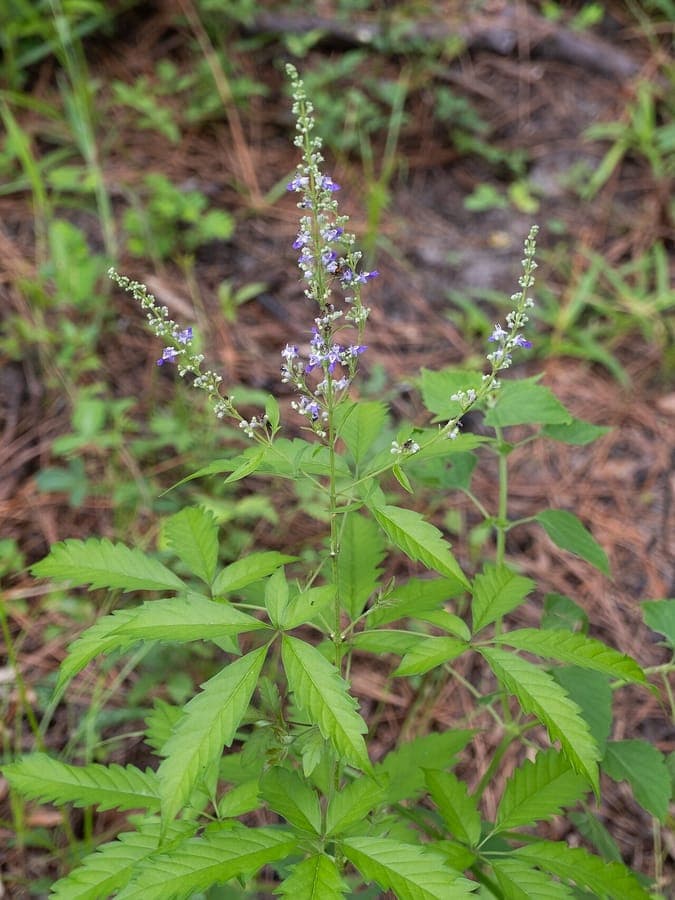
The Chinese chastetree (Vitex negundo), also known as Vitex, is an impressive ornamental shrub that deserves a place in summer garden designs. This shrub is valued for its long flowering period extending from July to October, producing beautiful purple-blue flower spikes. With elegant five-part foliage and a gracefully spreading habit, Vitex negundo typically reaches 2-4 meters in height.
The Chinese chastetree is popular in garden design because it attracts many bees and butterflies. At gardenworld.app, landscape designers can effectively use this plant for biodiversity and color accents. The long flowering period ensures sustained color display throughout the summer season.
Appearance and bloom
The characteristic flowers of Vitex negundo are small, tubular flowers with five-lobed petals that may be purple, blue, or pink varieties. The flowers are clustered in slender spikes that can reach 10-15 centimeters long. The foliage is palmately divided into five narrow, lance-shaped leaflets, from which the common name derives.
The scent of the foliage is characteristically aromatic, especially when touched. After flowering, dark berries appear, which are not particularly edible for humans but do attract birds. This makes Vitex negundo valuable for wildlife interactions.
Ideal location
Vitex negundo thrives best in full sun locations where it receives at least six hours of direct sunlight daily. Full sun results in the best flowering and most compact growth. In zones with intense summer heat, some afternoon shade may be acceptable, but this can limit flowering.
The plant tolerates wind well and can be used in exposed sites. In gardenworld.app design, this robustness can be leveraged for windy front yard situations.
Soil requirements
Vitex negundo is highly tolerant of soil types and grows even in poor, dry soils. A pH of 5.5 to 8.0 is acceptable. The plant tolerates both acidic and alkaline soils. This makes it highly suitable for situations where soil improvement is minimal.
Drainage must be good, however, as Vitex negundo is sensitive to waterlogging. In very clay soils, adding sand and organic matter is recommended. Once established, minimal soil preparation is needed.
Diseño gratis
¿Quieres ver Chinese chastetree: complete guide en tu jardín? Crea un diseño gratis ahora.
Watering
After the initial planting phase (first 6-8 weeks), Vitex negundo is highly drought-tolerant. Regular watering does enhance growth and flowering, especially in early years. During dry periods, supplemental water can improve flowering.
Once established, this plant has minimal water needs and can grow for long periods without rain. This makes it an ideal choice for sustainable, water-smart gardens. In very wet winters, water stagnation must be prevented.
Pruning
Vitex negundo tolerates heavy pruning well. For more compact growth, it can be cut back to mid-height in spring. This stimulates more flowering shoots. Spent flower spikes can be removed after flowering for neatness.
Structural pruning can be done anytime, but because Vitex negundo produces much flowering on new wood, heavy pruning does not result in loss of flowering. For enhanced bird feeding, fruit can be left on.
Maintenance calendar
MARCH-APRIL: Structural pruning; remove winter damage. MAY-JUNE: Growth accelerates; regular water during dry spells. JULY-AUGUST: Early-flowering; abundant nectar source for pollinators. SEPTEMBER-OCTOBER: Continuous flowering; encourage fruiting for birds. NOVEMBER-DECEMBER: Minimal activity; winter preparation. JANUARY-FEBRUARY: Winter dormancy; sparse watering.
Winter hardiness
Vitex negundo is winter-hardy to around -5 to -10 degrees Celsius in warm-temperate climates. In cold winter regions, severe freezing to ground level can occur, but the plant typically regrows from the root. Young plants need winter protection, especially in the first year.
In most temperate regions, protection in normal winters is not needed. In severe winters (below -15C), some mulching around the base may be beneficial. The plant tolerates light frost well without permanent damage.
Companion plants
Vitex negundo combines beautifully with other summer-flowering plants such as lavender, delphinium, and Japanese asters. The purple-blue tones contrast nicely with yellow flowers. Evergreen underplanting adds background structure. In gardenworld.app designs, Vitex works well in borders, as an accent plant, or as a solo specimen.
The plant attracts many insects, so nearby flowering locations with welcoming habitat enhance ecological value.
Closing
The Chinese chastetree offers exceptional value for long-term garden design through its sustained flowering, drought tolerance, and ecological benefits. It simplifies groundwork by adapting to diverse situations. Through gardenworld.app, this versatile shrub can be strategically placed for maximum pollinator attraction and color accents from July through October.
¿Quieres ver Chinese chastetree: complete guide en tu jardín? Crea un diseño gratis ahora.
Sube una foto, elige un estilo y obtén un diseño fotorrealista con lista de plantas en menos de un minuto.
Más de 10.000 jardines diseñados
Sin tarjeta de crédito


Plantas similares
Apple mint (Mentha x villosa): complete guide
Mentha x villosa
Meet apple mint (Mentha x villosa): a fruity-scented kitchen herb with woolly leaves, perfect for tea and mojitos.
Salvia peyronii: complete guide
Salvia peyronii
Discover Salvia peyronii, a rare Lebanese mountain sage. Growing tips, hardiness, and companion planting for a Mediterranean gravel garden.
Bigleaf mint (Mentha x rotundifolia): complete guide
Mentha x rotundifolia
Discover bigleaf mint: cultivation, care tips, and garden uses. Learn how to grow this aromatic herb with soft, hairy leaves.