
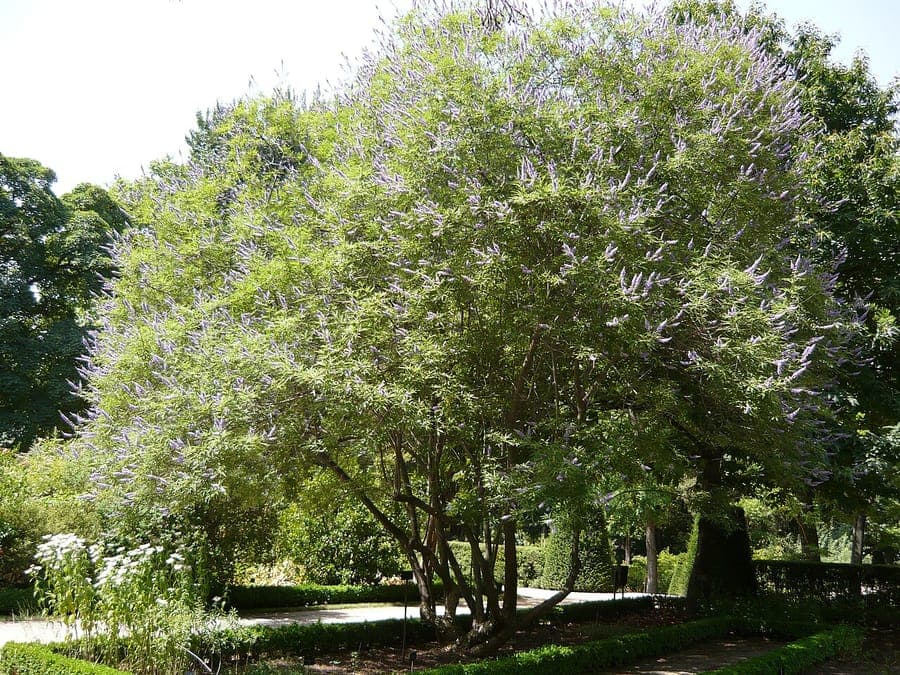
Cillas / CC BY-SA 4.0, via Wikimedia Commons
Chasteberry: complete guide
Vitex agnus-castus
¿Quieres ver Chasteberry: complete guide en tu jardín?
1 minuto, sin tarjeta de crédito
Overview
The Chasteberry (Vitex agnus-castus), also known as Monk's Pepper, is an elegant shrub originating from the Mediterranean region and Central Asia. This plant has been known for thousands of years for its beautiful violet flowers and historical uses. The name "agnus-castus" refers to traditional use by monks.
It is a semi-hardy to hardy shrub that can reach 3-4 meters tall. The plant belongs to the Lamiaceae family (mint family) and is widely used in Mediterranean gardens, borders, and as a specimen plant. The Chasteberry grows best in warm, sunny locations and is highly tolerant of drought.
Appearance and Bloom
The Chasteberry is a striking plant with a graceful, open growth habit. The leaves are linear and dark green, providing beautiful contrast with the flowers. The plant displays a natural, airy structure that is very valuable in garden design.
Flowers appear from June to September in dense spikes at the branch tips. They display a color ranging from purple to blue-violet, though white and pink varieties also exist. The flowers attract bees, butterflies, and other pollinators.
After flowering, small brown nuts form with a round shape. These fruits can remain on the plant throughout winter, providing extra winter interest. The scent of the entire plant (leaves, flowers, and fruits) is characteristic and pleasantly aromatic.
Ideal Location
The Chasteberry thrives best in warm, sunny locations. Ensure at least 6-8 hours of direct sunlight daily. More sun results in fuller blooms. The plant is very temperature-tolerant and can grow against warm walls, but also feels at home in open garden borders.
The plant can be planted protectively against northerly winds and frost. Although hardy to about -10°C, it grows better in sheltered, wind-protected positions. In cold regions, you can place the plant against warm masonry.
For optimal growth, do not place the Chasteberry in full shade. Partial shade is acceptable, but will result in fewer flowers.
Soil
The Chasteberry is particular about soil quality. Sandy to chalky soils are ideal. The plant prefers to be dry and requires well-draining soil. Heavy clayey soils can lead to root problems and disease.
Ensure good drainage by adding sand or gravel if your soil is heavy and compacted. The pH can be neutral to alkaline (pH 7-7.5). The plant tolerates dry soils better than wet conditions.
When planting, add compost or garden sulfur to improve water drainage. Repeat this annually as a top layer.
Diseño gratis
¿Quieres ver Chasteberry: complete guide en tu jardín? Crea un diseño gratis ahora.
Watering
Once established, the Chasteberry is highly drought-tolerant. Water regularly during the first growing season (May-September) until the plant is well-established. Once established, the plant can withstand long dry periods.
During the growing season, water deeply and thoroughly when the soil feels dry. Excessive water leads to weak root systems and disease susceptibility.
After blooming (September), gradually reduce water. In winter, almost no water is needed unless prolonged drought occurs.
Pruning
The Chasteberry undergoes best light pruning in early spring (March-April) before the new growing season begins. Remove all frost-damaged or damaged branches. Cut approximately one-third of the length to maintain compactness and fullness.
The plant flowers on new wood, so early pruning promotes full blooms. Remove spent flowering material in September if desired.
Minimal pruning creates a more natural form. Heavy pruning can take multiple seasons to recover in volume.
Maintenance Calendar
March: Prune the plant April: First feeding with slow-release fertilizer May: Regular watering; watch for pest problems June-September: Regular watering; enjoy the bloom October: Stop feeding; reduce watering November-February: Minimal care; frost protection in cold areas
Winter Hardiness
The Chasteberry is semi-hardy and can tolerate temperatures down to about -10°C. In warmer climates (USDA zones 7-10), it is fully hardy. In colder regions, the aboveground parts die back in frost and regrow from the roots.
In areas with severe winters, build protective structures with frost cloth around young plants. Mulch the base of the plant with 5-10 cm of compost in November.
Established plants are much more winter-hardy than young specimens. They recover well from frost-related damage.
Companion Planting
The Chasteberry combines well with other Mediterranean plants such as Lavender, Rosemary, and Roses. Plant in groups of 3-5 for maximum effect. Combine with silver-leaved plants and grasses for contrast.
Excellent as a specimen plant in a solitary position. Also suitable for container cultivation in warm, sheltered locations. Use in drought-tolerant borders and "Mediterranean gardens".
Closing Remarks
The Chasteberry is a valuable element of any sunny, Mediterranean-oriented garden. With minimal maintenance and attention, it offers years of beauty and characterful interest. Whether you are creating a Mediterranean garden or simply looking for a hardy, drought-tolerant shrub, the Chasteberry certainly deserves your consideration. Available at OBI and Hornbach in Germany.
¿Quieres ver Chasteberry: complete guide en tu jardín? Crea un diseño gratis ahora.
Sube una foto, elige un estilo y obtén un diseño fotorrealista con lista de plantas en menos de un minuto.
Más de 10.000 jardines diseñados
Sin tarjeta de crédito


Plantas similares
Apple mint (Mentha x villosa): complete guide
Mentha x villosa
Meet apple mint (Mentha x villosa): a fruity-scented kitchen herb with woolly leaves, perfect for tea and mojitos.
Salvia peyronii: complete guide
Salvia peyronii
Discover Salvia peyronii, a rare Lebanese mountain sage. Growing tips, hardiness, and companion planting for a Mediterranean gravel garden.
Bigleaf mint (Mentha x rotundifolia): complete guide
Mentha x rotundifolia
Discover bigleaf mint: cultivation, care tips, and garden uses. Learn how to grow this aromatic herb with soft, hairy leaves.